All species › Passerines › Antbirds › Spot-crowned Antvireo
Spot-crowned Antvireo | Dysithamnus puncticeps
Vlekkapmiervireo | Batarito coronipunteado | Choquinha-de-coroa-pintada
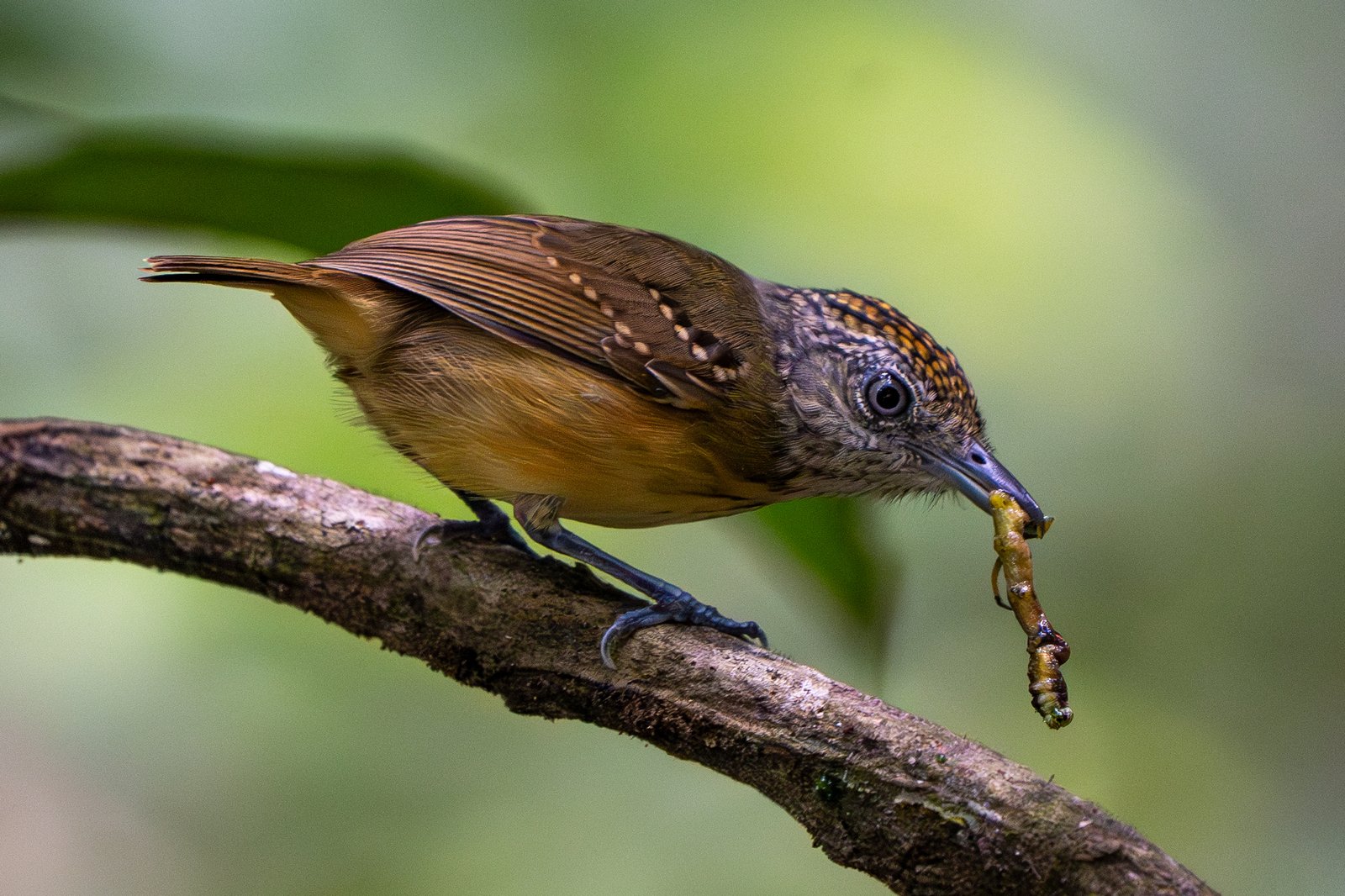
The Spot-crowned Antvireo is a small antvireo of the understorey of humid lowland and foothill forest on the Pacific side of Colombia and Ecuador. The male has a dark, white-spotted crown. Like its relatives it moves slowly and travels with mixed flocks.
Voice
The song is a rapid trill that first rises slightly and then falls, at a pace that is even at first and slightly accelerates at the end. The call is a short, descending chirr.
Recording: Rainforest Connection — CC BY-NC-SA 4.0 · xeno-canto
Identification
11 cm, stocky, with a large head and a fairly heavy, slightly hooked bill. The male has a dark grey crown with many white spots, grey ear coverts and greyish-olive upperparts, with a hidden white patch between the shoulders; the wing coverts are blackish with white tips. The throat, breast and upper belly are white with dark streaks, and the flanks are olive-grey. The female has a rufous crown with dark spots, pale ear coverts and pale, ochraceous underparts with little streaking.
Confusion species
Plain Antvireo Dysithamnus mentalis usually lives higher, has an unspotted crown, a dark mask and no streaks on the breast. Dot-winged Antwren Microrhopias quixensis is slimmer, with a long, white-tipped tail and a thin bill; the male is black.
Habitat
Understorey and mid-storey of humid evergreen lowland and foothill forest, also at forest edges and in older secondary forest, up to about 1000 m in Colombia and 800 m in Ecuador. It picks insects and spiders from leaves and twigs, often in mixed flocks. The nest is a cup suspended in a twig fork, low in the vegetation.
Where the bird is most at home, classified by the vegetation units of the Andes and the west coast.


Range and movements
Colombia: on the Pacific slope and in the Pacific lowlands, and in the lowlands of the lower Cauca valley in the north. Ecuador: in the north-west, south to Manabí and Santo Domingo de los Tsáchilas. Absent from Peru, Bolivia and the Galápagos. Outside the guide area on the Caribbean side of Costa Rica and in Panama.
- Resident
- dark = core range, pale = thinly spread
How and when to look
Search mixed flocks in the understorey of lowland forest in the Chocó or in north-western Ecuador, for example in Esmeraldas. Look for a small, slow-moving bird with a white-spotted crown.
Conservation status
Least Concern. Fairly common to uncommon; numbers are thought to be declining through deforestation in the Pacific lowlands.
Scientific name
Dysithamnus puncticeps | Salvin, 1866
Salvin described the species in 1866 and placed it straight away in the genus where it still stands. The genus Dysithamnus was introduced in 1847 by Cabanis. The genus name combines Greek duō, 'to plunge', and thamnos, 'bush'. The species name comes from Latin punctum, 'spot', and -ceps, 'headed', for the spotted crown. The specimen the first description was based on came from Veraguas, Panama.