All species › Passerines › Antbirds › Bicolored Antvireo
Bicolored Antvireo | Dysithamnus occidentalis
Chapmans miervireo | Batarito bicolor | Choquinha-bicolor
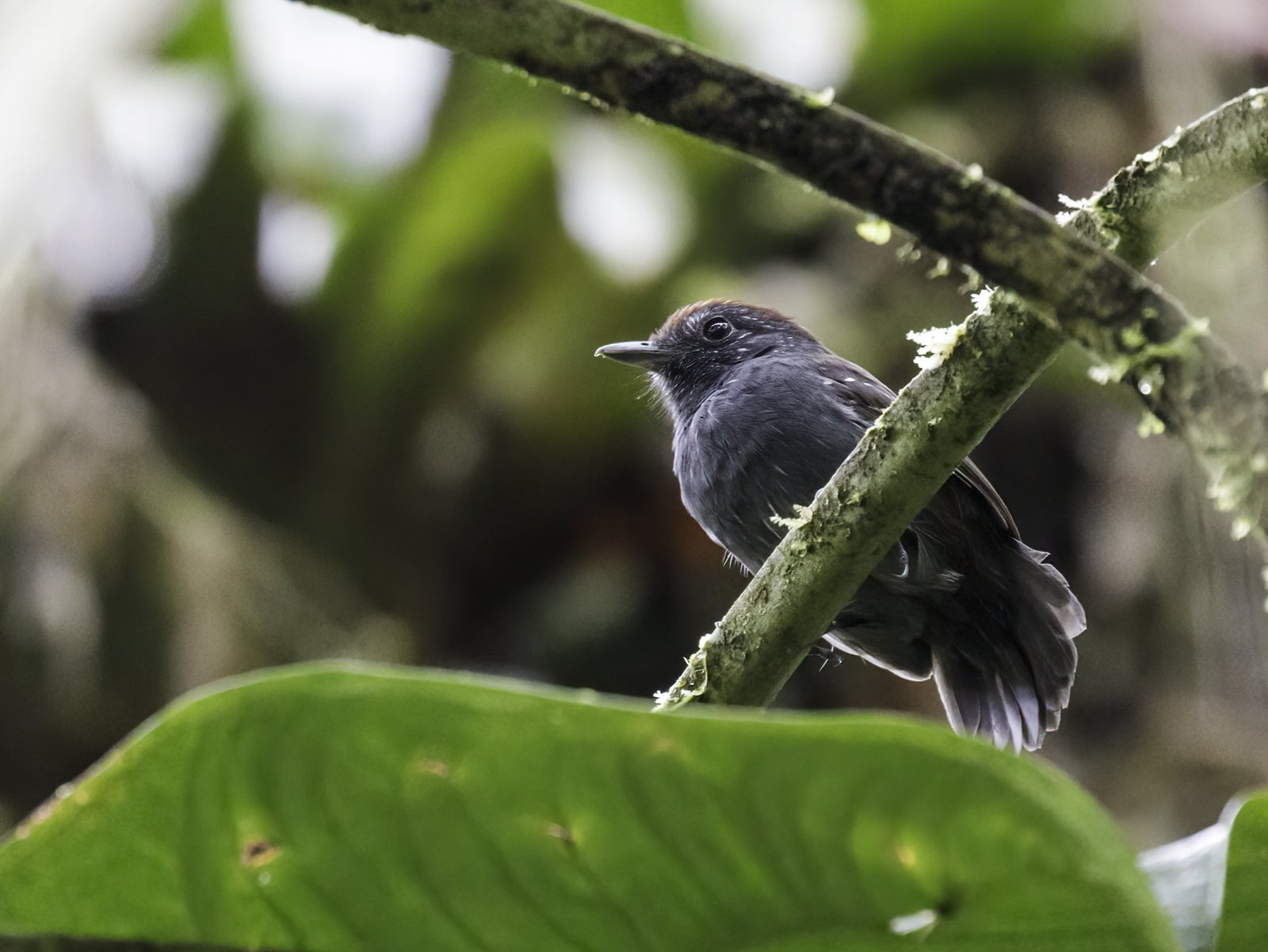
The Bicolored Antvireo is a large, dark antvireo of the dense understorey of cloud forest in the northern Andes. The species is rare, local and poorly known; its voice has not yet been described with certainty. There are two forms: a dark one on the Pacific slope of Colombia and the far north of Ecuador, and a somewhat paler one on the eastern slope of Ecuador and northern Peru.
Voice
Poorly known. In Ecuador the most frequently heard call is a fast, throaty scold; also clear peeu notes and a fast, rising pu-pu-pooyeh. From Peru an accelerating, descending series of clear, rising whistles has been described that may be the song, and a deep, chattering growl.
Recording: Brian Cox — CC BY-NC-SA 4.0 · xeno-canto
Identification
13–14 cm, stocky, with a fairly heavy, hooked bill. The male is blackish grey, slightly paler below, with a hidden white patch between the shoulders and white spots on the greater and median wing coverts. The female has a chestnut crown and upperparts, with pale spots on the wing coverts; the face, throat and breast are dark grey with thin white streaks, and the belly is olive-brown. On the eastern slope both sexes are somewhat paler, with entirely white lesser coverts.
Confusion species
White-streaked Antvireo Dysithamnus leucostictus lives on the eastern slope, is smaller and greyer; the female has a rufous crown and grey, white-streaked underparts but lacks the olive-brown belly. Plain Antvireo Dysithamnus mentalis is smaller, with a dark mask and pale underparts. Uniform Antshrike Thamnophilus unicolor is plain slate-grey without wing spots, with a pale iris; the female is brown with a grey face.
Habitat
Dense understorey of humid montane and cloud forest, often at openings, forest edges and treefalls with much undergrowth; in Colombia between 1600 and 2400 m, on the eastern slope of Ecuador between 1500 and 2050 m, in Peru between 2000 and 2500 m. It searches dense vegetation for insects, sometimes in mixed flocks. Little is known about the nest.
Where the bird is most at home, classified by the vegetation units of the Andes and the west coast.


Range and movements
Colombia: on the Pacific slope of the Western Andes, from southern Antioquia southwards, locally. Ecuador: in the far north on the Pacific slope (Carchi) and on the eastern slope in Napo and Morona-Santiago. Peru: in Amazonas and San Martín. Absent from Bolivia and the Galápagos. Does not occur outside the guide area.
- Resident
- dark = core range, pale = thinly spread
How and when to look
Search the dense understorey of cloud forest in the Western Andes of Colombia or on the eastern slope in southern Ecuador, especially at treefall gaps and shrubby forest edges. The bird keeps hidden; listen for the fast, throaty scold.
Conservation status
Near Threatened. The world population is estimated at 7300–8000 mature individuals and is declining. The main threat is loss of montane forest to agriculture, especially in Ecuador; in Colombia, too, protected areas are surrounded by deforestation.
Scientific name
Dysithamnus occidentalis | (Chapman, 1923)
Chapman described the species in 1923 as Thamnophilus aethiops occidentalis; because it was later moved to another genus, the author and year stand in brackets. The genus Dysithamnus was introduced in 1847 by Cabanis. The genus name combines Greek duō, 'to plunge', and thamnos, 'bush'. The species name comes from Latin occidentalis, 'western', for its occurrence in the Western Andes. The specimen the first description was based on came from Cocal, Western Andes, Colombia.