All species › Passerines › Antbirds › White-streaked Antvireo
White-streaked Antvireo | Dysithamnus leucostictus
Witstreepmiervireo | Batarito albirrayado | Choquinha-de-estrias-brancas
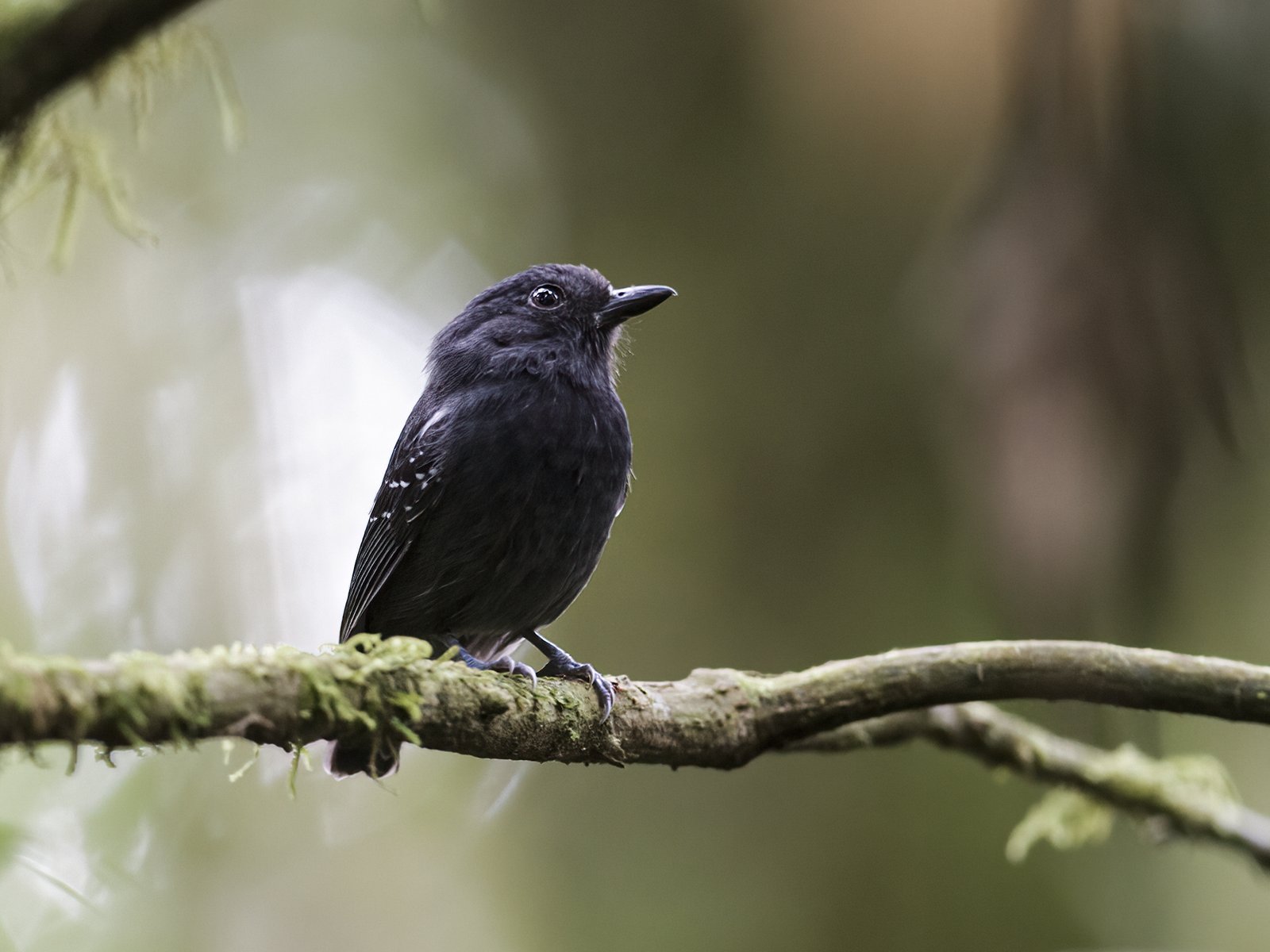
The White-streaked Antvireo is a dark grey antvireo of the understorey of montane forest on the eastern slope of the Andes. Its name refers to the female, which has rufous upperparts and grey underparts with conspicuous white streaks. The species is tied to little-disturbed forest.
Voice
The song is a short series of strong whistles falling in pitch. Calls are shorter and sharper.
Recording: Mauricio Álvarez-Rebolledo (Colección de Sonidos Ambientales - Instituto Humboldt) — CC BY-NC-SA 4.0 · xeno-canto
Identification
12–13 cm, stocky, with a fairly heavy, hooked bill. The male is mostly dark grey, with a hidden white patch between the shoulders and white tips and edges to the wing coverts; the breast is darker than the upperparts. The female has a rufous crown, nape, upperparts, wings and tail; the sides of the head, throat and underparts are grey with bold white streaks, and the flanks and undertail coverts are brownish and unstreaked.
Confusion species
Bicolored Antvireo Dysithamnus occidentalis is larger and darker; the female has a chestnut crown and an olive-brown belly, with thinner white streaks. Plain Antvireo Dysithamnus mentalis is smaller and paler, with a dark mask and whitish to yellow underparts. The male Slaty Antwren Myrmotherula schisticolor is smaller and slimmer, with a black throat and breast and a thin bill.
Habitat
Understorey of humid evergreen montane and foothill forest, mainly in little-disturbed forest; in Colombia between 900 and 1800 m, in Ecuador mostly between 1300 and 1800 m, in Peru between 1350 and 1850 m. It gleans insects and other arthropods from leaves and twigs, often in mixed flocks. Little is known about the nest.
Where the bird is most at home, classified by the vegetation units of the Andes and the west coast.


Range and movements
Colombia: on the eastern slope of the Eastern Andes, from Cundinamarca southwards. Ecuador: on the eastern slope of the Andes. Peru: only in the north, in Cajamarca and Amazonas. Absent from Bolivia and the Galápagos. A related form, sometimes treated as a separate species, lives outside the guide area in the coastal mountains of Venezuela.
- Resident
- dark = core range, pale = thinly spread
How and when to look
Search mixed flocks in the understorey of montane forest on the eastern slope of Ecuador, for example along forest trails between 1300 and 1800 m. Look for a dark grey bird with white wing spots accompanied by a rufous, white-streaked female.
Conservation status
Least Concern. The population size is unknown and thought to be declining; the only known threat is habitat loss.
Scientific name
Dysithamnus leucostictus | Sclater, 1858
Sclater described the species in 1858 and placed it straight away in the genus where it still stands. The genus Dysithamnus was introduced in 1847 by Cabanis. The genus name combines Greek duō, 'to plunge', and thamnos, 'bush'. The species name comes from Greek leukos, 'white', and stiktos, 'spotted', for the white streaks and spots. The specimen the first description was based on came from Río Napo, Ecuador.