All species › Passerines › Tanagers and allies › Band-tailed Seedeater
Band-tailed Seedeater | Catamenia analis
Witstaartcatamenia | Semillero colifajeado | Papa-capim-de-cauda-barrada
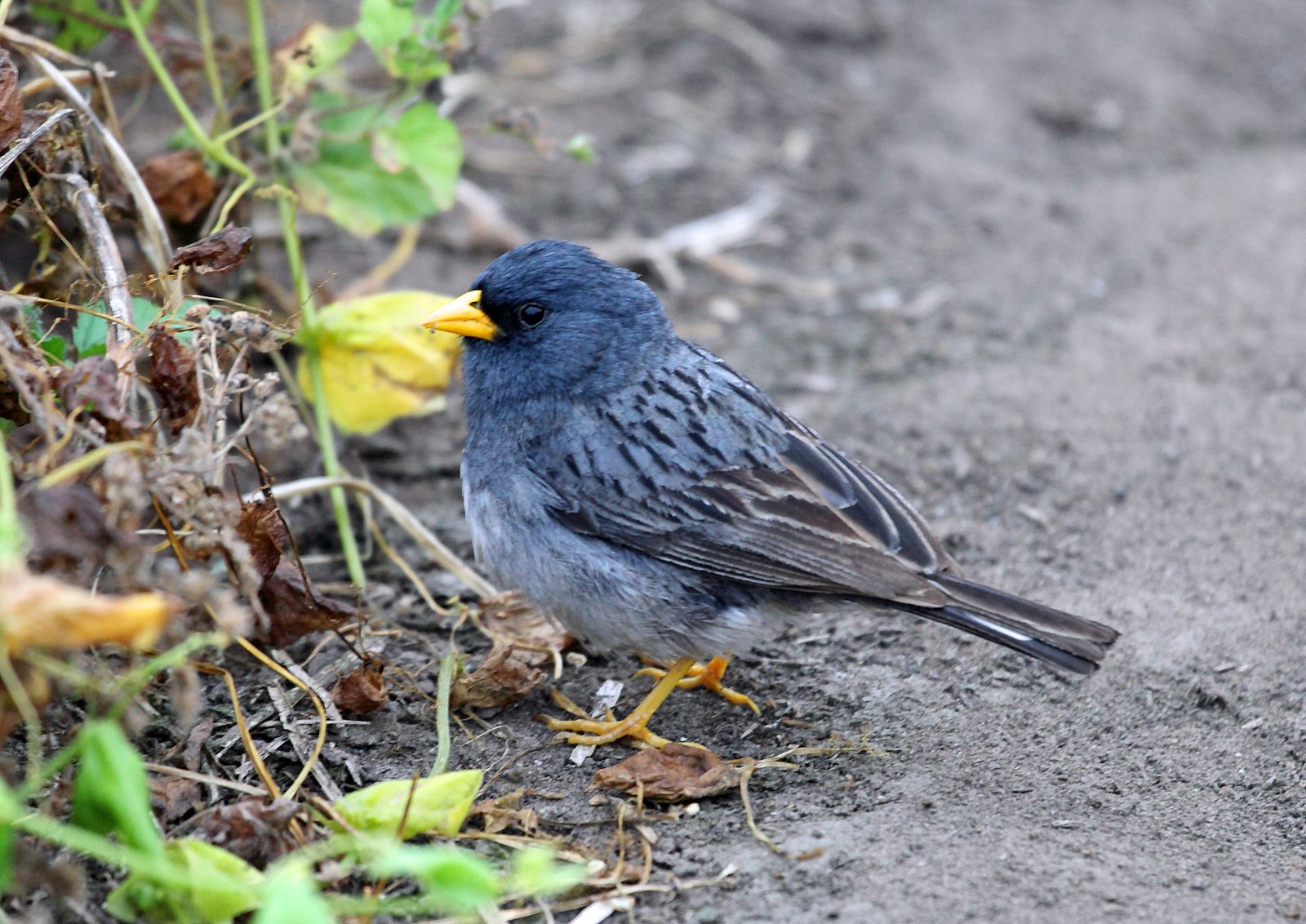
The Band-tailed Seedeater is a small, grey seedeater of shrubby slopes and farmland in the Andes, from Colombia to Bolivia. In flight, the white band across the middle of the tail is conspicuous. It is one of the commonest seedeaters of the dry inter-Andean valleys and occurs lower on the west slope in Peru than its relatives.
Voice
The song is a short, dry, buzzy trill, sometimes preceded by a few separate notes, from a shrub or wire. The call is a short chip.
Recording: John V. Moore — CC BY-NC-SA 4.0 · xeno-canto
Identification
12 cm, with a short, thick, yellowish to pinkish-yellow bill. The male is grey, darker above with faint streaks, with blackish lores and chin, a paler grey belly and a chestnut vent. A white band crosses the middle of the tail, visible mainly in flight; some birds also have a small white patch on the wing. The female is brown, streaked above and on the breast, with the same white tail band and a paler rusty vent. Young birds resemble the female.
Confusion species
Plain-colored Seedeater Catamenia inornata is larger, with a pink bill, no white tail band and no black around the bill. Paramo Seedeater Catamenia homochroa is darker slate-grey, without a tail band, and lives in higher, wetter shrubbery. Band-tailed Sierra Finch Rhopospina alaudina also has white in the tail, but is larger, with a yellow to orange bill, and the male has a white belly. Ash-breasted Sierra Finch Geospizopsis plebejus has a pointed, dark bill and no white tail band.
Habitat
Shrubby mountain slopes, hedgerows, field edges, terraces, gardens and dry scrub in the inter-Andean valleys, also along the edge of the puna, roughly between 1500 and 4000 m; in Peru locally on the west slope to near the coast. It lives in pairs or small groups and eats seeds of grasses and herbs on or near the ground. The nest is a cup of grass in a shrub.
Where the bird is most at home, classified by the vegetation units of the Andes and the west coast.


Range and movements
In Colombia locally in the Andes, mainly in the Eastern Andes and in the south. In Ecuador in the inter-Andean valleys and on the slopes above them. In Peru widespread in the Andes and on the west slope. In Bolivia in the Andes. Absent from the Galápagos. Outside the guide area in northern Chile and north-western Argentina.
- Resident
- dark = core range, pale = thinly spread
How and when to look
Along fields, hedgerows and shrubby roadsides in the dry valleys, look for small grey birds that show a white tail band when flushed.
Conservation status
Least Concern. Widespread and common; it benefits from small-scale farming with hedgerows and shrubs.
Scientific name
Catamenia analis | (d'Orbigny, ACVMD & de Lafresnaye, 1837)
D'Orbigny, ACVMD & de Lafresnaye described the species in 1837 as Linaria analis; because it was later moved to another genus, the author and year stand in brackets. The genus Catamenia was introduced in 1850 by Bonaparte. The genus name probably comes from Greek katamēnia, 'menses', presumably referring to the rufous undertail coverts. The species name is Latin analis, 'of the vent', referring to the coloured undertail coverts. The specimen the first description was based on came from Sicasica and Cochabamba, Bolivia.