All species › Passerines › Tanagers and allies › Boulder Finch
Boulder Finch | Idiopsar brachyurus
Páramogors | Yal grande | Tico-tico-dos-rochedos
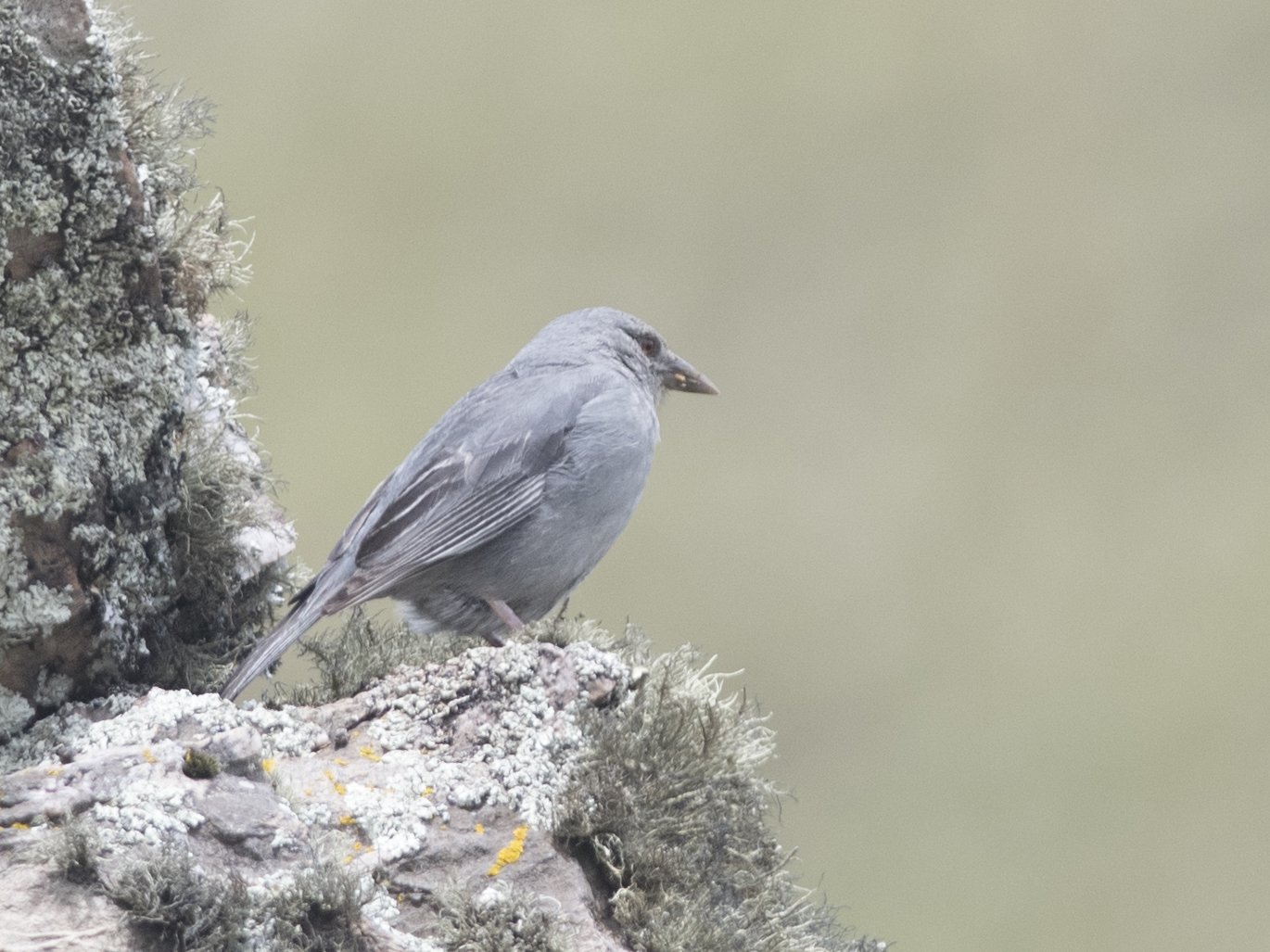
The Boulder Finch is the most heavily built species of the genus Idiopsar: a grey finch with a short tail and a very long, spike-like bill, living in fields of large boulders on the high puna. In the guide area it occurs mainly in Bolivia, with a few sites in the far south of Peru. Little is known about its habits.
Voice
Poorly described; mainly short, sharp calls.
Recording: Juha Honkala — CC BY-NC-SA 4.0 · xeno-canto
Identification
18 cm, with a very long, stout-based, pointed bill and a short tail. The upperparts are plain lead-grey, the underparts paler grey with a whitish belly and vent; fine pale streaks below the eye. The outer tail feathers have a white outer edge. The female is slightly browner. Young birds are browner, streaked below and grizzled grey on the face.
Confusion species
Plumbeous Sierra Finch Geospizopsis unicolor is smaller, with a shorter, conical bill and a longer tail. Glacier Finch Idiopsar speculifer has a white throat, a white crescent below the eye and a white wing patch. White-throated Sierra Finch Idiopsar erythronotus has a clear white throat and a shorter bill.
Habitat
Boulder fields, scree slopes and rocky grassland on the high puna, mostly between 4000 and 4600 m, occasionally down to about 3500 m. It forages on and among the rocks; its food and nest are poorly known.
Where the bird is most at home, classified by the vegetation units of the Andes and the west coast.


Range and movements
In Bolivia in the Andes of the north and centre of the country. In Peru only in the far south, near the Bolivian border. Absent from Colombia, Ecuador and the Galápagos. Outside the guide area in north-western Argentina.
- Resident
- dark = core range, pale = thinly spread
How and when to look
In Bolivia, search slopes with many large boulders above 4000 m; birds often perch on a boulder and their grey colour blends with the rocks. At a few sites in Bolivia it is fairly common.
Conservation status
Least Concern. Rare and local over most of its range, but its habitat is remote and little threatened.
Scientific name
Idiopsar brachyurus | Cassin, 1867
Cassin described the species in 1867 and placed it straight away in the genus where it still stands. He introduced the genus Idiopsar in that same work. The genus name combines Greek idios, 'distinct, peculiar', with psar, 'starling'. The species name comes from Greek brachus, 'short', and oura, 'tail'. The specimen the first description was based on came from La Paz, Bolivia.