All species › Nightjars › Nightjars and nighthawks › Band-winged Nightjar
Band-winged Nightjar | Systellura longirostris
Vleugelbandnachtzwaluw | Chotacabras alifajeado | Bacurau-da-telha
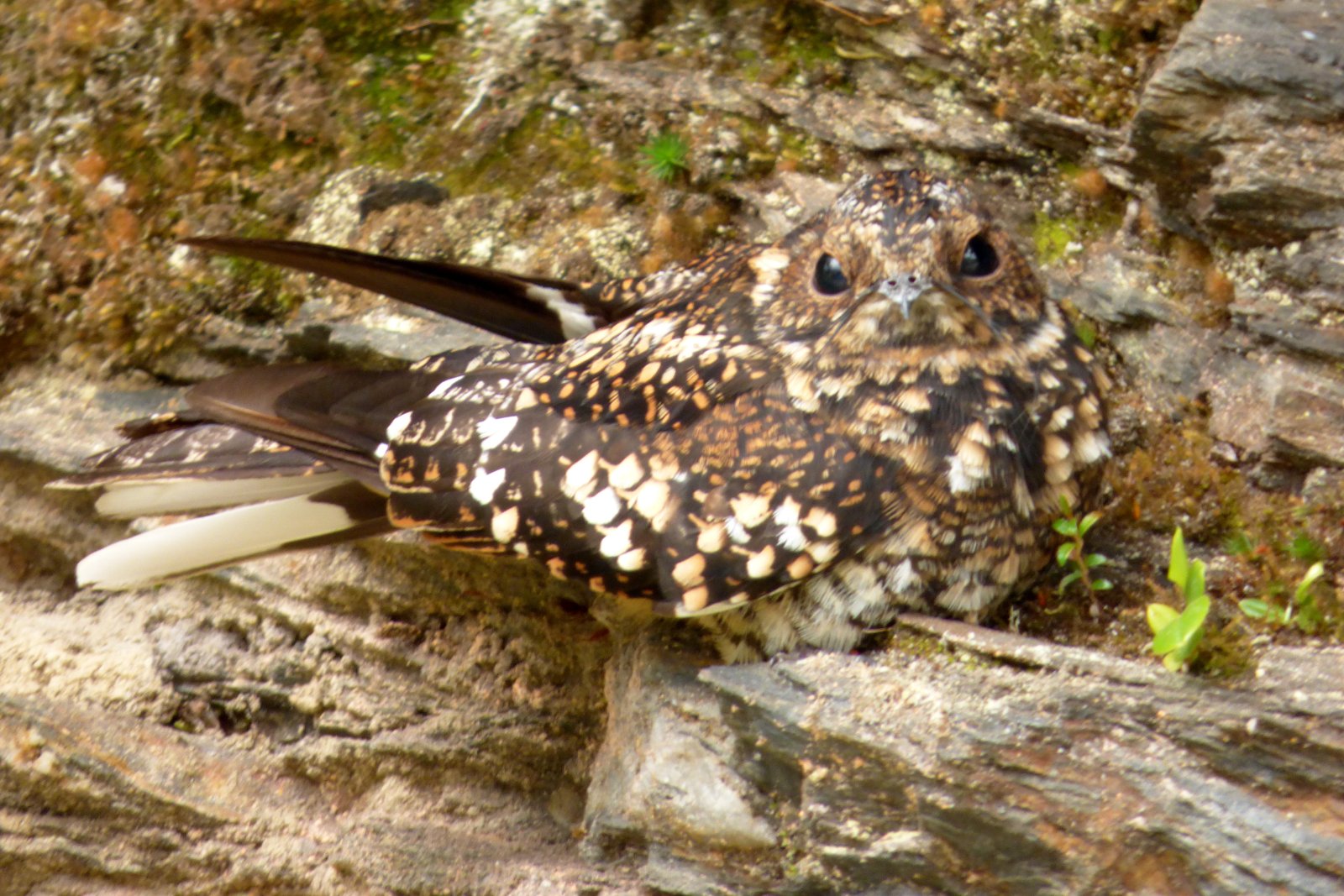
The Band-winged Nightjar is the nightjar of the open Andean highlands, from forest edges to páramo and puna. By day it rests on the ground among stones or low vegetation; at dusk it hunts over open ground and along roads. In flight the male shows a white band across the wing and white in the tail.
Voice
The territorial call is a high, sharp whistle repeated every one to three seconds, mainly at dusk and dawn. In flight, mainly in the breeding season, a high cheet. A flushed female gives a nasal tchree.
Recording: José Dellacasa Bravo — CC BY-NC-SA 4.0 · xeno-canto
Identification
21–25 cm. Grey-brown, heavily spotted and streaked with black and buff, with a rufous nuchal collar. The male has a white band across the outer primaries, a white band in the tail and often a white patch on the lower throat. In the female the wing band is buff, the tail lacks white and the throat is tawny-buff.
Confusion species
Tschudi's Nightjar Quechuavis decussata of the arid coast of Peru is smaller and greyer and lives lower. Females of Lyre-tailed Nightjar Uropsalis lyra and Swallow-tailed Nightjar Uropsalis segmentata lack a pale wing band and live in montane forest. Pauraque Nyctidromus albicollis lives lower, is larger and has a longer tail.
Habitat
Open country in the Andes: forest edges, scrub, rocky slopes, páramo, puna, fields and villages, sometimes on rooftops. Mostly between 1500 and 4200 m. It hunts flying insects at dusk and at night. No nest is built; the one or two eggs lie in a scrape on bare ground, sometimes beside a road.
Where the bird is most at home, classified by the vegetation units of the Andes and the west coast.


Range and movements
In Colombia in the Andes and in the Sierra Nevada de Santa Marta. In Ecuador in the Andes. In Peru in the Andes, along the whole length of the country. In Bolivia in the Andes. Absent from the Galápagos. Outside the guide area in Venezuela and, in other subspecies, south to Tierra del Fuego and in south-eastern Brazil.
- Resident
- dark = core range, pale = thinly spread
How and when to look
Walk or drive at dusk along roads through open mountain country; birds sit on the road or on stones and flush in the headlights. The high whistle carries far.
Conservation status
Not Evaluated (NE) in its current circumscription, without Tschudi's Nightjar. The species is widespread and also occurs in open, man-made landscapes.
Scientific name
Systellura longirostris | (Bonaparte, 1825)
Bonaparte described the species in 1825 as Caprimulgus longirostris; because it was later moved to another genus, the author and year stand in brackets. The genus Systellura was introduced in 1912 by Ridgway. The genus name comes from Greek sustellō, 'to shorten', and oura, 'tail'. The species name comes from Latin longus, 'long', and rostrum, 'bill'. The specimen the first description was based on came from South America.