All species › Woodpeckers and allies › Woodpeckers › Bar-bellied Woodpecker
Bar-bellied Woodpecker | Veniliornis nigriceps
Bandbuikspecht | Carpintero ventribarrado | Pica-pau-de-barriga-barrada
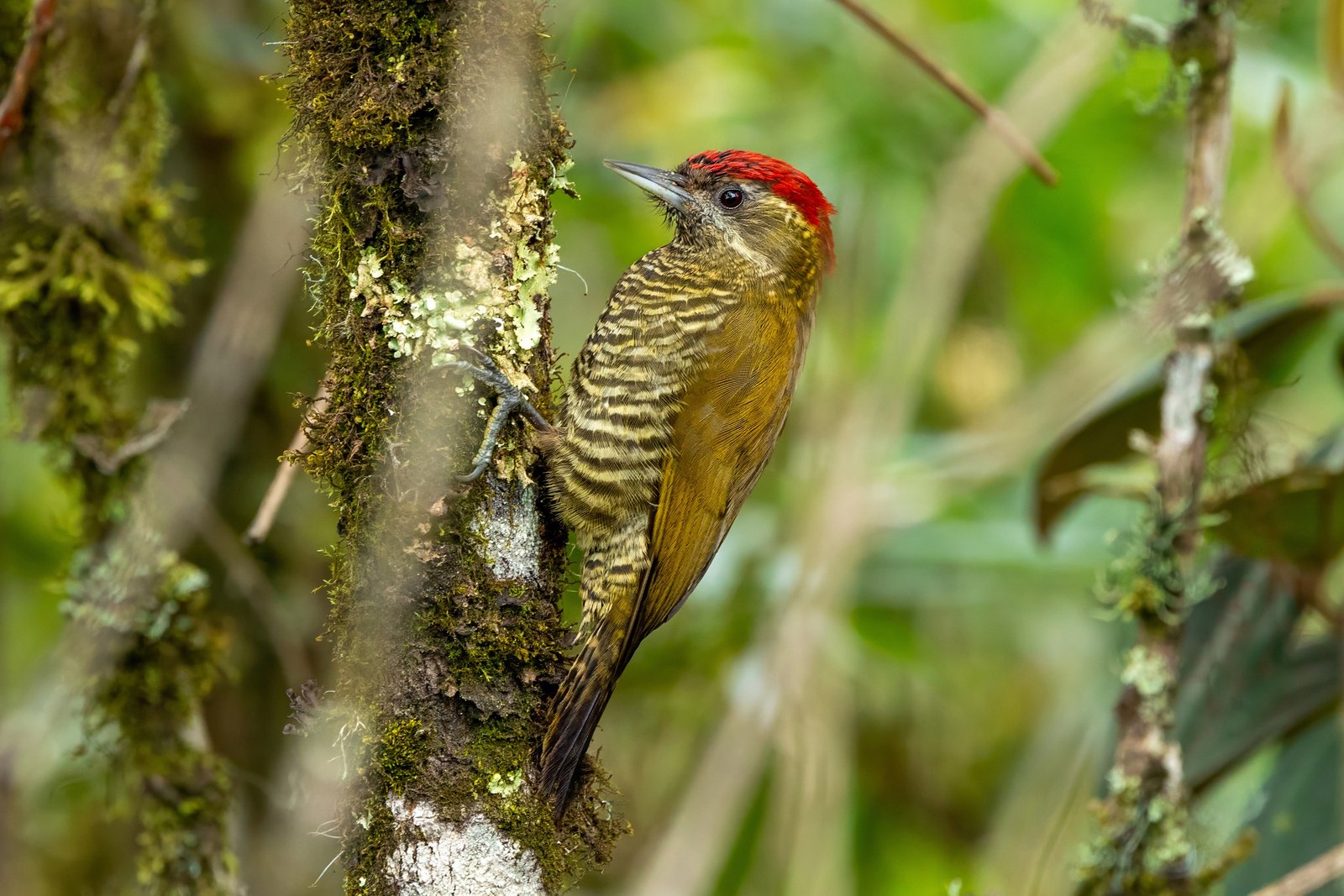
The Bar-bellied Woodpecker is the woodpecker of the highest montane forest in the Andes, from cloud forest up to the treeline and into Polylepis woodland. It is densely barred from throat to belly and has a dark head with fine white stripes. The species occurs only in the guide area.
Voice
A short, rasping rattle and single, sharp keek calls; it calls rather little. It drums in short bursts.
Recording: Charlie Vogt — CC BY-NC-SA 4.0 · xeno-canto
Identification
18–19 cm, with a straight, dark bill. The upperparts are bronzy to olive-green, the tail dark with pale bars. The face is blackish with a narrow white supercilium and a white malar stripe. The entire underparts, from throat to undertail coverts, are densely barred dark olive and yellowish white. The male has a red crown with black feather tips, the female a black crown.
Confusion species
Yellow-vented Woodpecker Veniliornis dignus is smaller, usually lives lower and has a plain yellow lower belly. Crimson-mantled Woodpecker Colaptes rivolii has a red mantle and a yellow, unbarred belly. Golden-olive Woodpecker Colaptes rubiginosus is larger, with a grey crown and a pale cheek, and usually lives lower.
Habitat
High cloud forest and elfin forest up to the treeline, Polylepis woodland, thickets and scrub with Chusquea bamboo at the edge of páramo and puna, roughly between 2000 and 4000 m. It searches mossy branches, trunks and bamboo stems for insects and larvae, often in mixed flocks. It nests in a self-excavated cavity.
Where the bird is most at home, classified by the vegetation units of the Andes and the west coast.


Range and movements
In Colombia in the Central and Eastern Andes, mainly in the south. In Ecuador on both slopes of the Andes in the highest forest belt. In Peru along the entire eastern slope and locally on the western slope in the north. In Bolivia on the eastern slope of La Paz and Cochabamba. Absent from the lowlands and the Galápagos. Does not occur outside the guide area.
- Resident
- dark = core range, pale = thinly spread
How and when to look
Search at the treeline and in Polylepis groves, for example along high roads in northern Ecuador and around Cusco. Follow mixed flocks of tanagers and ovenbirds; the woodpecker often travels with them.
Conservation status
Least Concern. High-elevation forest and Polylepis groves are locally cut and burned, but the species has a large range.
Scientific name
Veniliornis nigriceps | (d'Orbigny, ACVMD, 1840)
D'Orbigny, ACVMD described the species in 1840 as Picus nigriceps; because it was later moved to another genus, the author and year stand in brackets. The genus Veniliornis was introduced in 1854 by Bonaparte. The genus name combines Venilia, a Roman deity, with Greek ornis, 'bird'. The species name comes from Latin niger, 'black', and -ceps, 'headed', for the dark head. The specimen the first description was based on came from Palca Grande, Ayopaya, Bolivia.