All species › Woodpeckers and allies › Woodpeckers › Yellow-vented Woodpecker
Yellow-vented Woodpecker | Veniliornis dignus
Geelbuikspecht | Carpintero ventriamarillo | Pica-pau-de-crisso-amarelo
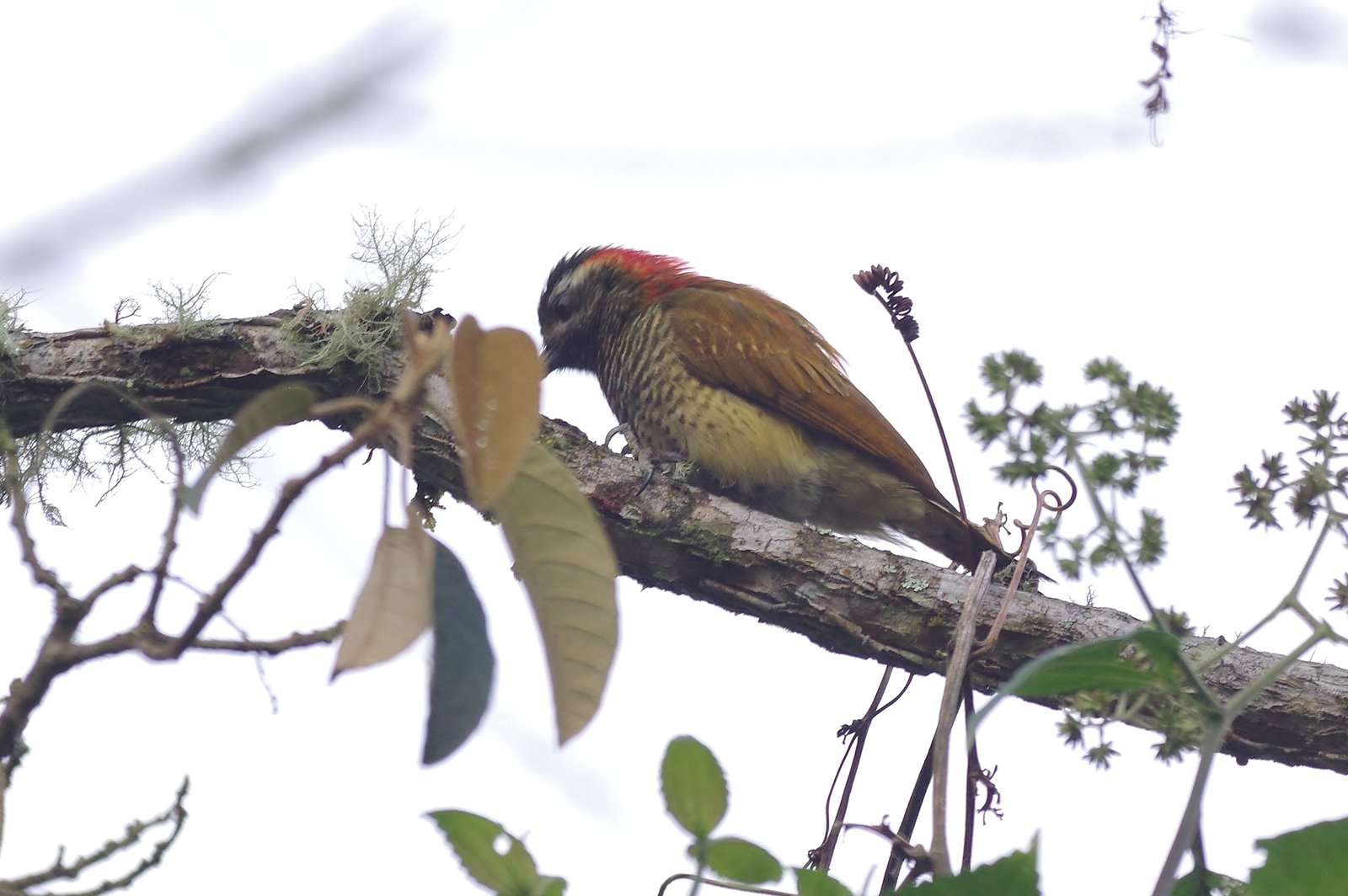
The Yellow-vented Woodpecker is a small woodpecker of the cloud forest of the northern Andes, with olive-green upperparts, a barred breast and a plain yellow lower belly. It often forages in the middle levels and canopy and regularly travels with mixed flocks. It often forages slowly and quietly on mossy branches and calls relatively little.
Voice
A rapid, nasal series, kee-kee-kee-kee, and sharp, single calls. It drums in short bursts.
Recording: Jonas Nilsson — CC BY-NC-SA 4.0 · xeno-canto
Identification
16–17 cm, with a straight, dark bill. The upperparts are olive-green, the wings with a golden tinge. The face is dark with a white supercilium and a white malar stripe. The breast and flanks are barred blackish and yellowish white; the lower belly and undertail coverts are plain yellow. The male has a red crown and nape, the female a blackish crown with at most some red on the nape.
Confusion species
Bar-bellied Woodpecker Veniliornis nigriceps is larger, usually lives higher, up to the treeline, and is densely barred on the lower belly too, without yellow. Smoky-brown Woodpecker Leuconotopicus fumigatus is uniformly brown without bars. Golden-olive Woodpecker Colaptes rubiginosus is larger, with a grey crown, a pale cheek and fully barred underparts.
Habitat
Humid montane forest and cloud forest, forest edges and old secondary forest, roughly between 1200 and 2700 m. It searches mossy branches and trunks in the middle levels and canopy for insects and larvae, often in mixed flocks. It nests in a self-excavated cavity.
Where the bird is most at home, classified by the vegetation units of the Andes and the west coast.


Range and movements
In Colombia in all three Andean ranges. In Ecuador mainly on the eastern slope, locally also on the western slope in the north. In Peru on the eastern slope south to about the centre of the country. Absent from Bolivia, the lowlands and the Galápagos. Outside the guide area in western Venezuela.
- Resident
- dark = core range, pale = thinly spread
How and when to look
Follow mixed flocks in the cloud forest on the eastern slope of Ecuador and Peru and check small woodpeckers on mossy branches. On a barred woodpecker, look for the plain yellow lower belly.
Conservation status
Least Concern. The species depends on montane forest and declines locally where this is cleared.
Scientific name
Veniliornis dignus | (Sclater & Salvin, 1877)
Sclater & Salvin described the species in 1877 as Chloronerpes dignus; because it was later moved to another genus, the author and year stand in brackets. The genus Veniliornis was introduced in 1854 by Bonaparte. The genus name combines Venilia, a Roman deity, with Greek ornis, 'bird'. The species name comes from Latin dignus, 'worthy, deserving'; why Sclater and Salvin chose this name is not clear. The specimen the first description was based on came from Remedios, Antioquia, Colombia.