All species › Woodpeckers and allies › Woodpeckers › Scarlet-backed Woodpecker
Scarlet-backed Woodpecker | Veniliornis callonotus
Roodrugspecht | Carpintero dorsiescarlata | Pica-pau-de-dorso-escarlate
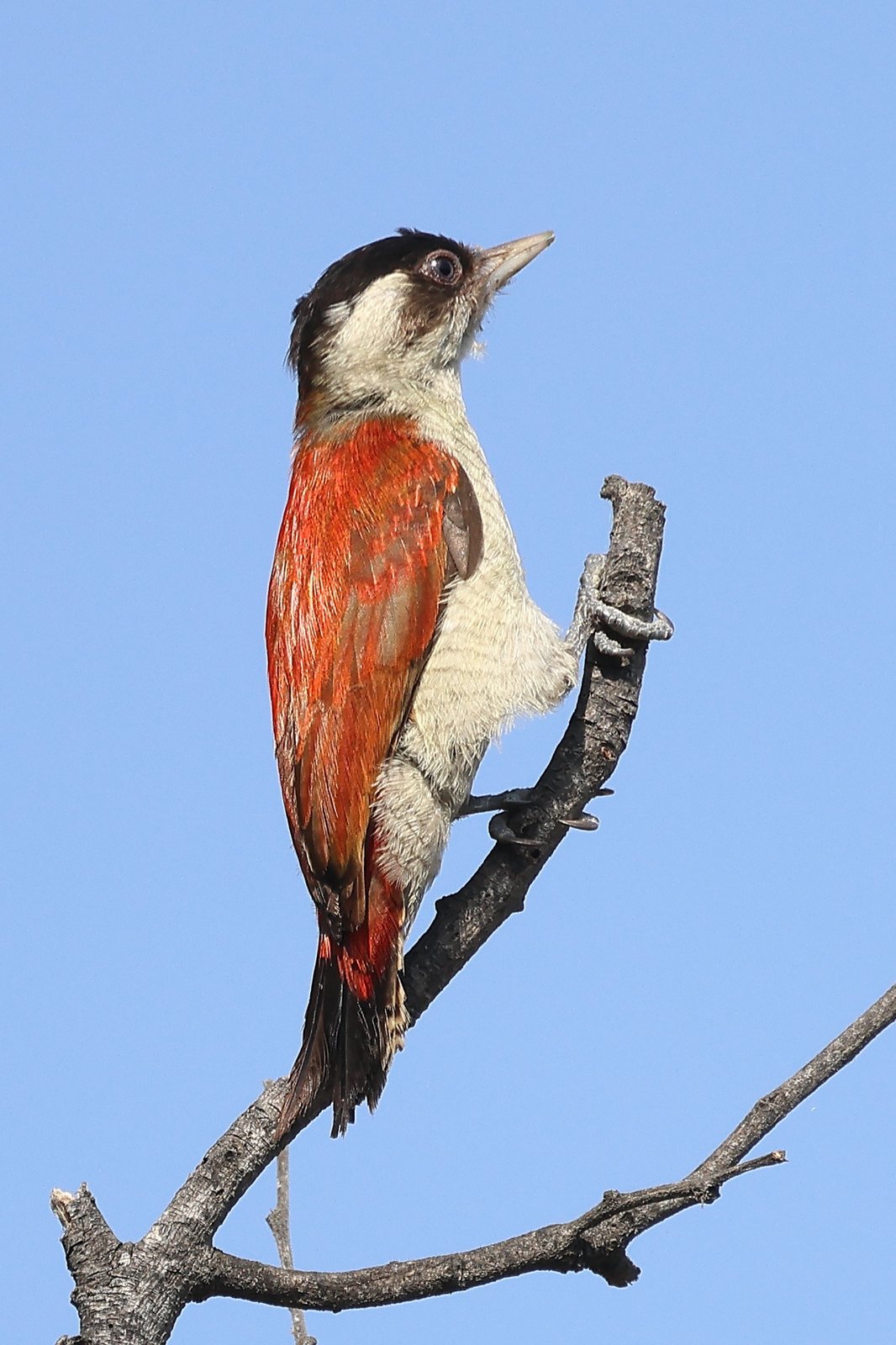
The Scarlet-backed Woodpecker is a small woodpecker of the dry west, with a scarlet back and wings and pale, almost unmarked underparts. It is the only woodpecker in the guide area with entirely red upperparts. The species is one of the birds characteristic of the Tumbesian region of Ecuador and Peru.
Voice
A dry, rapid rattle, trrrrr, and sharp, single keek calls. It drums in short bursts.
Recording: Patricio Mena Valenzuela — CC BY-NC-SA 4.0 · xeno-canto
Identification
14–15 cm, with a short, straight, pale, horn-coloured bill. The back, scapulars and wing coverts are scarlet, the flight feathers blackish brown with pale bars. The rump is red to reddish brown, the tail black with white-barred outer feathers. The face is white with a dark ear patch and a dark stripe behind the eye. The underparts are white to dull white, in the north with fine dark bars on the breast and flanks, in the south almost unmarked. The male has a red-and-black crown, the female a black crown.
Confusion species
Red-rumped Woodpecker Veniliornis kirkii has an olive-green back with only a red rump and densely barred underparts, and lives in more humid forest. Smoky-brown Woodpecker Leuconotopicus fumigatus is uniformly brown. No other small woodpecker in the dry west has a red back.
Habitat
Dry deciduous forest, thorn scrub, semi-open woodland with cacti, riparian woodland and forest edges in the dry west, from sea level to about 1500 m, locally higher. It forages on thin branches and saplings, often low, searching for insects and larvae. It nests in a self-excavated cavity in a dead branch.
Where the bird is most at home, classified by the vegetation units of the Andes and the west coast.


Range and movements
In Colombia only in the south-west, in dry valleys of Cauca and Nariño. In Ecuador in the western lowlands and on the lower western slopes, mainly in the dry centre and south. In Peru in the north-west, from Tumbes and Piura south to about La Libertad. Absent from Bolivia, east of the Andes and from the Galápagos. Almost confined to the guide area.
- Resident
- dark = core range, pale = thinly spread
How and when to look
Search dry forest and scrub in south-western Ecuador and north-western Peru, for example around Tumbes and in the dry forests of Loja. Listen for the dry rattle from the scrub.
Conservation status
Least Concern. The dry forest within its range is heavily logged and grazed, but the species also lives in degraded woodland and scrub.
Scientific name
Veniliornis callonotus | (Waterhouse, 1841)
Waterhouse described the species in 1841 as Picus callonotus; because it was later moved to another genus, the author and year stand in brackets. The genus Veniliornis was introduced in 1854 by Bonaparte. The genus name combines Venilia, a Roman deity, with Greek ornis, 'bird'. The species name comes from Greek kallos, 'beauty', and nōtos, 'back', for the scarlet back. The specimen the first description was based on came from Guayaquil, Ecuador.