All species › Woodpeckers and allies › Woodpeckers › Dot-fronted Woodpecker
Dot-fronted Woodpecker | Veniliornis frontalis
Vlekkapspecht | Carpintero de las yungas | Pica-pau-de-fronte-pintada
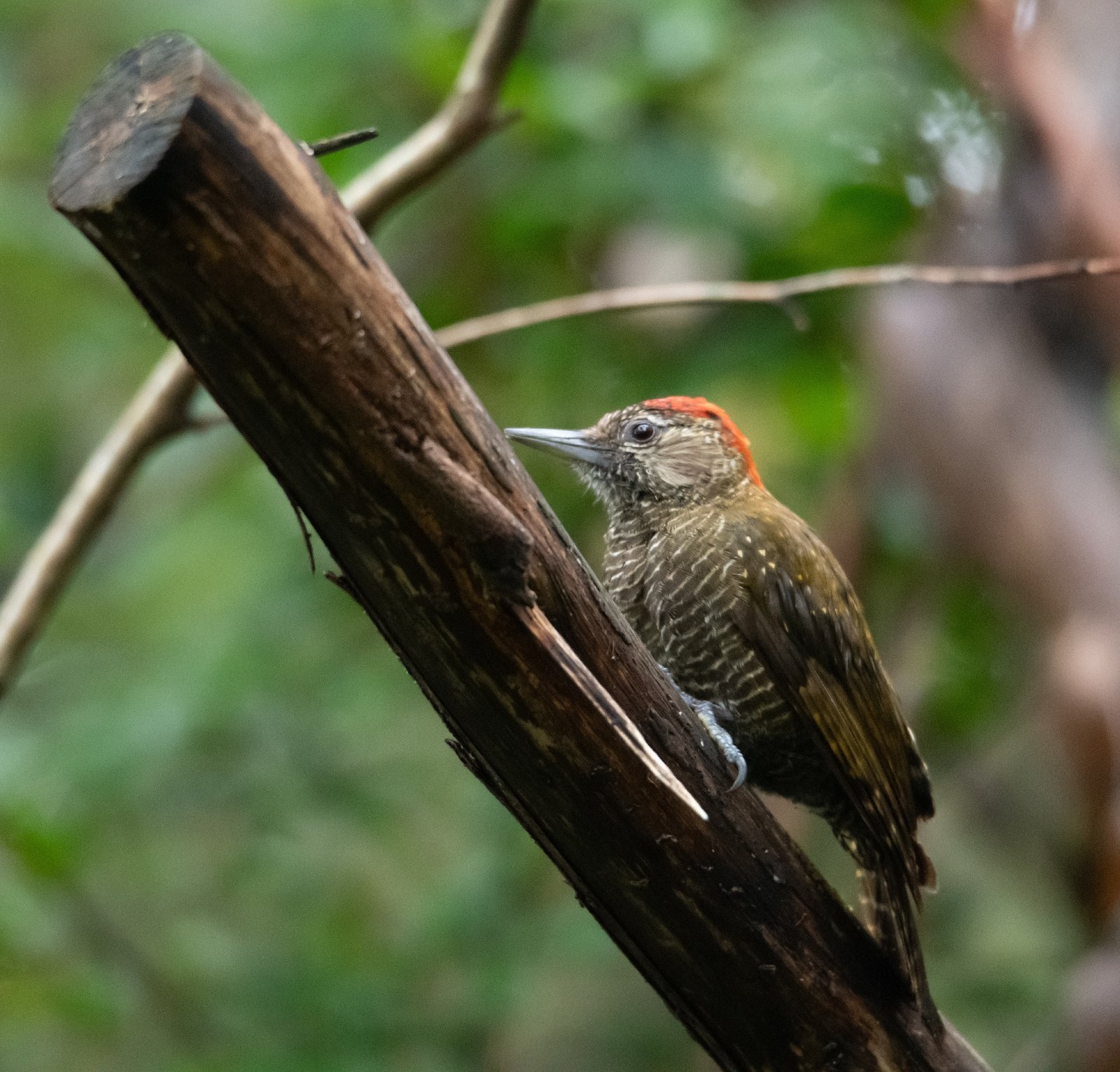
The Dot-fronted Woodpecker is a small, olive woodpecker of the forests on the eastern slope of the Andes in southern Bolivia and north-western Argentina. It closely resembles the Little Woodpecker and has been merged with it by some authors; the two hybridize locally. The feature behind its name is the densely white-dotted forehead.
Voice
A series of eight to ten short, high notes, wik-wik-wik, and a harsher, single wik call. It drums in short bursts.
Recording: Jacob Wijpkema — CC BY-NC-SA 4.0 · xeno-canto
Identification
16 cm, with a short, straight, dark bill. The upperparts are yellowish olive-green, the wing coverts with small pale spots. The face is olive-brown with a narrow white supercilium and a white malar stripe. The underparts are olive-grey with narrow whitish bars. In the male the forehead is olive-brown to greyish brown with many white dots, and the crown and nape are red with dark grey feather bases. The female has an olive-brown crown, dotted white throughout and without red.
Confusion species
Little Woodpecker Veniliornis passerinus lacks white dots on the forehead and lives mainly in the lowlands; intermediates occur in the contact zone. Striped Woodpecker Veniliornis lignarius in the Bolivian Andes is barred black and white above and streaked below. Checkered Woodpecker Veniliornis mixtus is also checkered black and white and lives in open lowland woodland.
Habitat
Humid Yungas montane forest, dry montane woodland and especially the transition zone between them, with forest edges and old secondary forest, up to about 2000 m but mostly lower. It searches branches and trunks in the middle levels for insects and larvae. It nests in a self-excavated cavity in a dead branch.
Where the bird is most at home, classified by the vegetation units of the Andes and the west coast.


Range and movements
In Bolivia on the eastern slope of the Andes and in the adjacent valleys, from Cochabamba and western Santa Cruz south to Chuquisaca and Tarija. Absent from Colombia, Ecuador, Peru and the Galápagos. Outside the guide area in north-western Argentina, south to Tucumán.
- Resident
- dark = core range, pale = thinly spread
How and when to look
Search forest edges and semi-open woodland of the Yungas in southern Bolivia, for example in the valleys of Tarija. Check every small olive-green woodpecker for the white-dotted forehead.
Conservation status
Least Concern. The species has a limited range and is probably declining through deforestation, but no direct threats are known.
Scientific name
Veniliornis frontalis | (Cabanis, 1883)
Cabanis described the species in 1883 as Cloronerpes (Campias) frontalis; because it was later moved to another genus, the author and year stand in brackets. The genus Veniliornis was introduced in 1854 by Bonaparte. The genus name combines Venilia, a Roman deity, with Greek ornis, 'bird'. The species name comes from Latin frons, 'forehead', for the dotted forehead. The specimen the first description was based on came from Tucumán, Argentina.