All species › Woodpeckers and allies › Woodpeckers › Little Woodpecker
Little Woodpecker | Veniliornis passerinus
Musspecht | Carpintero chico | Pica-pau-pequeno
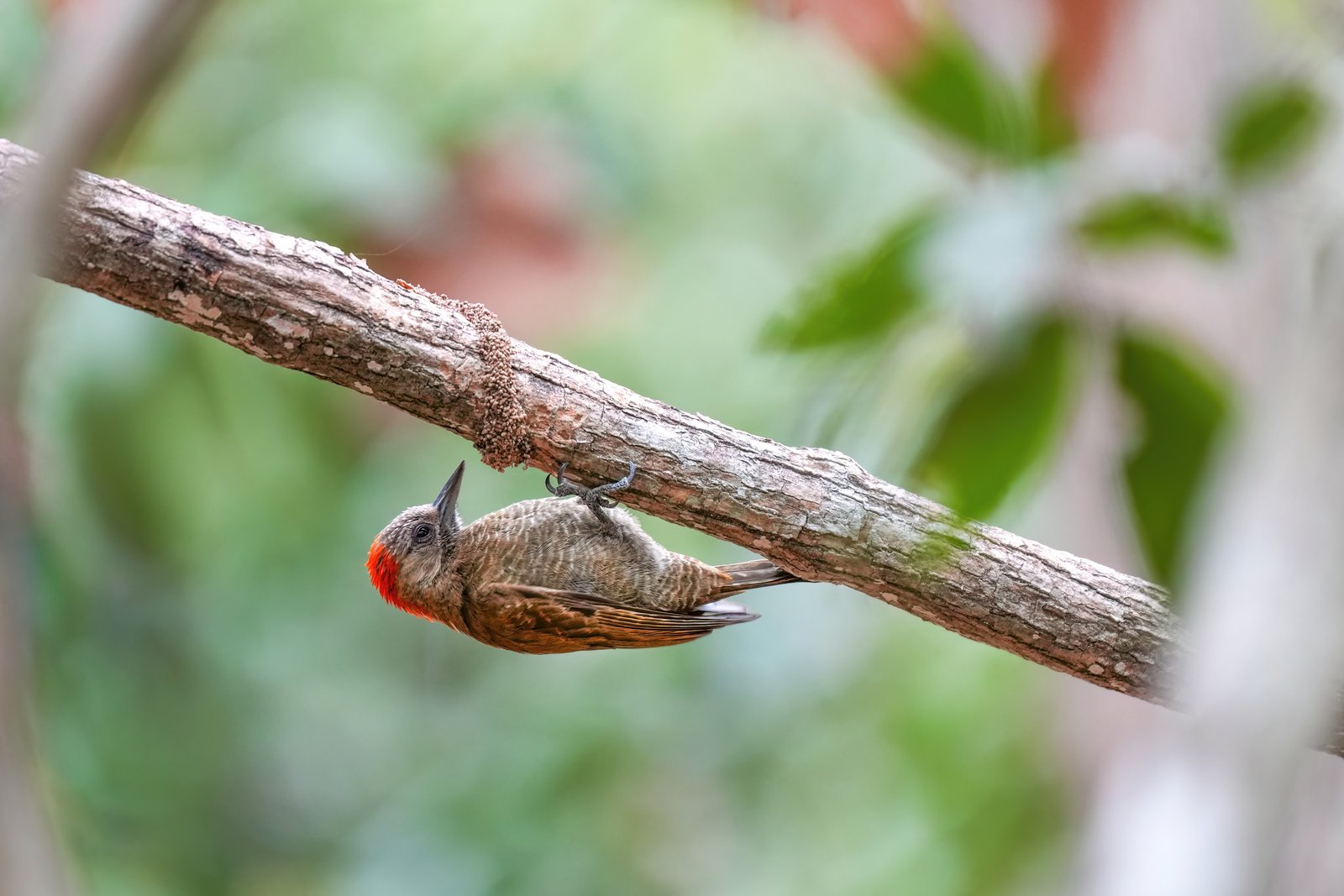
The Little Woodpecker is a small, olive woodpecker of forest edges, river islands and open woodland in the lowlands east of the Andes. It often forages low to mid-level on thin branches and saplings, alone or in pairs, and sometimes joins mixed flocks. Of the Veniliornis woodpeckers of the guide area it has the widest range.
Voice
A rapid, high series of short notes, kee-kee-kee-kee, and single, sharp wik calls. It drums in short, soft bursts.
Recording: Robson Silva e Silva — CC BY-NC-SA 4.0 · xeno-canto
Identification
15–16 cm, with a short, straight, dark bill. The upperparts are plain olive-green to olive-brown, sometimes with small pale spots on the wing coverts. The face is greyish brown with a narrow white supercilium and a white malar stripe. The underparts are densely barred greyish olive and dull white. The male has a red crown with grey feather bases, the female a greyish brown crown without red. Juveniles are duller, young males with some red on the crown.
Confusion species
Red-stained Woodpecker Veniliornis affinis is slightly larger and more golden green, with red spots on the wing coverts and a yellow nape, and lives mainly high in the forest interior. Dot-fronted Woodpecker Veniliornis frontalis in southern Bolivia has a dark forehead with dense white dots. Checkered Woodpecker Veniliornis mixtus in eastern Bolivia is checkered black and white above and streaked below.
Habitat
Forest edges, gallery forest, várzea, river islands with young forest, open woodland in savanna and cerrado, dry forest and gardens with trees, from the lowlands to about 1000 m, in Bolivia locally higher. It searches thin branches, vines and stems for insects and larvae. It nests in a self-excavated cavity in a dead branch or trunk.
Where the bird is most at home, classified by the vegetation units of the Andes and the west coast.


Range and movements
In Colombia in the lowlands east of the Andes, in the llanos and Amazonia. In Ecuador in the eastern lowlands, mainly along the large rivers. In Peru in the Amazonian lowlands, mainly along rivers. In Bolivia widespread in the lowlands and on the lower slopes, from the Beni savannas to the dry forest of the south-east. Absent west of the Andes and from the Galápagos. Outside the guide area in Venezuela, the Guianas, Brazil, Paraguay and northern Argentina.
- Resident
- dark = core range, pale = thinly spread
How and when to look
Search river islands and forest edges along large rivers; the birds often forage at eye level in young woodland. Listen for the high series of calls and the soft drumming.
Conservation status
Least Concern. The species has a large range and adapts to open and disturbed woodland.
Scientific name
Veniliornis passerinus | (Linnaeus, 1766)
Linnaeus described the species in 1766 as Picus passerinus; because it was later moved to another genus, the author and year stand in brackets. The genus Veniliornis was introduced in 1854 by Bonaparte. The genus name combines Venilia, a Roman deity, with Greek ornis, 'bird'. The species name comes from Latin passerinus, 'sparrow-like' (from passer, 'sparrow'), for its small size. The specimen the first description was based on came from Cayenne, French Guiana.