All species › Woodpeckers and allies › Woodpeckers › Striped Woodpecker
Striped Woodpecker | Veniliornis lignarius
Streepkopspecht | Carpintero bataraz grande | Pica-pau-listrado
The Striped Woodpecker is a small, black-and-white barred woodpecker of the Andes of Bolivia, Argentina and Chile. In the guide area it lives only in the mountains of central and southern Bolivia, in dry montane woodland, scrub and Polylepis groves. In the south of its range part of the population moves north or to lower areas in winter.
Voice
A high, sharp pik or peek and a fast, squeaky rattle. It drums briefly.
Recording: Cristian Pinto Fernandez — CC BY-NC-SA 4.0 · xeno-canto
Identification
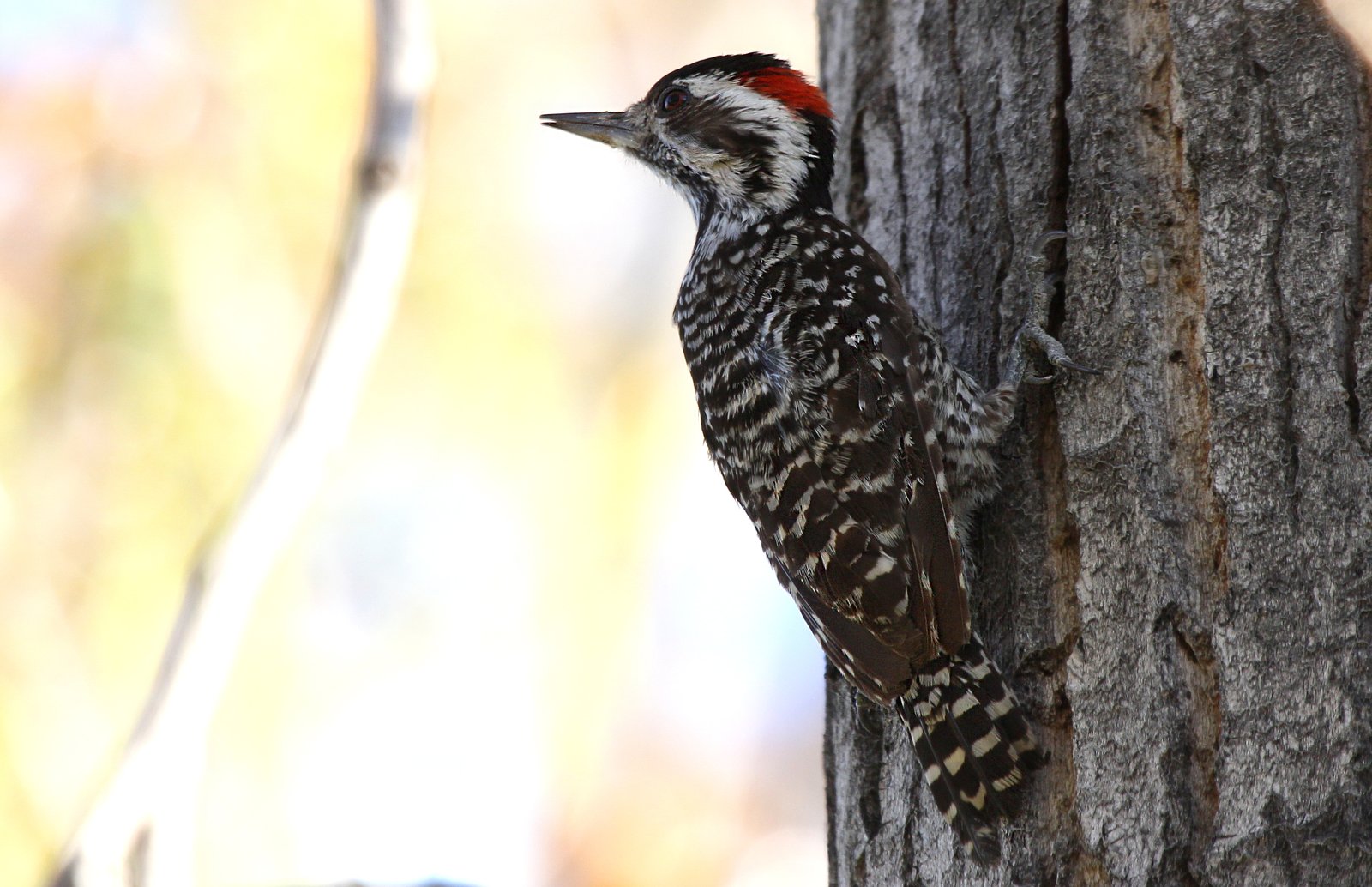
15–16 cm, with a straight, fairly long, grey bill. The crown is blackish with fine white streaks; the male has a red patch on the hindcrown, lacking in the female. A white supercilium and a white malar stripe enclose a blackish ear patch. The upperparts are evenly barred black and white, and the tail is barred black and white. The underparts are white with dense black streaks on the throat and breast, turning into bars on the flanks.
Confusion species
Checkered Woodpecker Veniliornis mixtus is slightly smaller, with a shorter bill, a more checkered pattern on the upperparts and finer streaks below, and lives in the lowlands of eastern Bolivia. Dot-fronted Woodpecker Veniliornis frontalis has an olive-green back and lives in humid montane forest in the Yungas. White-fronted Woodpecker Melanerpes cactorum is larger, with a white forehead, a black back with a white central stripe and unstreaked underparts.
Habitat
Dry and semi-humid montane woodland, scrub and groves of alder and Polylepis in inter-Andean valleys, riparian woodland and hedgerows around fields, in Bolivia roughly between 1500 and 3500 m. It searches for insects and larvae on trunks, branches and thin twigs, alone or in pairs. It nests in a self-excavated cavity in a tree.
Where the bird is most at home, classified by the vegetation units of the Andes and the west coast.


Range and movements
In Bolivia in the Andes of the centre and south of the country, mainly in the dry valleys and on the eastern slope. Absent from Colombia, Ecuador, Peru and the Galápagos. Outside the guide area in north-western Argentina and in Chile and southern Argentina, where it also occurs in lowlands and temperate forest.
- Resident
- dark = core range, pale = thinly spread
How and when to look
In the dry valleys of central and southern Bolivia, search alder and Polylepis groves and streamside scrub for a small, black-and-white barred woodpecker. The high pik is often the first sign.
Conservation status
Least Concern. In Bolivia the species is locally distributed and depends on the remaining groves and scrub in the dry valleys.
Scientific name
Veniliornis lignarius | (Molina, 1782)
Molina described the species in 1782 as Picus Lignarius; because it was later moved to another genus, the author and year stand in brackets. The genus Veniliornis was introduced in 1854 by Bonaparte. The genus name combines Venilia, a Roman deity, with Greek ornis, 'bird'. The species name comes from Latin lignarius, 'of wood, carpenter' (from lignum, 'wood'), for its woodworking habits. The specimen the first description was based on came from Chile.