All species › Woodpeckers and allies › Woodpeckers › Checkered Woodpecker
Checkered Woodpecker | Veniliornis mixtus
Streepstaartspecht | Carpintero bataraz chico | Pica-pau-chorão
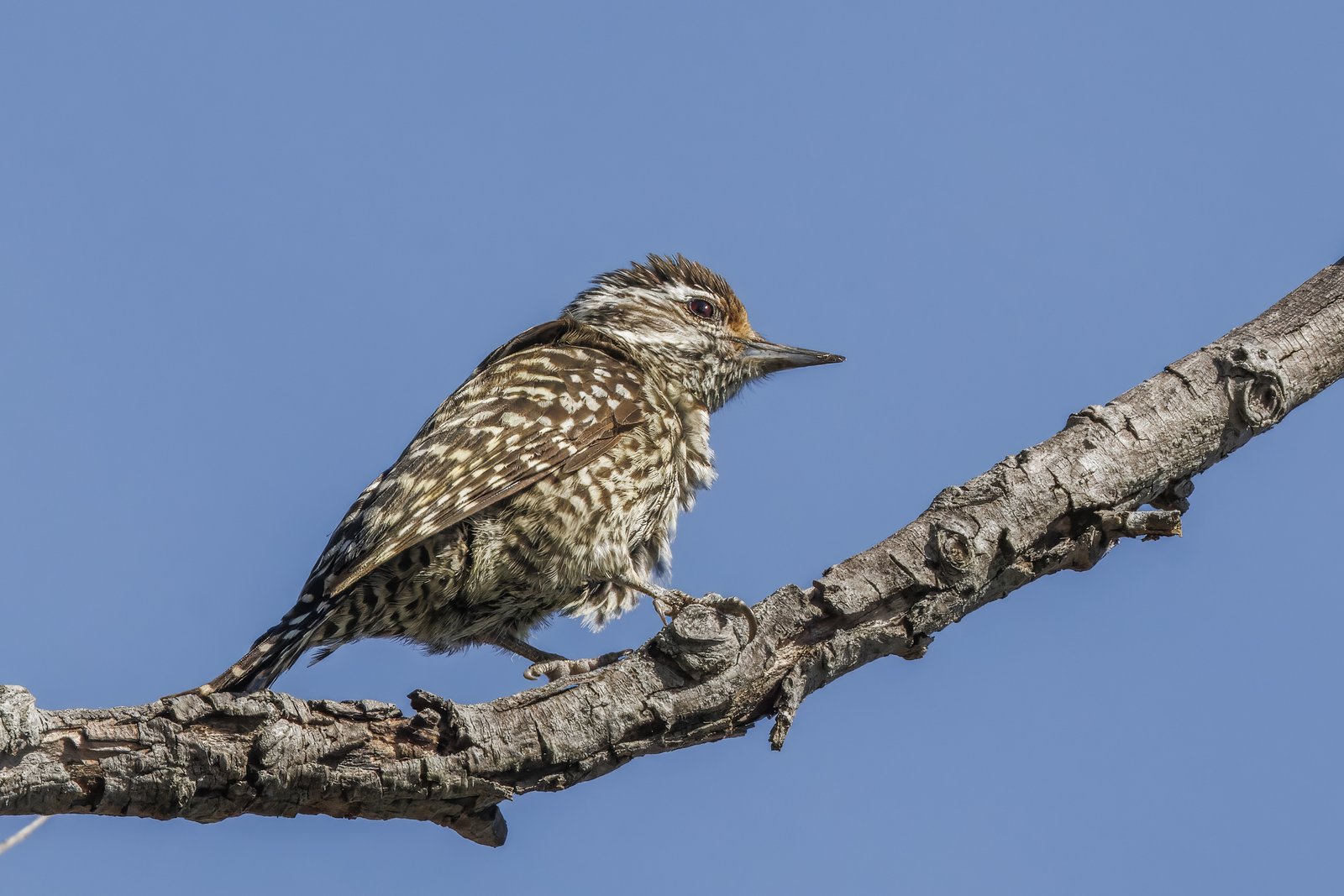
The Checkered Woodpecker is a small, black-and-white checkered woodpecker of savannas, open woodland and the Chaco in southern South America. In the guide area it occurs only in the lowlands of eastern Bolivia. It often forages on thin branches and twigs and is less tied to large trees than most woodpeckers.
Voice
A short, high pik and a soft, fast, slightly descending rattle. It drums softly.
Recording: Franco Vushurovich — CC BY-NC-SA 4.0 · xeno-canto
Identification
14–15 cm, with a short, straight bill. The crown is dark brown with white streaks; the male has a red patch on the hindcrown, lacking in the female. A white supercilium and a white malar stripe enclose a broad dark brown ear patch. The upperparts are blackish brown with white spots and bars, giving a checkered pattern. The tail is barred black and white. The underparts are dull white, with dark streaks on the breast and flanks.
Confusion species
Striped Woodpecker Veniliornis lignarius is very similar, but is slightly larger, with a longer bill, more evenly barred upperparts and more heavily streaked underparts, and lives in the Andes. Little Woodpecker Veniliornis passerinus has an olive-green back without white markings. White-fronted Woodpecker Melanerpes cactorum is larger, with a white forehead and a white back stripe.
Habitat
Savanna and cerrado with scattered trees, open dry woodland, Chaco scrub, gallery forest and forest edges in the lowlands, up to about 1000 m. It searches for insects and larvae on thin branches, twigs and stems, often low to mid-height. It nests in a self-excavated cavity in a dead branch or tree.
Where the bird is most at home, classified by the vegetation units of the Andes and the west coast.


Range and movements
In Bolivia in the eastern lowlands, mainly in the savannas of Beni and Santa Cruz and in the Chaco. Absent from Colombia, Ecuador, Peru and the Galápagos. Outside the guide area in central and southern Brazil, Paraguay, Uruguay and northern and central Argentina.
- Resident
- dark = core range, pale = thinly spread
How and when to look
In the savannas and open woodland of eastern Bolivia, search scattered trees and shrubs for a small, checkered black-and-white woodpecker. The short pik often reveals where it is.
Conservation status
Least Concern. The species has a large range and tolerates semi-open landscapes, but conversion of savanna and dry woodland to farmland reduces its habitat locally.
Scientific name
Veniliornis mixtus | (Boddaert, 1783)
Boddaert described the species in 1783 as Picus mixtus; because it was later moved to another genus, the author and year stand in brackets. The genus Veniliornis was introduced in 1854 by Bonaparte. The genus name combines Venilia, a Roman deity, with Greek ornis, 'bird'. The species name comes from Latin mixtus, 'mixed', for the checkered black-and-white plumage. The specimen the first description was based on came from Buenos Aires, Argentina.