All species › Woodpeckers and allies › Woodpeckers › Red-rumped Woodpecker
Red-rumped Woodpecker | Veniliornis kirkii
Roodstuitspecht | Carpintero lomirrojo | Pica-pau-de-sobre-vermelho
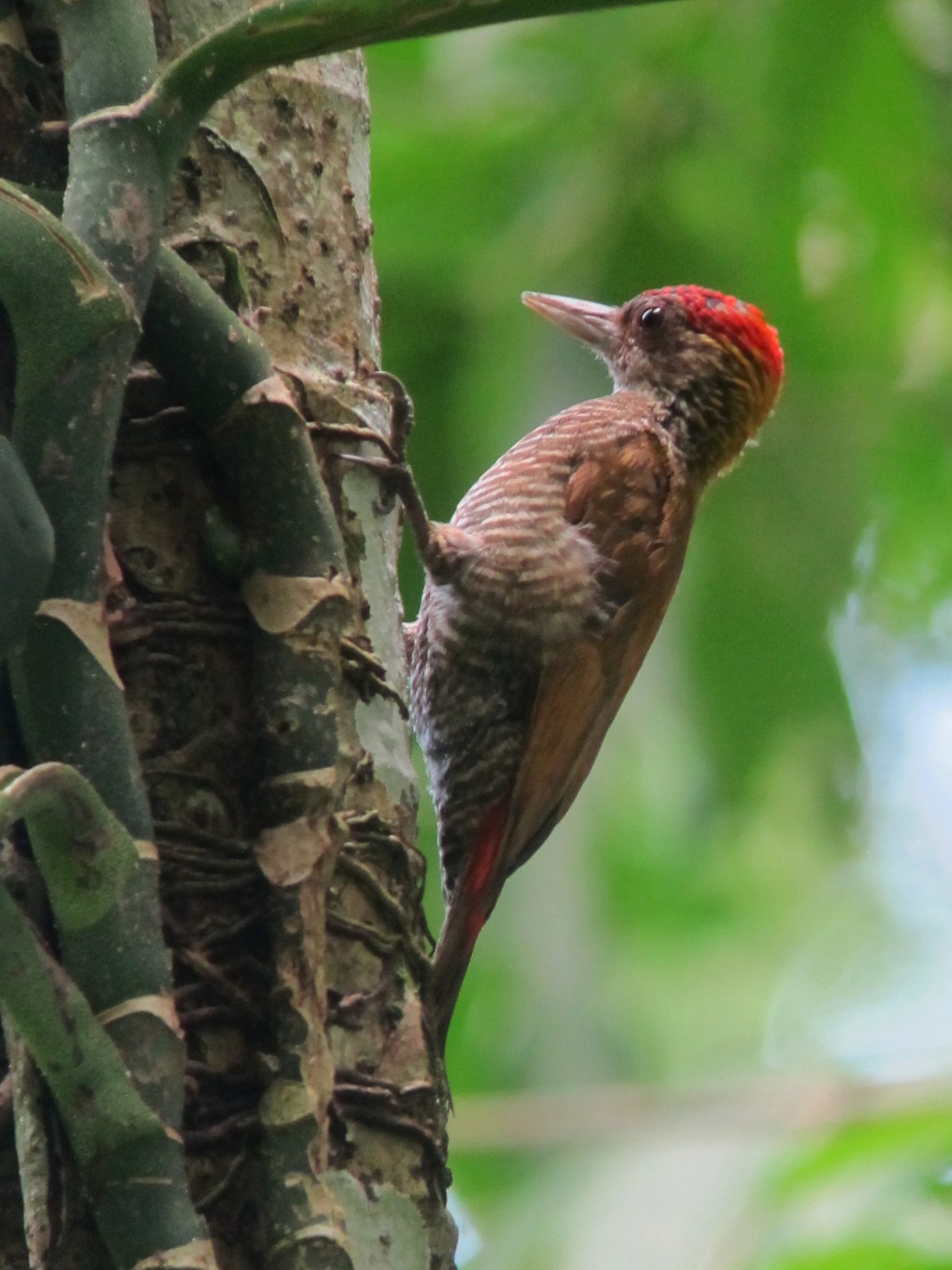
The Red-rumped Woodpecker is a small Veniliornis woodpecker of the lowlands west and north of the Andes. Its red rump is often hidden under the wings when perched, but stands out when it flies off. It lives in humid forest as well as in drier woodland and mangroves, mostly in the middle and upper levels.
Voice
A series of high, shrill notes kee-kee-kee-kee, a short pik and a dry rattle. It drums in short bursts.
Recording: Jerome Fischer — CC BY-NC-SA 4.0 · xeno-canto
Identification
15–16 cm, with a straight, dark bill. The upperparts are olive-brown with a golden sheen, and the rump and uppertail coverts are red. The face is brownish, with a paler forehead. The underparts are densely barred dark brown and dull white. The tail is dark brown. The male has red streaks on the crown and a red nape; the female has a brown crown without red and a yellowish nape.
Confusion species
Scarlet-backed Woodpecker Veniliornis callonotus has a scarlet back and nearly unmarked white underparts, and lives in dry forest in south-western Ecuador and north-western Peru. Choco Woodpecker Veniliornis chocoensis lacks the red rump and has a reddish tinge on the back. Smoky-brown Woodpecker Leuconotopicus fumigatus is plain sooty brown, without barring. Little Woodpecker Veniliornis passerinus lives east of the Andes and lacks the red rump.
Habitat
Humid and semi-humid lowland forest, forest edges, tall secondary forest, dry woodland, gallery forest and mangroves, from sea level to about 1500 m. It searches for insects and larvae on branches and trunks in the middle and upper levels, alone or in pairs, sometimes with mixed flocks. It nests in a self-excavated cavity in a tree.
Where the bird is most at home, classified by the vegetation units of the Andes and the west coast.


Range and movements
In Colombia in the Pacific and Caribbean lowlands, in the Magdalena valley and locally east of the Andes in the north-east. In Ecuador in the western lowlands and foothills. In Peru only in the far north-west, in Tumbes. Absent from Bolivia and the Galápagos. Outside the guide area in south-western Costa Rica, Panama, Venezuela, extreme northern Brazil and Trinidad and Tobago.
- Resident
- dark = core range, pale = thinly spread
How and when to look
Search forest edges and tall secondary forest in western Ecuador and the Colombian lowlands for a small, olive-brown woodpecker on thin branches. When the bird flies off, the red rump is visible.
Conservation status
Least Concern. The species has a large range and tolerates secondary forest, although much forest is being lost locally in western Ecuador.
Scientific name
Veniliornis kirkii | (Malherbe, 1845)
Malherbe described the species in 1845 as Picus (Chloropicus) Kirkii; because it was later moved to another genus, the author and year stand in brackets. The genus Veniliornis was introduced in 1854 by Bonaparte. The genus name combines Venilia, a Roman deity, with Greek ornis, 'bird'. The species name honours John Kirk (fl. 1845), a collector on Tobago. The specimen the first description was based on came from Tobago, Trinidad and Tobago.