All species › Woodpeckers and allies › Woodpeckers › Smoky-brown Woodpecker
Smoky-brown Woodpecker | Leuconotopicus fumigatus
Roetspecht | Carpintero café | Pica-pau-enfumaçado
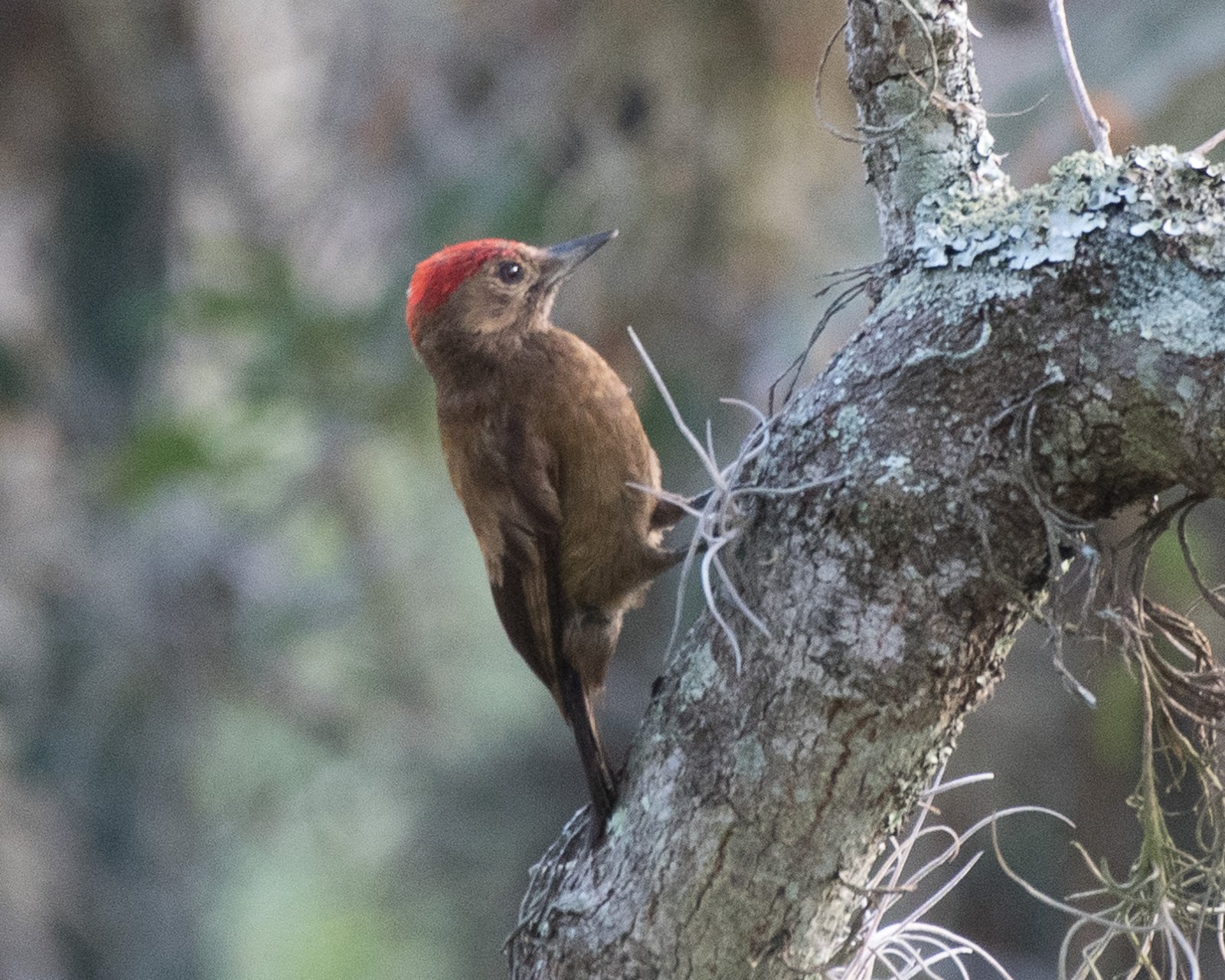
The Smoky-brown Woodpecker is a small, plain sooty-brown woodpecker of humid montane forest and foothills in the Andes. It lacks the barring and spotting of most related woodpeckers and has a paler face with a dark ear patch. It often forages low in dense growth and vine tangles, and is noticed more by its sharp calls than by its plumage.
Voice
A sharp, short kwek or chuck, often repeated, and a fast, dry rattle. It drums softly and fast.
Recording: Juan Freile — CC BY-NC-SA 4.0 · xeno-canto
Identification
16–18 cm, with a straight, grey bill. The body is almost plain dark sooty brown, slightly warmer on the back and wings; the wings and tail are darker. The face is paler brownish grey, with a darker ear patch and a faint pale line above and below the eye. The male has a red crown; in the female the crown is dark brown. Juveniles show some red on the crown, including females.
Confusion species
Red-rumped Woodpecker Veniliornis kirkii is smaller, with a red rump and densely barred underparts. Bar-bellied Woodpecker Veniliornis nigriceps has an olive-green back and densely barred black-and-white underparts, and lives higher in cloud forest. Golden-olive Woodpecker Colaptes rubiginosus is larger, with an olive-green back, barred underparts and a grey crown bordered red.
Habitat
Humid montane forest at lower and middle elevations, foothill forest, forest edges, secondary forest and scrub with vines, mostly between about 500 and 2500 m, locally lower or higher. It searches for insects and larvae in dead branches, bamboo and dense growth, often in the lower levels, and joins mixed flocks. It nests in a self-excavated cavity in dead wood.
Where the bird is most at home, classified by the vegetation units of the Andes and the west coast.


Range and movements
In Colombia in all three Andean ranges and in the Sierra Nevada de Santa Marta. In Ecuador on both slopes of the Andes. In Peru along the eastern slope and in the north-west on the western slope. In Bolivia in the Yungas and the foothills of the eastern slope. Absent from the Galápagos. Outside the guide area from Mexico to Panama, in Venezuela and in north-western Argentina.
- Resident
- dark = core range, pale = thinly spread
How and when to look
Listen for the short kwek at forest edges and in secondary forest on the mountain slopes; the bird often sits low and half hidden in dense foliage. Follow mixed flocks along mountain roads.
Conservation status
Least Concern. The species has a large range and tolerates secondary forest and forest edges.
Scientific name
Leuconotopicus fumigatus | (d'Orbigny, ACVMD, 1840)
D'Orbigny, ACVMD described the species in 1840 as Picus fumigatus; because it was later moved to another genus, the author and year stand in brackets. The genus Leuconotopicus was introduced in 1845 by Malherbe. The genus name comes from Greek leukos, 'white', and -nōtos, 'backed', with Latin picus, 'woodpecker': a white-backed woodpecker. The species name comes from Latin fumigatus, 'smoked', for the smoky-brown plumage. The specimen the first description was based on came from Bolivia (according to the description).