All species › Woodpeckers and allies › Woodpeckers › Red-crowned Woodpecker
Red-crowned Woodpecker | Melanerpes rubricapillus
Roodkruinspecht | Carpintero coronirrojo | Pica-pau-de-coroa-vermelha
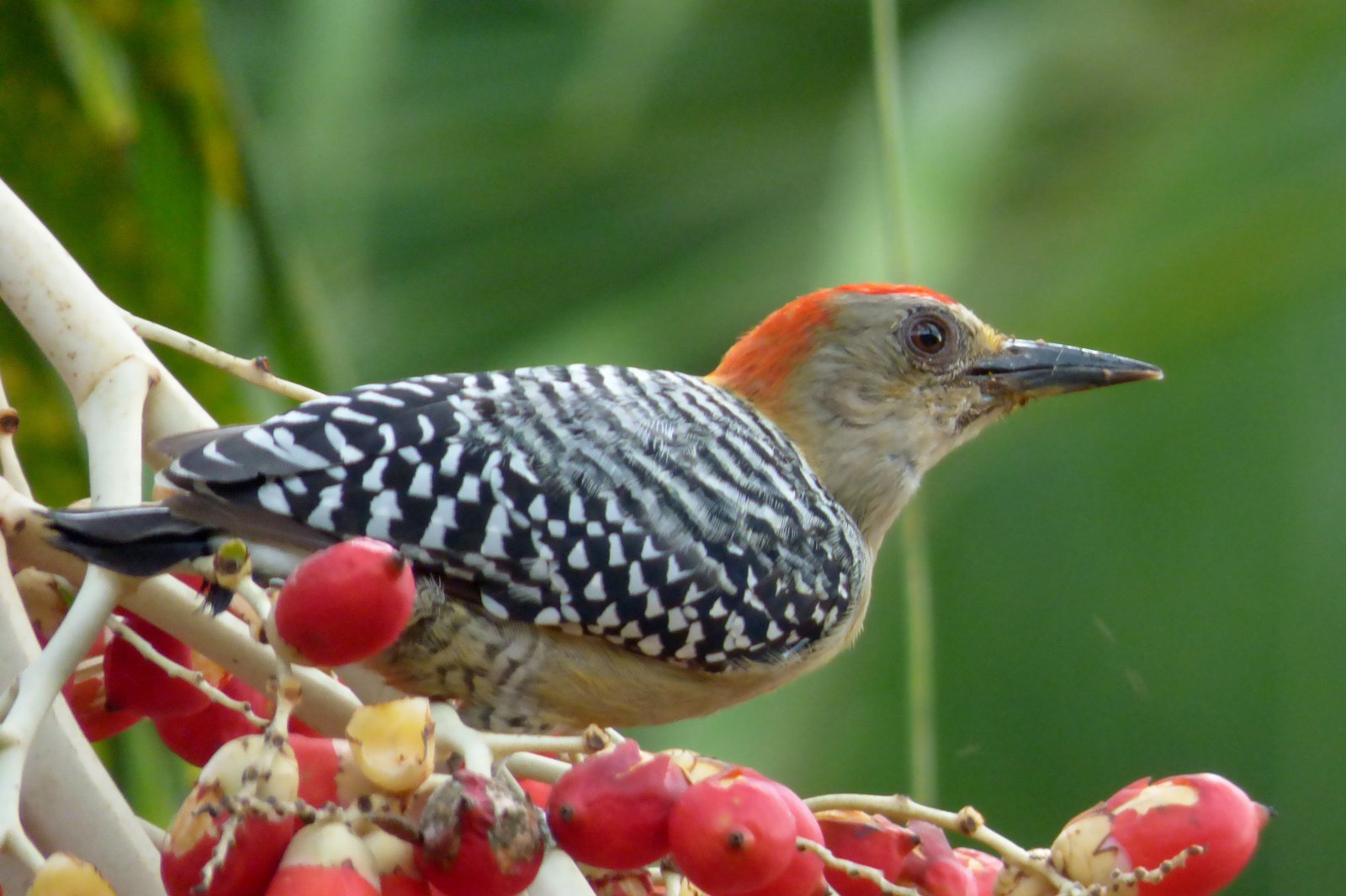
The Red-crowned Woodpecker is a medium-sized Melanerpes woodpecker with a black-and-white barred back and a pale, grey-buff head. In northern Colombia it is one of the most widespread woodpeckers of open woodland, gardens, plantations and mangroves. It adapts well to human-modified landscapes and also nests in palms and wooden posts.
Voice
A loud, rolling rattle krrrr or churr, and in encounters a series wicka-wicka-wicka. It drums in short bursts.
Recording: Francisco contreras — CC BY-NC-SA 4.0 · xeno-canto
Identification
16–18 cm, with a straight, blackish bill. The upperparts are densely barred black and white; the rump is white. The face, throat and underparts are pale grey to grey-buff, with a red to orange-red patch in the centre of the belly. The tail is black, with white bars on the central feathers. The male has a red crown and nape; in the female the crown is grey-buff and only the nape is red. Juveniles are duller.
Confusion species
Black-cheeked Woodpecker Melanerpes pucherani has a broad black band behind the eye, a yellow forehead and olive-grey underparts, and lives in more humid forest on the Pacific side. Golden-naped Woodpecker Melanerpes chrysauchen has a golden nape and a plain black back with a white central stripe. Red-rumped Woodpecker Veniliornis kirkii is smaller, with an olive-brown back and barred underparts.
Habitat
Open and semi-open woodland, dry and humid forest, forest edges, scrub, plantations, gardens, parks, palm groves and mangroves, from sea level to about 1700 m. It eats insects, fruit and nectar. It nests in a self-excavated cavity in a dead tree, a palm or a wooden post.
Where the bird is most at home, classified by the vegetation units of the Andes and the west coast.


Range and movements
In Colombia in the north, in the Caribbean lowlands and the Magdalena and Cauca valleys, and east of the Andes in the northern llanos. Absent from Ecuador, Peru, Bolivia and the Galápagos. Outside the guide area in south-western Costa Rica, Panama, Venezuela, the Guianas and Tobago.
- Resident
- dark = core range, pale = thinly spread
How and when to look
Look in parks, gardens and open woodland in the Caribbean lowlands of Colombia; the rolling call is often heard early in the morning. Birds regularly perch on posts, palms and dead branches.
Conservation status
Least Concern. The species has a large range and locally benefits from open, human-shaped landscapes.
Scientific name
Melanerpes rubricapillus | (Cabanis, 1862)
Cabanis described the species in 1862 as Centurus rubricapillus; because it was later moved to another genus, the author and year stand in brackets. The genus Melanerpes was introduced in 1832 by Swainson. The genus name comes from Greek melas, 'black', and herpēs, 'creeper', from herpō, 'to creep'. The species name comes from Latin ruber, 'red', and capillus, 'hair of the head', for the red crown. The specimen the first description was based on came from Barranquilla, Colombia.