All species › Woodpeckers and allies › Woodpeckers › White-fronted Woodpecker
White-fronted Woodpecker | Melanerpes cactorum
Cactusspecht | Carpintero del cardón | Pica-pau-de-testa-branca
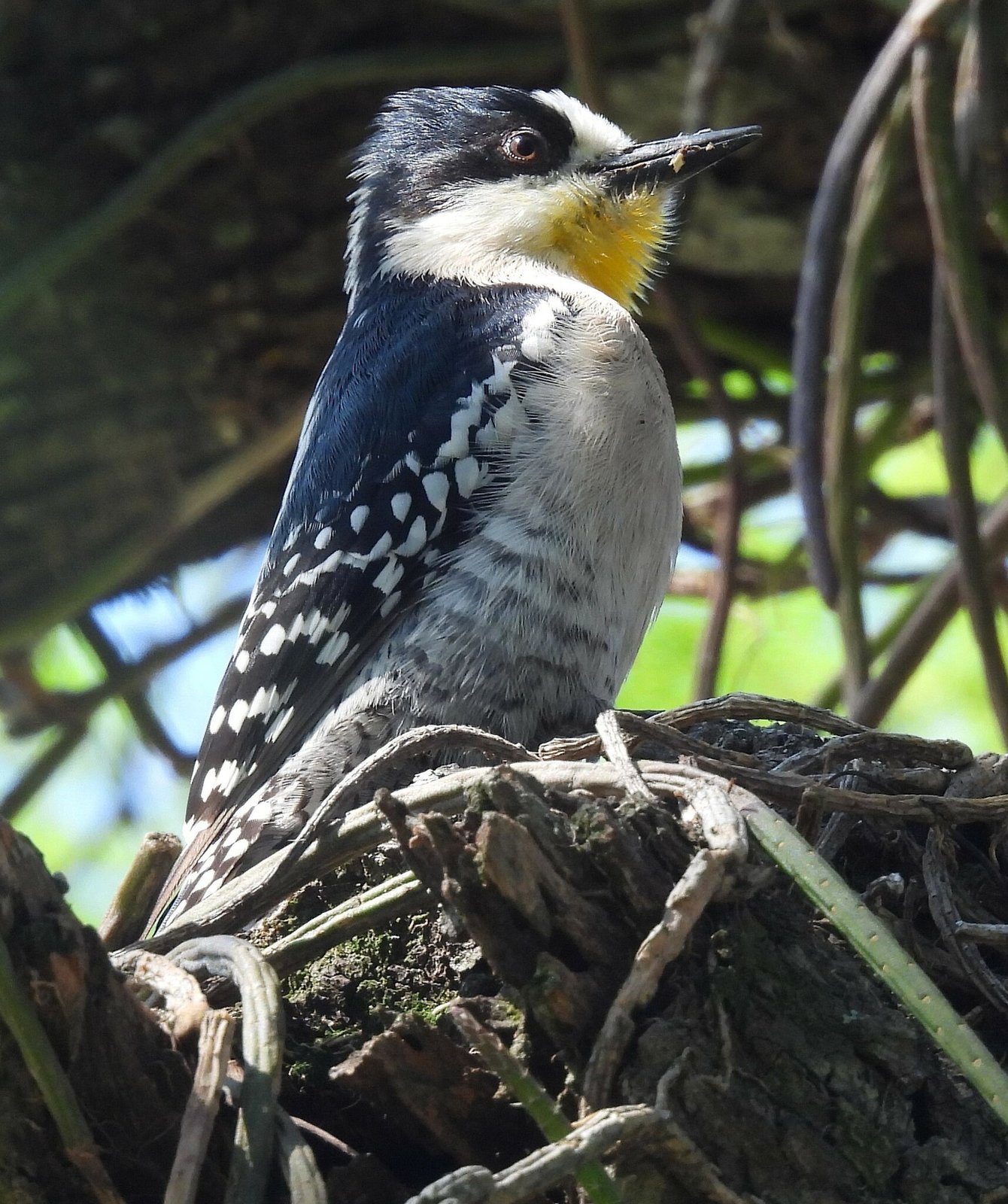
The White-fronted Woodpecker is a black-and-white Melanerpes woodpecker of dry Chaco forest and the dry valleys of Bolivia, with a conspicuous white forehead and a white central stripe on the back. It often lives in small, noisy groups. Columnar cacti play a major role in its life: it eats the fruit and excavates its nest cavity in them.
Voice
Noisy. A fast series of high, nasal notes week-week-week and a shrill, chattering cackle, often from several birds at once. It drums little.
Recording: Guilherme Melo — CC BY-NC-SA 4.0 · xeno-canto
Identification
16–17 cm, with a short, straight, black bill. The forehead, face and throat are white to yellowish white, with a black stripe through the eye that joins the black hindneck. The upperparts are glossy black, with a broad white stripe down the centre of the back and white spots and bars on the wings; the rump is white. The underparts are grey-buff, with a yellow wash on the belly. The male has a small red crown patch, lacking in the female.
Confusion species
White Woodpecker Melanerpes candidus is larger, with an all-white head and white underparts, and a yellow nape patch. Checkered Woodpecker Veniliornis mixtus and Striped Woodpecker Veniliornis lignarius are smaller, with barred upperparts and streaked underparts. Green-barred Woodpecker Colaptes melanochloros is much larger and barred green and yellow.
Habitat
Dry Chaco forest, thorn scrub with columnar cacti, dry woodland and scrub in inter-Andean valleys, open country with scattered trees and village edges, from the lowlands to about 3000 m. It eats insects, cactus fruit and other fruit, and drinks sap from small holes it drills in bark. It nests in a cavity in a columnar cactus or a tree.
Where the bird is most at home, classified by the vegetation units of the Andes and the west coast.


Range and movements
In Bolivia in the south-eastern lowlands, mainly in the Chaco, and in the dry valleys of the eastern slope of the Andes in the centre and south of the country. Absent from Colombia, Ecuador, Peru and the Galápagos. Outside the guide area in western Paraguay and northern and central Argentina.
- Resident
- dark = core range, pale = thinly spread
How and when to look
In the Chaco and in dry valleys with columnar cacti, look for small groups flying noisily from tree to tree. Birds often perch on top of cacti and dead branches.
Conservation status
Least Concern. The species has a large range and tolerates open, human-modified land, as long as cacti or trees for nest cavities remain.
Scientific name
Melanerpes cactorum | (d'Orbigny, ACVMD, 1839)
D'Orbigny, ACVMD described the species in 1839 as Picus cactorum; because it was later moved to another genus, the author and year stand in brackets. The genus Melanerpes was introduced in 1832 by Swainson. The genus name comes from Greek melas, 'black', and herpēs, 'creeper', from herpō, 'to creep'. The species name comes from Latin cactus (Greek kaktos), 'of the cacti', for the cacti in its habitat. The specimen the first description was based on came from Chaluani and Chilón, Mizque, Cochabamba, Bolivia.