All species › Woodpeckers and allies › Woodpeckers › Black-cheeked Woodpecker
Black-cheeked Woodpecker | Melanerpes pucherani
Zwartwangspecht | Carpintero cara negra | Pica-pau-de-bochecha-preta
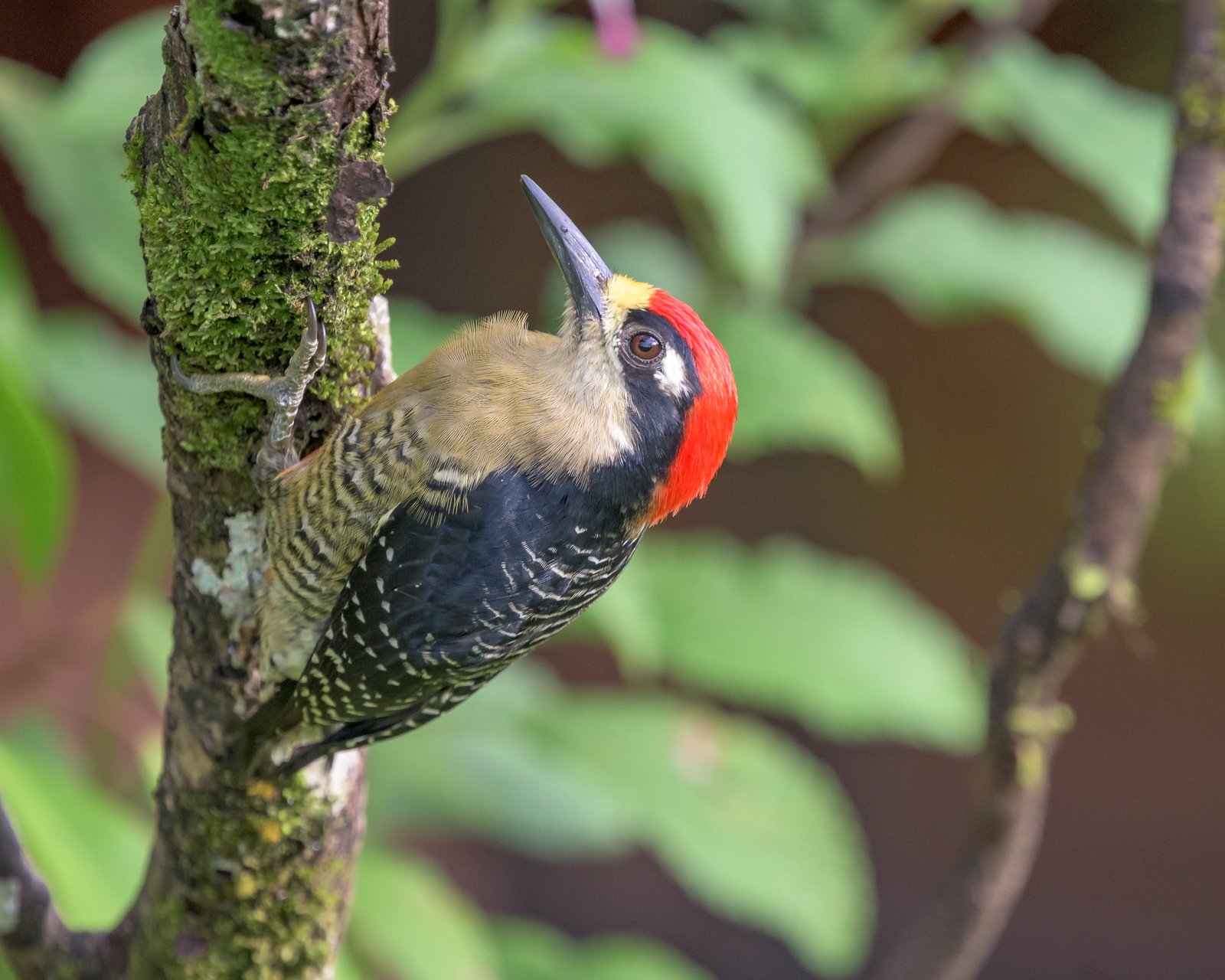
The Black-cheeked Woodpecker is a medium-sized Melanerpes woodpecker of humid lowland forest on the Pacific side of the guide area. A broad black band behind the eye, a yellow forehead and a red belly patch mark the species. It feeds mainly high in the canopy and along forest edges, where it takes much fruit as well as insects.
Voice
A rolling, rattling call churrr and high, shrill series chee-chee-chee, often exchanged between partners. It drums in short bursts on dead wood.
Recording: Sue Riffe — CC BY-NC-SA 4.0 · xeno-canto
Identification
17–19 cm, with a straight, black bill. The forehead is yellow and a broad black band runs from behind the eye to the hindneck, with a small white spot just behind the eye. The back and wings are black with narrow white bars; the rump is white. The throat and breast are olive-grey, the centre of the belly is red and the flanks are barred black. The male has the whole crown and nape red; in the female the centre of the crown is black and only the nape is red. Juveniles are duller, with less red.
Confusion species
Red-crowned Woodpecker Melanerpes rubricapillus has a pale, grey-buff head without a black band behind the eye, and lives in drier, open country in northern Colombia. Golden-naped Woodpecker Melanerpes chrysauchen has a golden nape and a plain black back with a white central stripe. Acorn Woodpecker Melanerpes formicivorus has a black-and-white face pattern and a plain black back, and lives in montane forest.
Habitat
Humid and wet lowland forest, forest edges, tall secondary forest, clearings with dead trees and shaded plantations, from the lowlands to about 1000 m, locally higher. It eats insects, fruit and nectar, mostly in the upper levels. It nests in a self-excavated cavity in a dead tree or branch.
Where the bird is most at home, classified by the vegetation units of the Andes and the west coast.


Range and movements
In Colombia in the Pacific lowlands and the foothills of the western slope of the Andes, and in the north-west into the Caribbean lowlands and the Magdalena valley. In Ecuador in the western lowlands and foothills, mainly in the north and centre. Only a few records are known from Peru. Absent east of the Andes and from the Galápagos. Outside the guide area from southern Mexico to Panama.
- Resident
- dark = core range, pale = thinly spread
How and when to look
In the early morning, search forest edges and clearings in the Chocó lowlands and western Ecuador for birds perched on dead branches above the canopy. Fruiting trees often attract several individuals.
Conservation status
Least Concern. The species tolerates forest edges and semi-open land, but depends on forest and is affected locally by deforestation in the Pacific lowlands.
Scientific name
Melanerpes pucherani | (Malherbe, 1849)
Malherbe described the species in 1849 as Zebrapicus Pucherani; because it was later moved to another genus, the author and year stand in brackets. The genus Melanerpes was introduced in 1832 by Swainson. The genus name comes from Greek melas, 'black', and herpēs, 'creeper', from herpō, 'to creep'. The species name honours Jacques Pucheran (1817–1895), French zoologist at the Muséum national d'histoire naturelle in Paris. The specimen the first description was based on came from Colombia.