All species › Woodpeckers and allies › Woodpeckers › Beautiful Woodpecker
Beautiful Woodpecker | Melanerpes pulcher
Prachtspecht | Carpintero bonito | Pica-pau-bonito
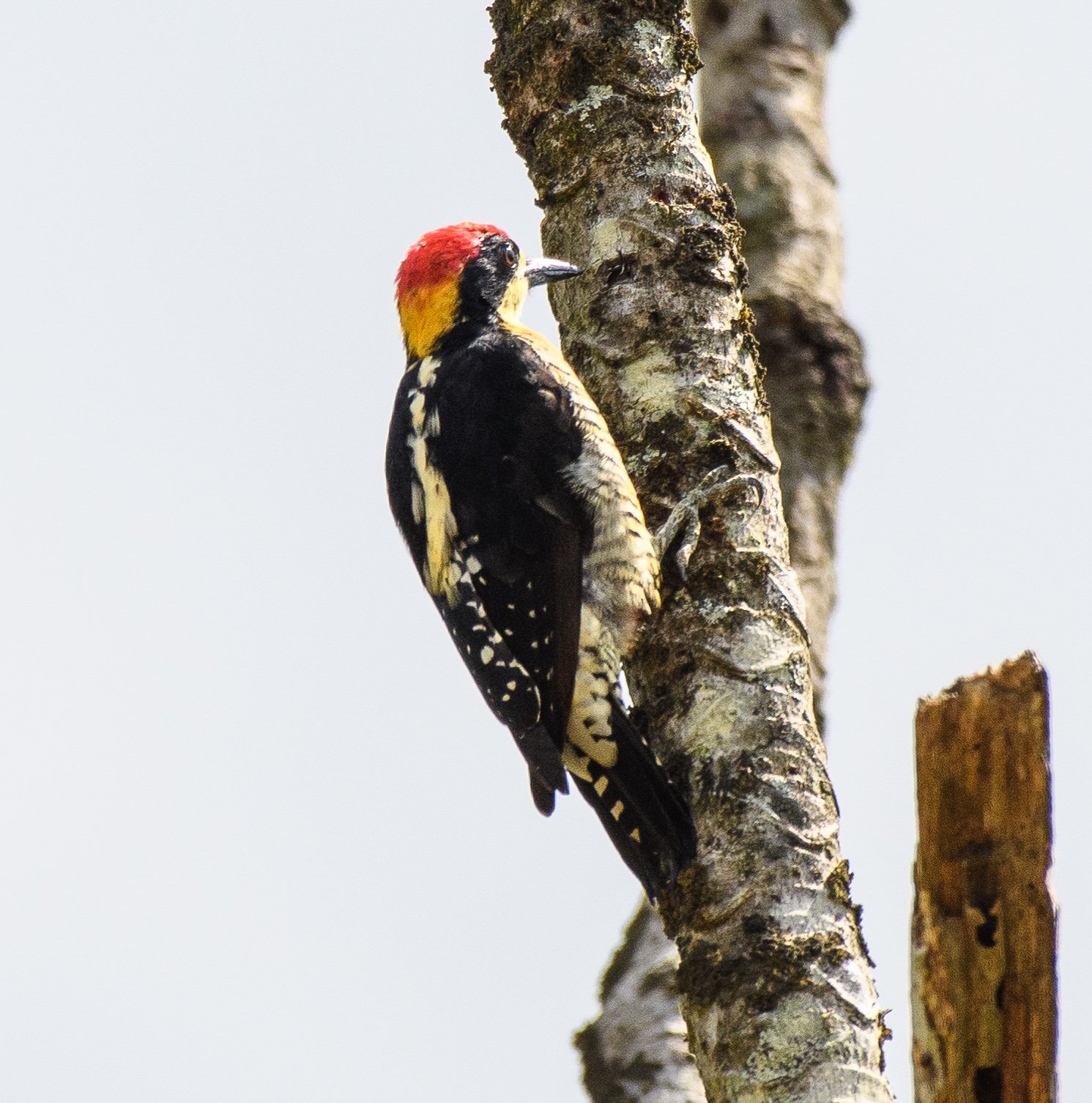
The Beautiful Woodpecker is a small, boldly patterned Melanerpes woodpecker found only in Colombia, in the Magdalena and Cauca valleys. It was formerly treated as a subspecies of the Golden-naped Woodpecker of Costa Rica and Panama. It lives in pairs or family groups in the canopy of humid forest and semi-open country.
Voice
A rolling, somewhat harsh churr and chattering series, often from pairs. It drums in short rolls.
Recording: Jerome Fischer — CC BY-NC-SA 4.0 · xeno-canto
Identification
18–19 cm, with a straight, dark bill. A broad black mask runs from the eye to the mantle; the nape is golden yellow. The back and wings are black, with a broad white stripe down the centre of the back and white bars on the wings. The underparts are grey to olive-brown, with a red patch in the centre of the belly and black-and-white barred flanks. The male has a red crown; in the female the crown is largely black.
Confusion species
Golden-naped Woodpecker Melanerpes chrysauchen is very similar but occurs only in Costa Rica and Panama. Red-crowned Woodpecker Melanerpes rubricapillus, in northern Colombia, has a black-and-white barred back without a white central stripe and a pale head without a black mask. Black-cheeked Woodpecker Melanerpes pucherani has a barred back and a white spot behind the eye, and lives mainly further west.
Habitat
Humid forest, tall secondary forest, forest edges, clearings with dead trees and shaded plantations, in the lowlands and on the lower slopes up to about 1500 m. It forages mainly in the canopy for insects and fruit. It nests in a self-excavated cavity, often in a dead tree.
Where the bird is most at home, classified by the vegetation units of the Andes and the west coast.


Range and movements
Only in Colombia, in the centre and north of the country: mainly the Magdalena valley, the Cauca valley and the adjacent lower slopes. Absent from Ecuador, Peru, Bolivia and the Galápagos. It does not occur outside Colombia.
- Resident
- dark = core range, pale = thinly spread
How and when to look
Search remnants of humid forest and shaded plantations in the middle Magdalena valley; pairs often perch on dead branches in the canopy and give themselves away by their rolling call.
Conservation status
Least Concern. Its range is small and largely deforested, but the species tolerates forest edges and semi-open landscapes.
Scientific name
Melanerpes pulcher | Sclater, 1870
Sclater described the species in 1870 and placed it straight away in the genus where it still stands. The genus Melanerpes was introduced in 1832 by Swainson. The genus name comes from Greek melas, 'black', and herpēs, 'creeper', from herpō, 'to creep'. The species name comes from Latin pulcher, 'fair, handsome'. The specimen the first description was based on came from Near Bogotá, Colombia.