All species › Passerines › Cotingas › Bare-necked Fruitcrow
Bare-necked Fruitcrow | Gymnoderus foetidus
Kaalnekvruchtenkraai | Cuervo higuero cuellopelado | Anambé-pombo
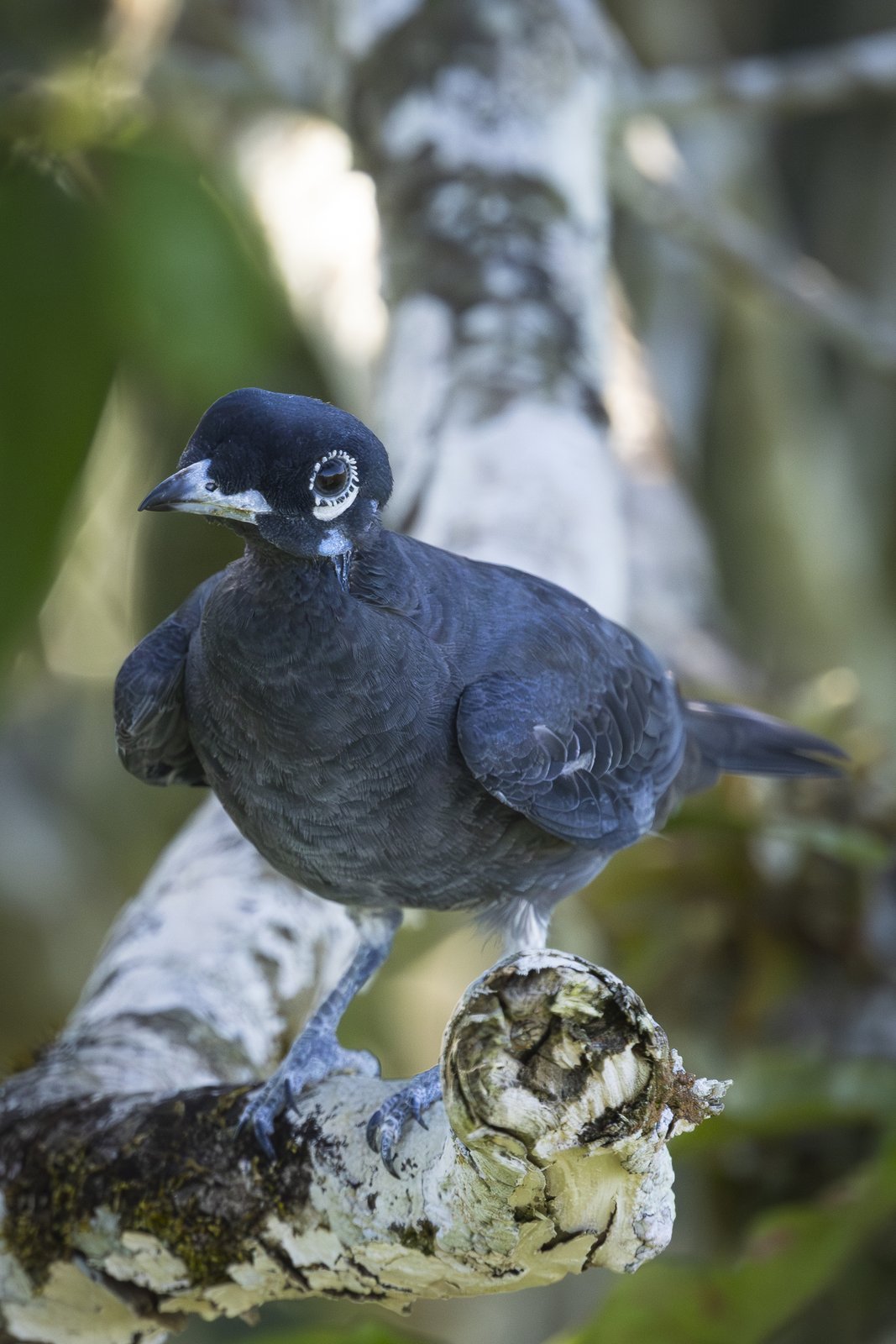
The Bare-necked Fruitcrow is a large, black cotinga of Amazonia, the male of which has bare, blue skin folds on the neck. It often flies singly or in loose groups high over rivers and forest, with an undulating flight and pale wings. The species is strongly tied to forest along rivers and on river islands.
Voice
An almost silent species; vocalizations are seldom heard.
No recording with a suitable Creative Commons licence is available for this species yet.
Identification
33–38 cm; the male is clearly larger than the female. A slender bird with a small head, a short, broad, bluish-grey bill and a medium-length tail. The male is black, with bare, pale blue, wrinkled skin on the sides of the neck and silvery grey flight feathers and greater coverts that contrast strongly in flight. The female is smaller and greyer, with less bare skin and less contrast in the wing. Young birds resemble the female.
Confusion species
Purple-throated Fruitcrow Querula purpurata is all black, without pale wings, the male with a purple-red throat; it lives in groups in the middle storey. Amazonian Umbrellabird Cephalopterus ornatus is larger and bulkier, with a crest and a breast wattle, and lacks pale wings. In flight it can recall a pigeon, but the pale wings and undulating flight distinguish it.
Habitat
Forest along rivers, várzea, river islands and the edges of terra firme forest in the lowlands, mostly below 500 m. It perches high in the crown or on bare branches above the forest. It eats mainly fruit, plucked in tree crowns. The nest is a small structure high on a branch.
Where the bird is most at home, classified by the vegetation units of the Andes and the west coast.


Range and movements
In Colombia in the lowlands east of the Andes. In Ecuador in the eastern lowlands. In Peru throughout the Amazonian lowlands. In Bolivia in the north and centre of the lowlands. Absent from the Galápagos. Outside the guide area in southern Venezuela, the Guianas and Brazilian Amazonia.
- Resident
- dark = core range, pale = thinly spread
How and when to look
Watch from a boat on the large rivers and from canopy towers for dark birds flying high overhead with undulating flight and pale wings. Along riverbanks they also perch on bare treetops.
Conservation status
Least Concern. Fairly common along the large rivers of Amazonia.
Scientific name
Gymnoderus foetidus | (Linnaeus, 1758)
Linnaeus described the species in 1758 as [Gracula] foetida; because it was later moved to another genus, the author and year stand in brackets. The genus Gymnoderus was introduced in 1809 by Geoffroy Saint-Hilaire. The genus name comes from Ancient Greek gumnos, 'bare', and dera, 'neck', for the bare neck. The species name is Latin foetidus, 'stinking'. The specimen the first description was based on came from Suriname.