All species › Passerines › Cotingas › Black-faced Cotinga
Black-faced Cotinga | Conioptilon mcilhennyi
Zwartmaskercotinga | Cotinga carinegra | Anambé-de-cara-preta
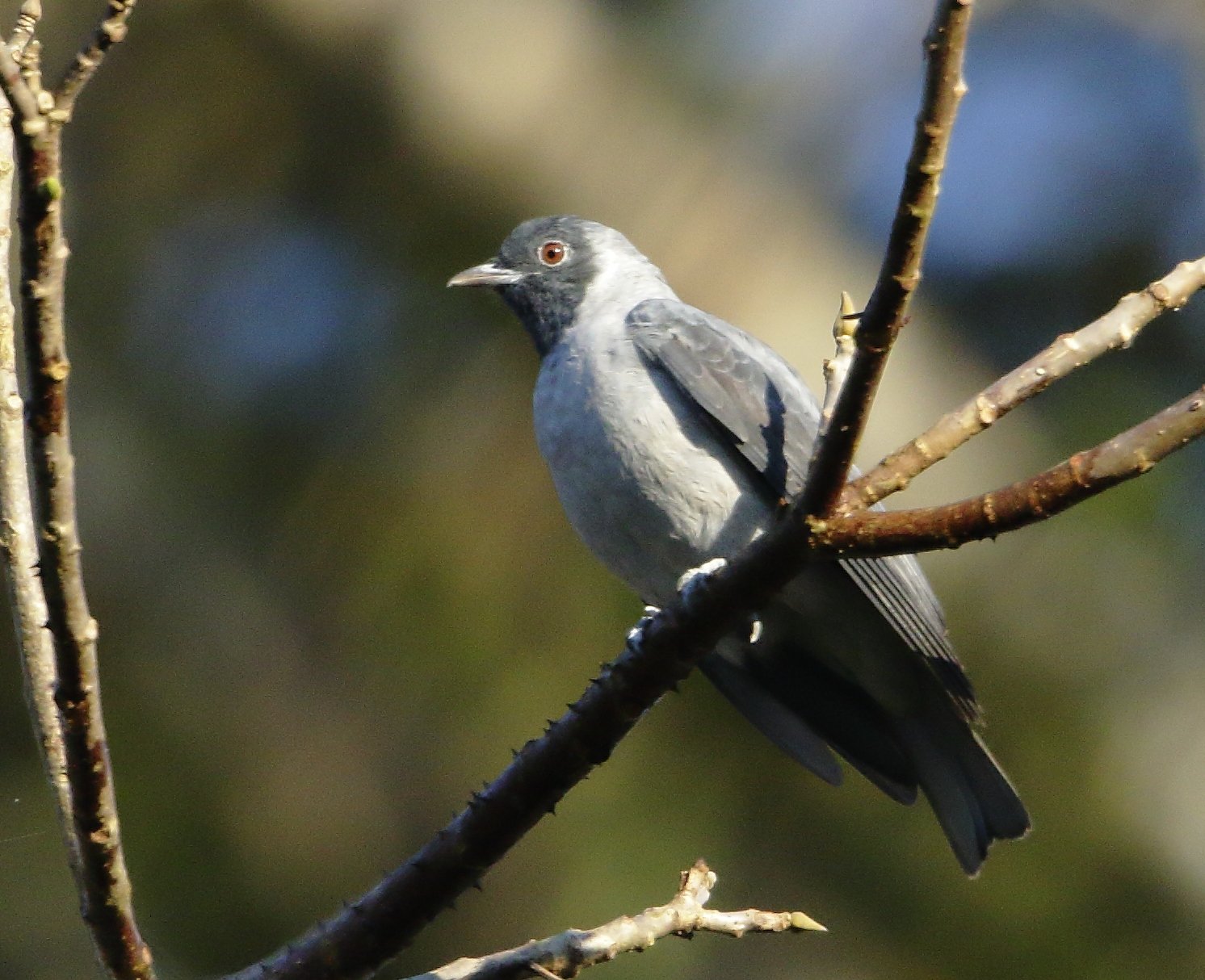
The Black-faced Cotinga is a medium-sized, grey cotinga with a black head from south-western Amazonia. The species was described only in the second half of the twentieth century and has a small range. It often perches on bare branches above the forest near lakes and swampy shores.
Voice
A short, barked puh, a quiet, descending coww and a squeaky, rising call that glides briefly upward.
Recording: Felipe Arantes — CC BY-NC-SA 4.0 · xeno-canto
Identification
23–25 cm. The male has a mostly black head and throat, with a white crescent behind the ear coverts. The upperparts are dark grey, the wings and tail darker grey still. The breast is paler grey, becoming white on the lower belly and undertail coverts. The female is slightly smaller and paler below. Both sexes have a dark reddish-brown iris, a dark greyish-brown bill with a slight hook and dark olive-grey legs.
Confusion species
Few other species in the guide area show this grey-and-black pattern. Masked Tityra Tityra semifasciata also has a black face, but is mostly white with a red bill base. Screaming Piha Lipaugus vociferans is plain grey, without a black head, and lives in the middle storey of the forest.
Habitat
Humid lowland forest, especially swampy or seasonally flooded areas around lakes (cochas) and rivers, also terra firme and burned forest; mostly below 300 m. It eats mainly fruit, often in large fig trees (Ficus), plucked while briefly hovering from a perch; also insects. It lives singly or in pairs. The few known nests were thin bowls of plant fibre in a branch fork, high in the tree.
Where the bird is most at home, classified by the vegetation units of the Andes and the west coast.


Range and movements
In Peru in the east, in Ucayali, Madre de Dios and Cusco, mainly north of the Madre de Dios River, including Manu National Park. In Bolivia only in the far north of Pando. Absent from Colombia, Ecuador and the Galápagos. Outside the guide area in western Acre in Brazil.
- Resident
- dark = core range, pale = thinly spread
How and when to look
Search at oxbow lakes in Madre de Dios, such as around Manu and the lodges along the Madre de Dios River, for a grey bird on a bare branch above the shoreline vegetation. Fruiting fig trees attract it.
Conservation status
Least Concern, but the population is unknown and probably decreasing. Threats are selective logging, oil and gas extraction, mining, road building and colonization.
Scientific name
Conioptilon mcilhennyi | Lowery & O'Neill, 1966
Lowery & O'Neill described the species in 1966 and placed it straight away in the genus where it still stands. He introduced the genus Conioptilon in that same work. The genus name comes from Greek konia, 'fine powder', and ptilon, 'down', referring to the powder-down feathers present over much of the body. The species name honours John S. McIlhenny, who sponsored the Louisiana State University Peruvian expedition of 1964–1965, during which the first specimens were collected. The specimen the first description was based on came from Balta, Río Curanja, Peru.