All species › Passerines › Cotingas › Pompadour Cotinga
Pompadour Cotinga | Xipholena punicea
Pompadourcotinga | Cotinga pompadour | Anambé-pompadora
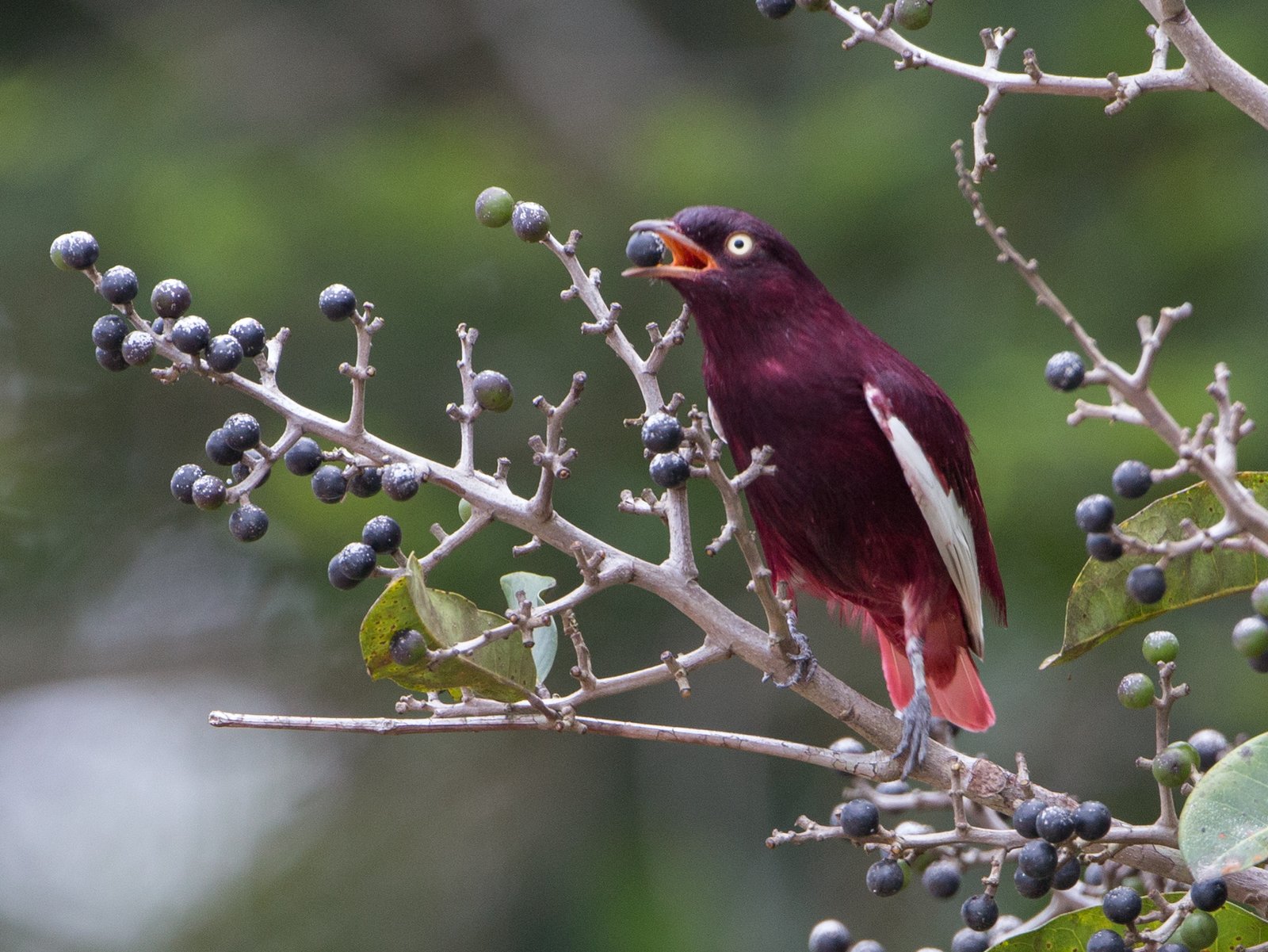
The Pompadour Cotinga is a medium-sized cotinga of the canopy in Amazonia and the Guianas. The male is glossy wine red with white wings, the female grey with white wing edges. In the guide area it is known mainly from the north-east, where it often perches high in trees in forest on sandy soils.
Voice
Mostly silent. Sometimes a short, croaking note; the male's wings can make a soft rattling sound in flight.
Recording: Jonas Nilsson — CC BY-NC-SA 4.0 · xeno-canto
Identification
20 cm, with a fairly small head and a short, broad bill. The male is glossy purplish to wine red, with mostly white flight feathers and elongated, stiff, purplish-red greater coverts lying over the white wing; the iris is yellowish white. The female is plain grey, slightly paler on the belly, with broad white edges to the wing coverts and tertials, and also a pale iris. Young males are grey with purplish-red patches.
Confusion species
The male Purple-breasted Cotinga Cotinga cotinga is blue with a purple breast and black wings. The female Purple-throated Cotinga Porphyrolaema porphyrolaema is brown and barred. The grey female can recall a female Spangled Cotinga Cotinga cayana, but that is brownish and scaled, without white wing edges and with a dark iris.
Habitat
The canopy and edges of humid lowland forest, especially forest on poor sandy soils, also forest edges along rivers; mostly below 500 m. It often perches on high, bare branches above the forest. It eats mainly fruit. The nest is a shallow cup high in a tree.
Where the bird is most at home, classified by the vegetation units of the Andes and the west coast.


Range and movements
In Colombia in the eastern Amazonian lowlands. In Ecuador rare and local in the north-east. In Peru mainly in the north-east, in Loreto. In Bolivia scarce in the north. Absent from the Galápagos. Outside the guide area in southern Venezuela, the Guianas and Brazilian Amazonia.
- Resident
- dark = core range, pale = thinly spread
How and when to look
In forest on sandy soils in north-eastern Peru, around Iquitos, and in eastern Colombia, scan the tops of tall trees from viewpoints for a wine-red bird with white wings.
Conservation status
Least Concern. Local and scarce in the guide area; widespread outside it.
Scientific name
Xipholena punicea | (Pallas, 1764)
Pallas described the species in 1764 as Turdus puniceus; because it was later moved to another genus, the author and year stand in brackets. The genus Xipholena was introduced in 1841 by Gloger. The genus name comes from Greek xiphos, 'sword', and laina, 'mantle, cloak', referring to the hard, stiff feathers of the males in breeding plumage. The species name comes from Latin puniceus, 'crimson, purple-red', after the male's plumage. The specimen the first description was based on came from Suriname.