All species › Passerines › Cotingas › Black-tipped Cotinga
Black-tipped Cotinga | Carpodectes hopkei
Witte cotinga | Cotinga blanco | Cotinga-branca-de-pontas-pretas
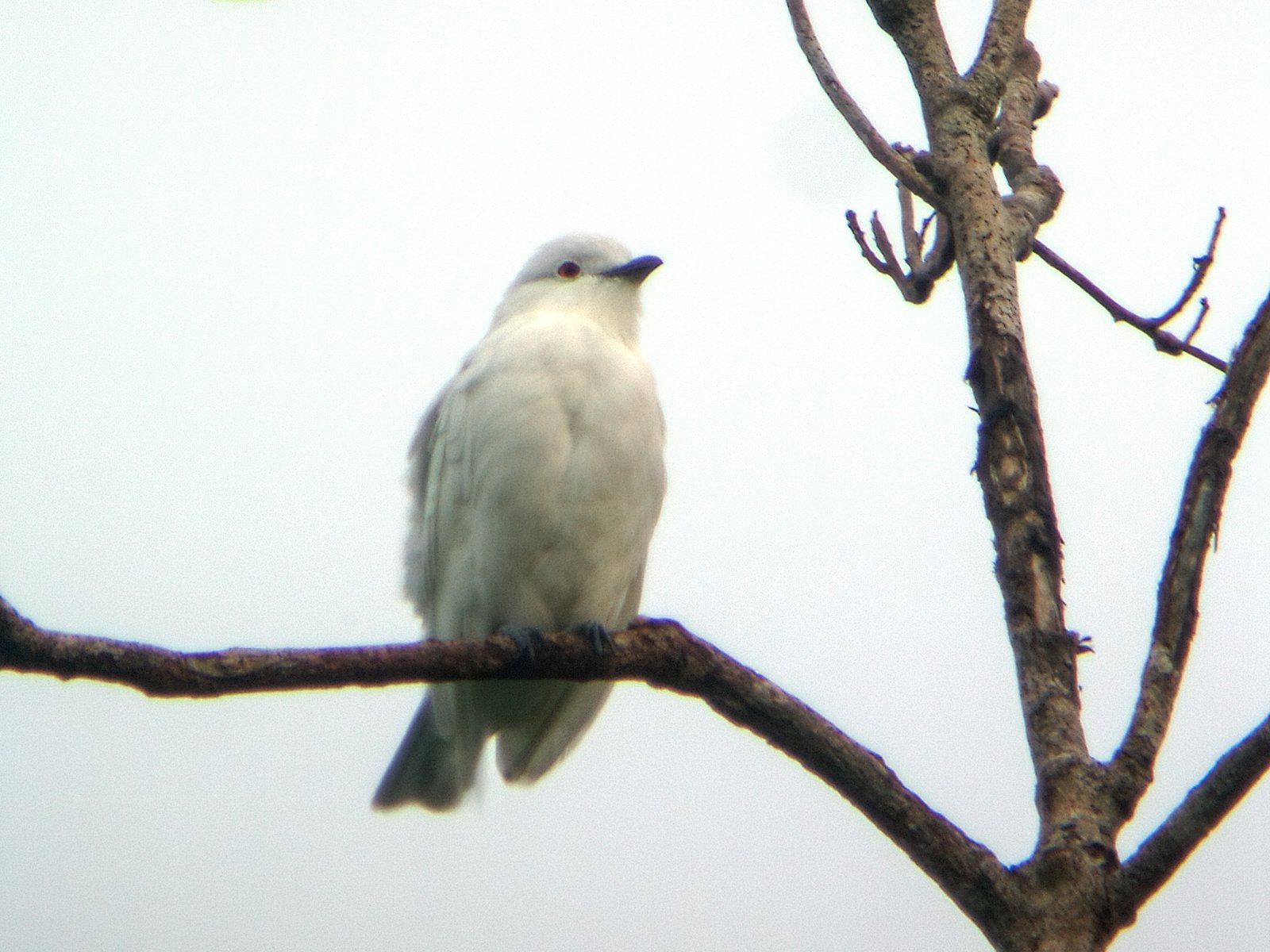
The Black-tipped Cotinga is a medium-sized cotinga of the Chocó rainforest along the Pacific coast. The male is entirely pure white, with only small black tips to the outer primaries. It often perches high in the crown of emergent trees, where a white dot in the green gives it away.
Voice
Largely silent; vocalizations are seldom heard.
Recording: Niels Krabbe — CC BY-NC-SA 4.0 · xeno-canto
Identification
24 cm, with a round head, a short, dark bill and a fairly short tail. The male is entirely white, with black tips to a few outer primaries and a dark eye. The female is pale grey above and whitish below, with darker grey wings and tail and white edges to the wing coverts and tertials. Young males at first resemble the female.
Confusion species
Snowy Cotinga Carpodectes nitidus of Central America lacks the black wingtips and is smaller; it does not occur in the guide area. Masked Tityra Tityra semifasciata and Black-crowned Tityra Tityra inquisitor are also largely white, but have much black in the wings, tail and on the head. In flight the male can resemble a white pigeon.
Habitat
The canopy and edges of humid lowland and foothill forest on the Pacific side, also forest edges and clearings with tall trees; mostly below 800 m. It eats mainly fruit, plucked in the crown or while fluttering. Little is known about its breeding.
Where the bird is most at home, classified by the vegetation units of the Andes and the west coast.


Range and movements
In Colombia in the Pacific lowlands, from Chocó south to Nariño. In Ecuador only in the north-west, mainly in Esmeraldas. Absent from Peru, Bolivia and the Galápagos. Outside the guide area in eastern Panama (Darién).
- Resident
- dark = core range, pale = thinly spread
How and when to look
In the Chocó lowlands of Esmeraldas and Pacific Colombia, scan the tops of tall trees from roads and viewpoints for a white bird. Females perch less openly and are overlooked more often.
Conservation status
Least Concern. The Chocó forest is being cleared locally for timber, farming and oil palm, but large parts are still forested.
Scientific name
Carpodectes hopkei | Berlepsch, 1897
Berlepsch described the species in 1897 and placed it straight away in the genus where it still stands. The genus Carpodectes was introduced in 1865 by Salvin. The genus name comes from Ancient Greek karpos, 'fruit', and dēktēs, 'biter'. The species name honours Gustav Hopke, a German collector in tropical America. The specimen the first description was based on came from San José, Río Dagua, Colombia.