All species › Passerines › Cotingas › Snowy Cotinga
Snowy Cotinga | Carpodectes nitidus
Sneeuwcotinga | Cotinga níveo | Cotinga-nívea
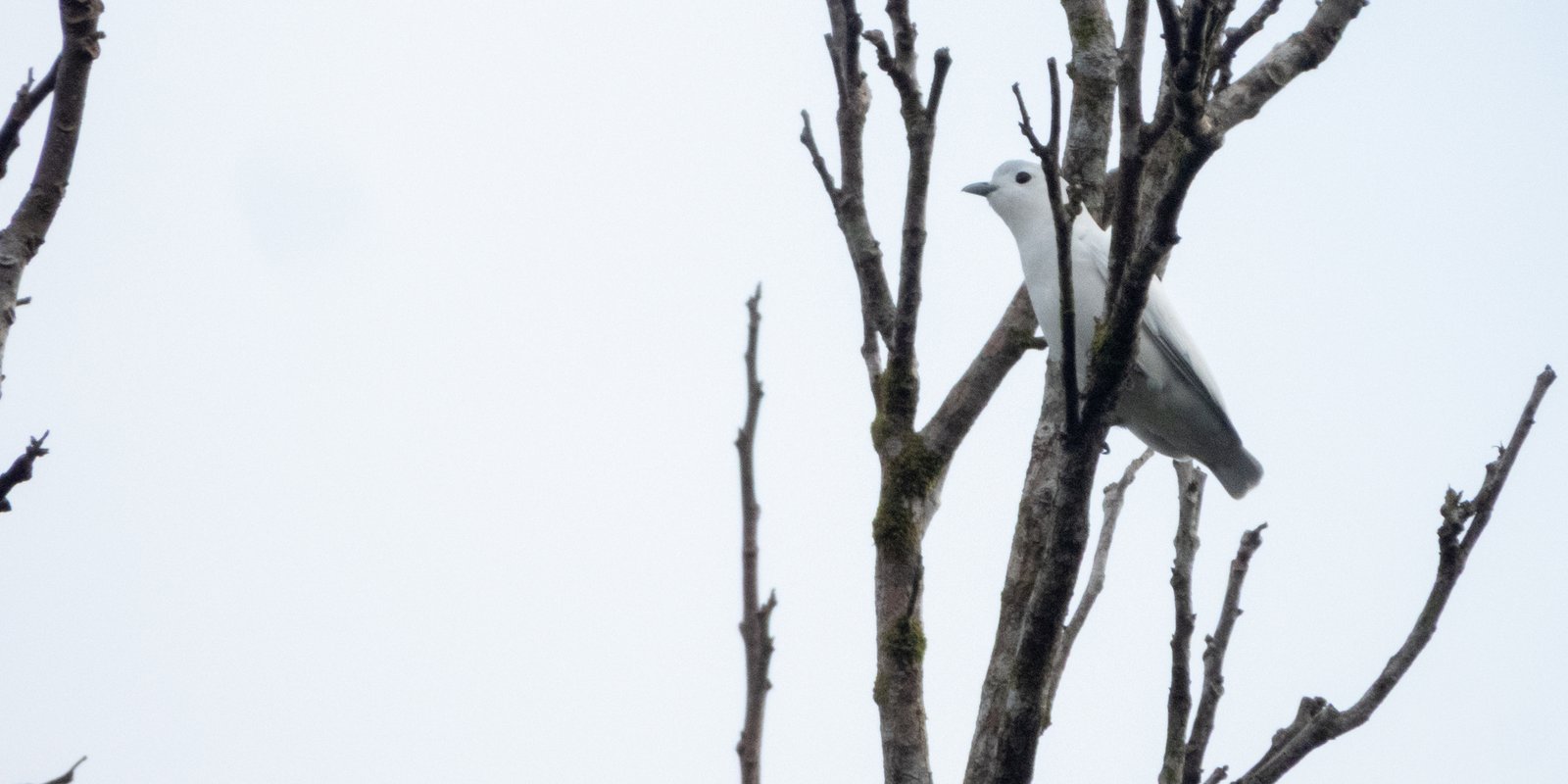
The Snowy Cotinga is a white cotinga of lowland rainforest on the Caribbean side of Central America. It does not occur in the guide area; the nearest birds live in western Panama. In the guide area it is replaced by the Black-tipped Cotinga of the Chocó.
Voice
Largely silent; vocalizations are seldom heard.
Recording: Brendan Sloan — CC BY-NC-SA 4.0 · xeno-canto
Identification
20 cm, with a round head, a short, dark bill and a dark eye. The male is entirely white, with a very faint bluish-grey wash on the upperparts and no black wingtips. The female is pale grey above and whitish below, with darker grey wings with white edges to the coverts and tertials.
Confusion species
Black-tipped Cotinga Carpodectes hopkei of the Chocó of Colombia and Ecuador is larger and the male has black tips to the outer primaries. Tityras, such as Masked Tityra Tityra semifasciata, have much black in the wings and tail.
Habitat
The canopy and edges of humid lowland and foothill forest on the Caribbean side, also clearings with tall, scattered trees; mostly below 750 m. It eats mainly fruit.
Where the bird is most at home, classified by the vegetation units of the Andes and the west coast.


Range and movements
Does not occur in Colombia, Ecuador, Peru, Bolivia or the Galápagos. Outside the guide area on the Caribbean side of Central America, from Honduras through Nicaragua and Costa Rica to western Panama.
- Resident
- dark = core range, pale = thinly spread
How and when to look
Not to be seen in the guide area. In Costa Rica and western Panama in the Caribbean lowlands, where it perches on tall, emergent trees.
Conservation status
Least Concern. Locally declining through clearance of lowland forest in Central America.
Scientific name
Carpodectes nitidus | Salvin, 1865
Salvin described the species in 1865 and placed it straight away in the genus where it still stands. He introduced the genus Carpodectes in that same work. The genus name comes from Ancient Greek karpos, 'fruit', and dēktēs, 'biter'. The species name is Latin nitidus, 'shining', for the gleaming white plumage. The specimen the first description was based on came from Tucurrique, Costa Rica.