All species › Passerines › Cotingas › Purple-throated Cotinga
Purple-throated Cotinga | Porphyrolaema porphyrolaema
Purperkeelcotinga | Cotinga golipúrpura | Cotinga-de-garganta-encarnada
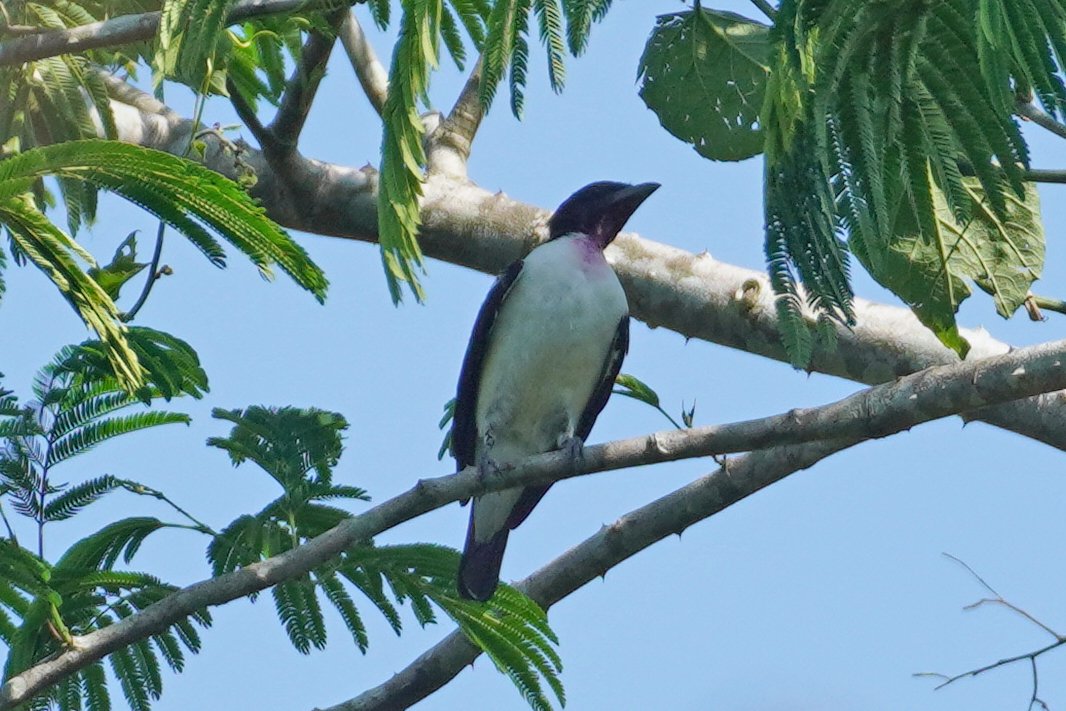
The Purple-throated Cotinga is a small, compact cotinga of the canopy in western Amazonia. The male is scaled black and white above and white below, with a deep purple throat. The species is scarce and patchily distributed throughout, and is usually seen perched high in a fruiting tree.
Voice
The male calls infrequently but loudly: a high, plaintive, falling whistle preeeeer of one to two seconds, repeated from a high perch. Also a tremulous werleeyoo.
Recording: John V. Moore — CC BY-NC-SA 4.0 · xeno-canto
Identification
16.5–18.5 cm, with a broad bill with an arched culmen and a square tail. The male is black above, with white fringes to the feathers of the back and wing coverts that give a scaled look; also a white wingstripe and white edges to the tertials. The throat is deep purple, the rest of the underparts white with some black barring on the rear flanks. The female is dark brown above with pale buff fringes, has an unbarred rufous throat and is cinnamon-buff below with black barring. The bill and legs are black, the iris dark brown.
Confusion species
The male Plum-throated Cotinga Cotinga maynana is turquoise blue with a purple throat and lacks the black-and-white pattern. The male Pompadour Cotinga Xipholena punicea has a wine-red body and white wings. Females of the cotingas of the genus Cotinga are greyish brown and scaled, without the rufous throat and the clear barring on the underparts.
Habitat
The canopy and edges of humid lowland forest, both terra firme and seasonally flooded várzea forest. Mostly below 400 m, locally to about 900 m. It eats mainly the fruit of forest trees, especially Cecropia, and occasionally small insects; it sometimes joins groups of other frugivores. Breeding is poorly known; the only nest described was high in a tree, in a fork of two horizontal branches.
Where the bird is most at home, classified by the vegetation units of the Andes and the west coast.


Range and movements
In Colombia in the south of the Amazonian lowlands. In Ecuador in the eastern lowlands. In Peru in the east, south to Madre de Dios. In Bolivia only in the extreme north-west. Absent from the Galápagos. Outside the guide area in western Brazil.
- Resident
- dark = core range, pale = thinly spread
How and when to look
Search from canopy towers and clearings with a view of the canopy, for example in eastern Ecuador or Madre de Dios. Listen for the high, falling whistle and then scan the bare tops of tall trees.
Conservation status
Least Concern. Scarce throughout, but the range is large and still largely forested.
Scientific name
Porphyrolaema porphyrolaema | (Deville & Sclater, 1852)
Deville & Sclater described the species in 1852 as Cotinga porphyrolaema; because it was later moved to another genus, the author and year stand in brackets. The genus Porphyrolaema was introduced in 1854 by Bonaparte. The genus name comes from Greek porphureos, 'purple', and laimos, 'throat'. The species name repeats the genus name: Greek porphureos, 'purple', and laimos, 'throat'. The specimen the first description was based on came from Sarayacu, Ucayali, Peru.