All species › Passerines › Cotingas › Long-wattled Umbrellabird
Long-wattled Umbrellabird | Cephalopterus penduliger
Ecuadoraanse parasolvogel | Pájaro paraguas longuipéndulo | Anambé-de-barbela-comprida
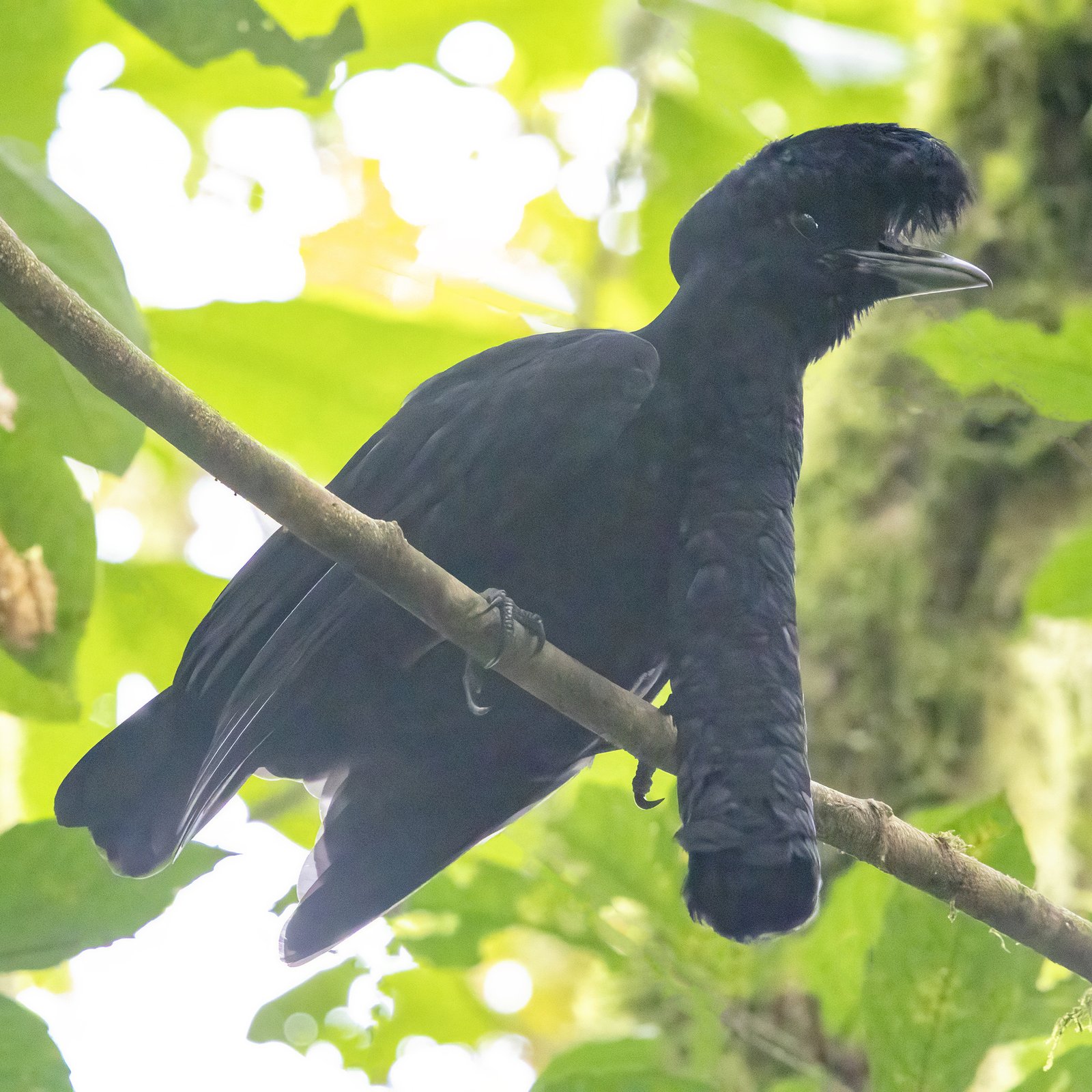
The Long-wattled Umbrellabird is a large, crow-like cotinga of the Chocó region. The male has a crest that falls like an umbrella over the bill and a long, feathered wattle on the breast. Males display at traditional sites in the forest, where they give deep, mooing sounds.
Voice
At the display site the male gives a deep, low, mooing boooo, reminiscent of a cow or a distant foghorn. Otherwise usually silent.
Recording: Olaf Jahn — CC BY-NC-SA 4.0 · xeno-canto
Identification
36–41 cm; the male is clearly larger than the female. Entirely black, with a bluish gloss. The male has a crest of hair-like feathers that falls forward over the bill, and a long, cylindrical wattle covered with short feathers that hangs down from the breast; in flight the wattle is retracted and held against the breast. The female has a smaller crest and a much shorter wattle. The eyes are dark and the bill is black.
Confusion species
Unmistakable within its range. Amazonian Umbrellabird Cephalopterus ornatus has a shorter wattle and lives east of the Andes, outside the range of this species. In flight the female may recall a crow or a large dark pigeon, but the crest and the undulating flight are distinctive.
Habitat
Humid, tall forest in the lowlands, foothills and lower slopes on the western side of the Andes, mainly in undisturbed forest but also at forest edges and in forest–farmland mosaics. It eats mainly fruit, including palm fruits, and also large insects and small lizards. The nest is a loose platform of twigs in a tree.
Where the bird is most at home, classified by the vegetation units of the Andes and the west coast.


Range and movements
Only in western Colombia and Ecuador: in Colombia on the Pacific side in the south-west; in Ecuador on the western slope of the Andes and in the adjacent lowlands, south to El Oro province. Absent from Peru, Bolivia and the Galápagos. Not known outside the guide area.
- Resident
- dark = core range, pale = thinly spread
How and when to look
Buenaventura Reserve near Piñas in El Oro, south-western Ecuador, has a well-known display site where males can be seen and heard early in the morning.
Conservation status
Vulnerable. Much of the forest in western Ecuador and Colombia has been cleared, and the remaining populations are small and fragmented. The species is also hunted locally.
Scientific name
Cephalopterus penduliger | Sclater, 1859
Sclater described the species in 1859 and placed it straight away in the genus where it still stands. The genus Cephalopterus was introduced in 1809 by Geoffroy Saint-Hilaire. The genus name comes from Ancient Greek kephalē, 'head', and pteron, 'feather' or 'wing', for the umbrella-shaped crest. The species name comes from Latin pendulus, 'hanging', and -ger, 'bearing', for the long hanging wattle on the breast. The specimen the first description was based on came from Pallatanga, Chimborazo, Ecuador.