All species › Passerines › Cotingas › Amazonian Umbrellabird
Amazonian Umbrellabird | Cephalopterus ornatus
Amazoneparasolvogel | Pájaro paraguas amazónico | Anambé-preto
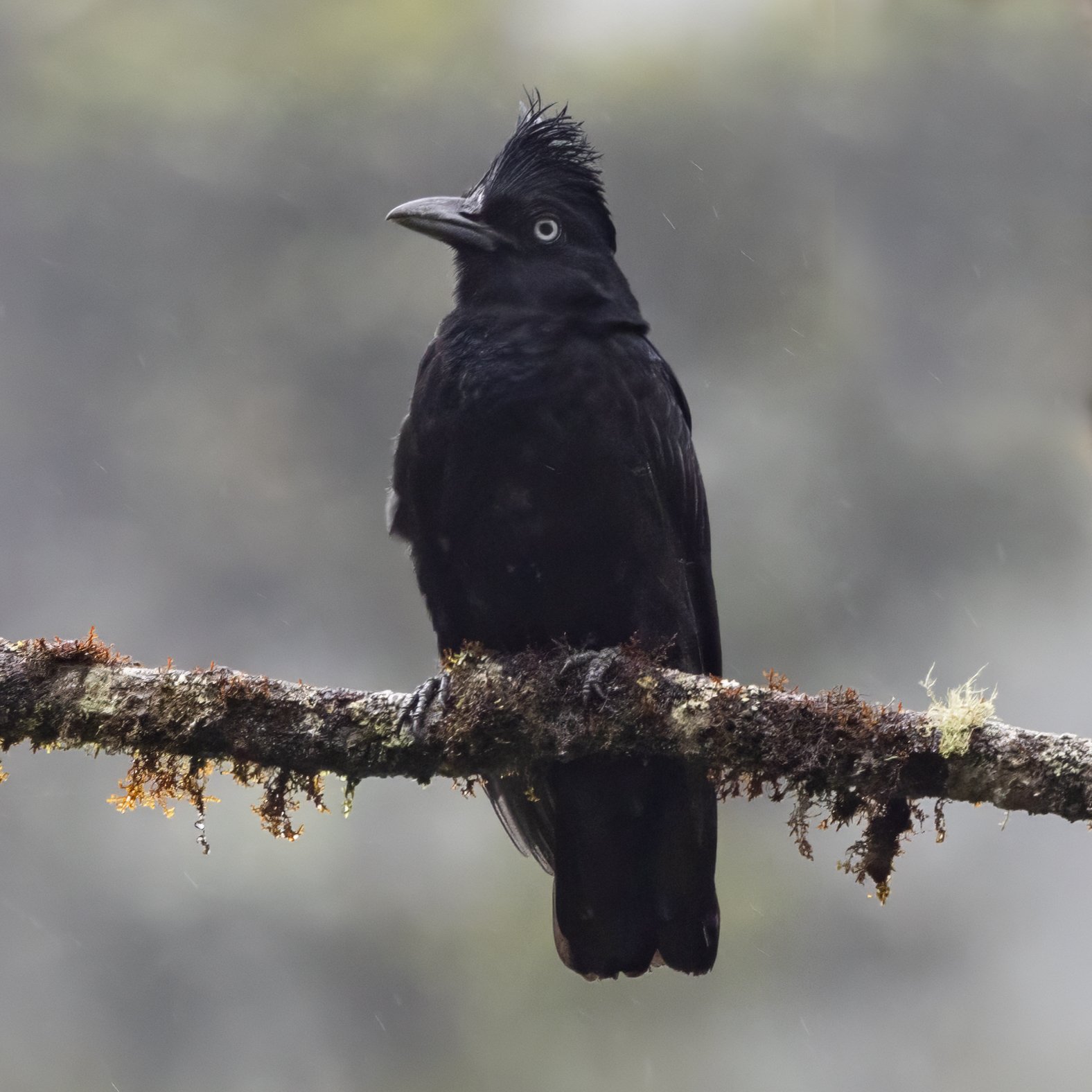
The Amazonian Umbrellabird is the largest cotinga of Amazonia, a black, crow-like bird with a crest that falls like an umbrella over the bill. It lives mainly on river islands and along rivers, and in the foothills of the Andes. Males display with raised crest and extended wattle and give a deep, booming sound.
Voice
At the display site the male gives a deep, low, booming boooo, thrusting the head forward and extending the wattle. Otherwise usually silent.
Recording: John V. Moore — CC BY-NC-SA 4.0 · xeno-canto
Identification
41–51 cm; the male is clearly larger than the female. Entirely black, with a bluish gloss. The male has a large crest of hair-like feathers with white shafts, which falls forward over the bill, and a fairly short, feathered wattle on the breast. The female has a smaller crest and a shorter wattle. The iris is pale grey to white, the bill black. It flies with an undulating flight, with slow, deep wingbeats.
Confusion species
Long-wattled Umbrellabird Cephalopterus penduliger has a much longer wattle and a dark iris, and lives west of the Andes. Purple-throated Fruitcrow Querula purpurata is much smaller, without a crest; the male has a purple-red throat. Bare-necked Fruitcrow Gymnoderus foetidus has a bare neck and no crest. Greater Ani Crotophaga major is smaller, with a long tail and a high, arched bill.
Habitat
Forest on river islands, riverine forest, várzea and forest edges along rivers in the lowlands, and humid foothill forest on the eastern slope of the Andes up to roughly 1300 m. It feeds mainly on fruit, including palm fruits, and also on large insects and small vertebrates. The nest is a loose platform of twigs in a tree.
Where the bird is most at home, classified by the vegetation units of the Andes and the west coast.


Range and movements
In Colombia in the lowlands east of the Andes. In Ecuador in the eastern lowlands and foothills. In Peru in the eastern lowlands and foothills from north to south. In Bolivia in the lowlands and foothills of the north and centre. Absent from the Galápagos. Outside the guide area in southern Venezuela, Guyana and Amazonian Brazil.
- Resident
- dark = core range, pale = thinly spread
How and when to look
During boat trips along large rivers look for birds flying from islands to the bank, for example along the Río Napo in Ecuador or in Manu in Peru; in the foothills display sites are known along the mountain roads on the eastern slope.
Conservation status
Least Concern. The species lives scattered at low densities and is hunted locally; foothill and riverine forest is being cleared in parts of the range.
Scientific name
Cephalopterus ornatus | Geoffroy Saint-Hilaire, 1809
Geoffroy Saint-Hilaire described the species in 1809 and placed it straight away in the genus where it still stands. He introduced the genus Cephalopterus in that same work. The genus name comes from Ancient Greek kephalē, 'head', and pteron, 'feather' or 'wing', for the umbrella-shaped crest. The species name is Latin ornatus, 'adorned', for the large crest. The specimen the first description was based on came from Barcelos, Amazonas, Brazil.