All species › Passerines › Cotingas › Capuchinbird
Capuchinbird | Perissocephalus tricolor
Capuchonvogel | Pájaro capuchino | Maú
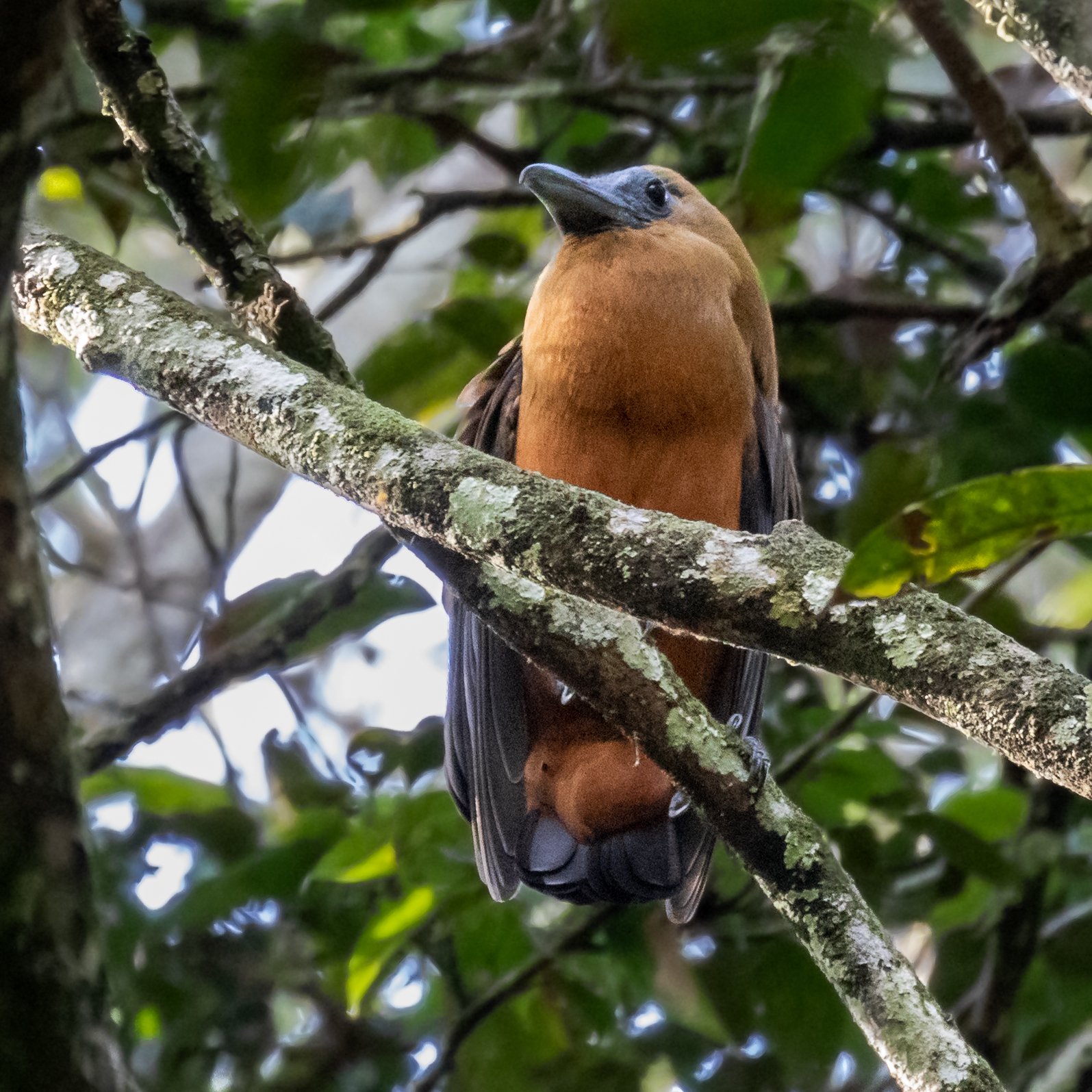
The Capuchinbird is a large, rufous-brown cotinga with a bare, bluish-grey head, of the lowland forest of north-eastern South America. Males display in small groups at fixed sites in the canopy, where they give a long, lowing sound. In the guide area the species occurs only in the far east of Colombia, at the edge of its range.
Voice
At the display site a long, deep, lowing sound that starts with a growling grrr and passes into a swelling aaaaa-oooooo, likened to a lowing cow or a distant chainsaw. Otherwise usually silent.
Recording: Tristan Guillebot de Nerville — CC BY-NC-SA 4.0 · xeno-canto
Identification
34–36 cm, with a heavy, dark bill and a short tail. The head and the front of the neck are bare, with bluish-grey skin, so that the edge of the feathering lies like a hood over the nape. The body and underparts are cinnamon to rufous-brown, the wings and tail blackish. Displaying males show orange, fluffy feathers on either side of the rump. The sexes are otherwise alike.
Confusion species
Virtually unmistakable in the guide area. Screaming Piha Lipaugus vociferans is smaller and grey, with a feathered head. Bare-necked Fruitcrow Gymnoderus foetidus also has a bare neck, but is black or dark grey.
Habitat
Mid-storey and canopy of humid lowland terra firme forest, mainly in undisturbed forest, up to roughly 1000 m. It feeds mainly on fruit and also on large insects. The nest is a small, loose platform of twigs in a tree; the female incubates and cares for the young alone.
Where the bird is most at home, classified by the vegetation units of the Andes and the west coast.


Range and movements
In the guide area only in the far east of Colombia, mainly in Guainía and locally in eastern Vichada. Absent from Ecuador, Peru, Bolivia and the Galápagos. Outside the guide area in southern and eastern Venezuela, the Guianas and northern Amazonian Brazil, north of the Amazon; most of the map lies there.
- Resident
- dark = core range, pale = thinly spread
How and when to look
In eastern Colombia display sites are visited in the forest around Inírida in Guainía; males are most active early in the morning and can then be found by their sound.
Conservation status
Least Concern. The range is large and largely forested; locally the species suffers from deforestation.
Scientific name
Perissocephalus tricolor | (Müller, 1776)
Müller described the species in 1776 as Corvus tricolor; because it was later moved to another genus, the author and year stand in brackets. The genus Perissocephalus was introduced in 1899 by Oberholser. The genus name comes from Greek perissos, 'extraordinary, strange', and kephalē, 'head', after the bare, hood-like head. The species name is Latin tricolor, 'three-coloured'. The specimen the first description was based on came from Cayenne, French Guiana.