All species › Passerines › Cotingas › Red-ruffed Fruitcrow
Red-ruffed Fruitcrow | Pyroderus scutatus
Roodkraagvruchtenkraai | Cuervo higuero golirrojo | Pavó
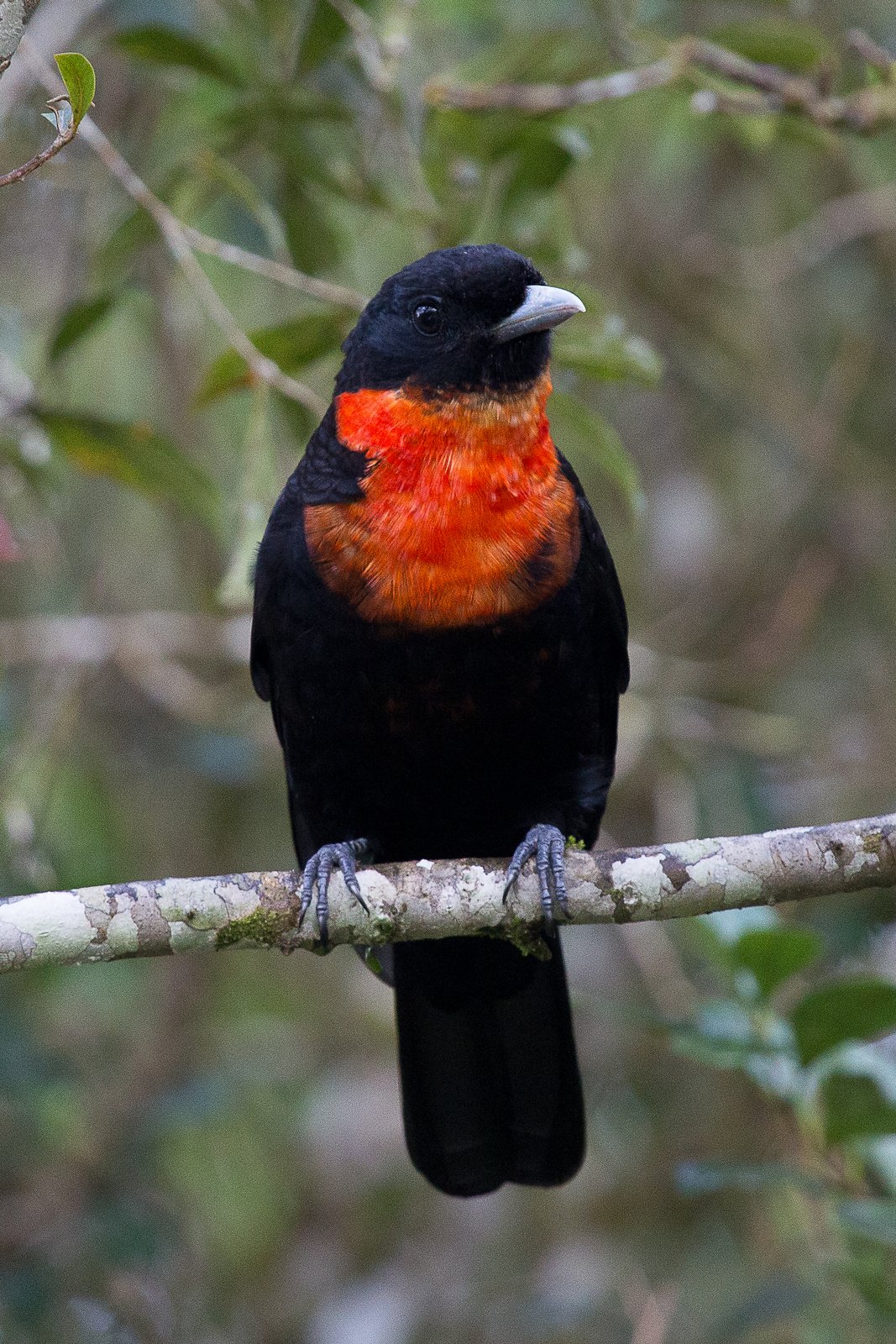
The Red-ruffed Fruitcrow is the largest cotinga of the Andes: a crow-like black bird with a glossy orange-red bib. It occurs patchily and locally in montane forest and is usually scarce. Males gather at display sites, where they give deep, booming sounds with the bib puffed out.
Voice
At the display site males give a deep, booming hoot, with the bib puffed out and the body leaning forward. Otherwise usually silent.
Recording: Rodrigo Dela Rosa — CC BY-NC-SA 4.0 · xeno-canto
Identification
38–46 cm; the male is larger than the female. The plumage is mostly black. The throat and upper breast form a large, glossy orange-red to reddish-orange bib of crinkled feathers. The bill is broad and bluish grey. In the Andes the belly is black; birds in south-eastern Brazil have a chestnut-spotted belly. The sexes are alike in colour.
Confusion species
Unlikely to be confused within its range. Purple-throated Fruitcrow Querula purpurata is smaller, lives in the lowlands, and the male has a purplish-red throat patch. Bare-necked Fruitcrow Gymnoderus foetidus of the Amazonian lowlands has a bare, blue neck. The female Andean Cock-of-the-Rock Rupicola peruvianus is dark rusty brown, with a crest on the head.
Habitat
Humid montane forest, mainly at middle elevations, and also forest edges and tall trees in semi-open country. It eats mainly fruit, plucked in the canopy, and also large insects.
Where the bird is most at home, classified by the vegetation units of the Andes and the west coast.


Range and movements
In Colombia scattered and local in the Andes; in Ecuador very rare and local; in Peru local on the eastern slope of the Andes. Not known with certainty from Bolivia. Absent from the Galápagos. Outside the guide area in the mountains of Venezuela and Guyana, and in the Atlantic Forest of south-eastern Brazil, eastern Paraguay and north-eastern Argentina.
- Resident
- dark = core range, pale = thinly spread
How and when to look
Scarce and unpredictable; the best chance is at fruiting trees in montane forest in Colombia. The booming sound of displaying males gives away display sites.
Conservation status
Least Concern, but scarce and local in the Andes. The species suffers from deforestation and is hunted locally.
Scientific name
Pyroderus scutatus | (Shaw, 1792)
Shaw described the species in 1792 as Coracias scutata; because it was later moved to another genus, the author and year stand in brackets. The genus Pyroderus was introduced in 1840 by Gray. The genus name comes from Greek pur, 'fire', and derē, 'neck', after the fiery red throat ruff. The species name is Latin scutatus, 'shielded', after the red breast patch. The specimen the first description was based on came from Nova Friburgo, Rio de Janeiro, Brazil.