All species › Passerines › Cotingas › Purple-throated Fruitcrow
Purple-throated Fruitcrow | Querula purpurata
Purperkeelvruchtenkraai | Cotinga quérula | Anambé-una
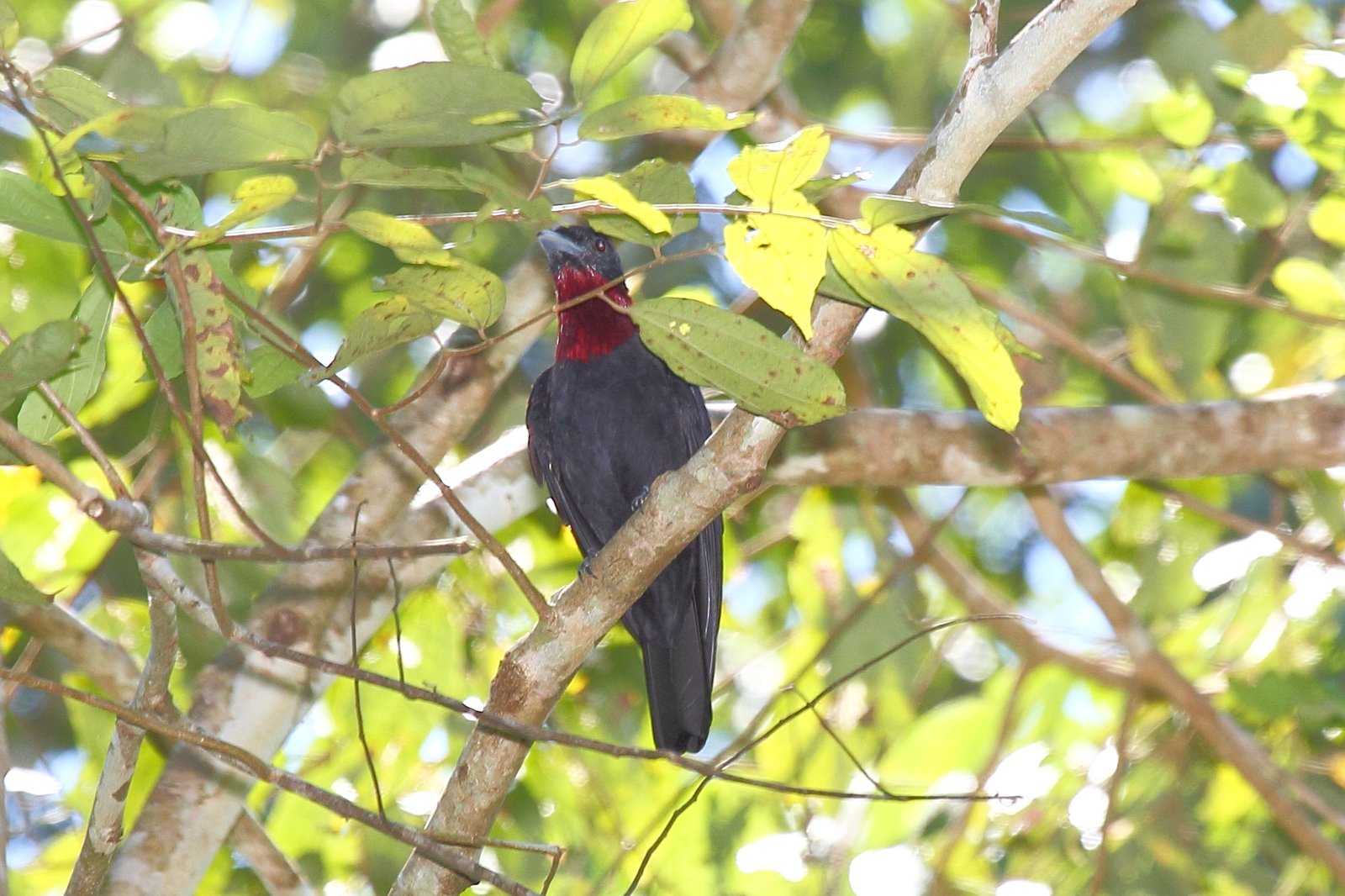
The Purple-throated Fruitcrow is a black cotinga of the mid-storey and canopy of humid lowland forest. It lives in noisy groups of three to six birds, which tend a nest together. The male has a purple-red throat patch, which it flares when excited.
Voice
Very vocal. Groups give loud, hollow, whistled notes, roughly koo-wáoo and oo-waa, often in chorus, as well as short, harsh calls.
Recording: JAYRSON ARAUJO DE OLIVEIRA — CC BY-NC-SA 4.0 · xeno-canto
Identification
25–30 cm; the male is larger than the female. Entirely dull black, with a broad, bluish-grey bill and broad, rounded wings. The male has a glossy purple-red throat, whose feathers are flared sideways when excited. The female and young birds are entirely black, without a throat patch.
Confusion species
Red-ruffed Fruitcrow Pyroderus scutatus is larger, with an orange-red throat and breast and a rufous belly, and lives in montane forest. Bare-necked Fruitcrow Gymnoderus foetidus has a bare, bluish-grey neck and silvery-grey wings (male) and often flies high over rivers. Black Caracara Daptrius ater and Red-throated Caracara Ibycter americanus are larger, with bare orange-red or red facial skin; Red-throated Caracara also lives in noisy groups. Greater Ani Crotophaga major has a long tail and a high, arched bill.
Habitat
Mid-storey and canopy of humid lowland terra firme and flooded forest, forest edges and mature second growth, from the lowlands to roughly 1000 m in the foothills. It feeds on fruit and large insects, which it often snatches from leaves in flight. It breeds cooperatively; the nest is a small, shallow platform high in a tree, and several group members feed the young.
Where the bird is most at home, classified by the vegetation units of the Andes and the west coast.


Range and movements
In Colombia in the lowlands of the Pacific coast and the north, and in the lowlands east of the Andes. In Ecuador in the north-western lowlands (Esmeraldas) and in the eastern lowlands. In Peru throughout the eastern lowlands. In Bolivia in the lowlands of the north and centre. Absent from the Galápagos. Outside the guide area from Nicaragua to Panama, in Venezuela, the Guianas and Amazonian Brazil.
- Resident
- dark = core range, pale = thinly spread
How and when to look
Listen in lowland forest for the hollow, whistled choruses of a group; from canopy towers at the forest lodges in the Amazonian lowlands of Ecuador and Peru groups can be followed in the canopy.
Conservation status
Least Concern. The species has a large range, but depends on large, continuous forest and disappears where the forest becomes fragmented.
Scientific name
Querula purpurata | (Müller, 1776)
Müller described the species in 1776 as Muscicapa purpurata; because it was later moved to another genus, the author and year stand in brackets. The genus Querula was introduced in 1816 by Vieillot. The genus name comes from Latin querulus, 'complaining, plaintive', after the calls. The species name is Latin purpuratus, 'clad in purple', after the male's purple throat. The specimen the first description was based on came from Cayenne, French Guiana.