All species › Passerines › Cotingas › Chestnut-crested Cotinga
Chestnut-crested Cotinga | Ampelion rufaxilla
Roodkopcotinga | Cotinga cresticastaña | Cotinga-de-crista-castanha
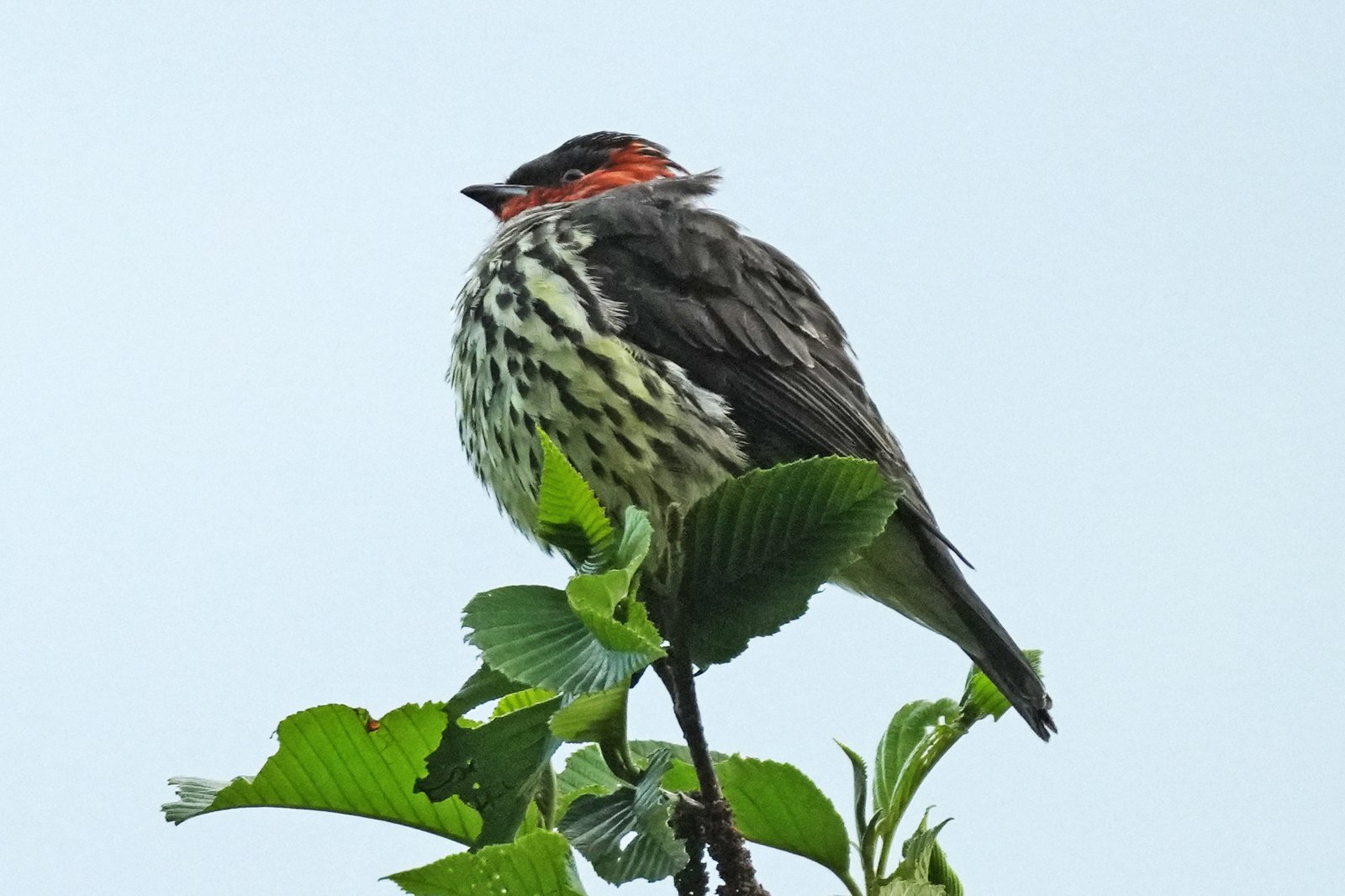
The Chestnut-crested Cotinga is a cotinga of montane forest at middle elevations, with a rufous face, a long chestnut crest and a yellow, streaked belly. It often sits quietly in the canopy or at the forest edge. On average it lives lower than the related Red-crested Cotinga.
Voice
The song is a quiet, deep, nasal croak, often with a stuttered introduction. The call is a single, nasal, croaking note. During display flights the wings make audible beats on the ascent and a braking whoosh on the descent.
Recording: Iván Lau — CC BY-NC-SA 4.0 · xeno-canto
Identification
20–23 cm, with a short, thick, bluish-grey bill with a black tip and a red iris. The crown is black, with a long, chestnut central crest. The face, nape and throat are chestnut, the upper breast is grey. The lower breast and belly are yellow, streaked black except in the centre of the belly. The upperparts are olive-grey with dark streaks, the wings and tail blackish, with chestnut wing coverts. The sexes are alike. Birds from Colombia (A. r. antioquiae) are larger, darker rufous and more heavily streaked.
Confusion species
Red-crested Cotinga Ampelion rubrocristatus usually lives higher, is grey, with a dark head, white streaks on the rump and undertail coverts and a white tail band, and has no yellow. Barred Fruiteater Pipreola arcuata is green, with a red bill and fine black barring on the underparts. In poor light the species may recall a large tyrant flycatcher or a thrush, but the crest and the yellow, streaked belly are distinctive.
Habitat
Humid montane forest, forest edges, clearings and mature second growth, in Colombia roughly between 1800 and 2800 m, in Peru between 1700 and 2800 m and in Bolivia between 1300 and 3000 m. It feeds mainly on fruit, including mistletoe berries. Little is known about the nest.
Where the bird is most at home, classified by the vegetation units of the Andes and the west coast.


Range and movements
In Colombia locally in the Central Andes, from Antioquia to Huila, and in the Western Andes in Valle del Cauca and Cauca. In Ecuador rare: perhaps in the far north, in Sucumbíos, and on the eastern slope from southern Zamora-Chinchipe southwards. In Peru on the eastern slope of the Andes from north to south. In Bolivia on the eastern slope, south to Cochabamba. Absent from the Galápagos. Not known outside the guide area.
- Resident
- dark = core range, pale = thinly spread
How and when to look
Look in the canopy and at the edges of montane forest at middle elevations for birds sitting quietly on a projecting branch; in Colombia for example at Río Blanco Reserve near Manizales, in Peru along the mountain roads on the eastern slope.
Conservation status
Least Concern. The species is local and usually seen in low numbers; montane forest at middle elevations is being converted to farmland in many areas.
Scientific name
Ampelion rufaxilla | (Tschudi, 1844)
Tschudi described the species in 1844 and placed it straight away in the genus where it still stands. The genus Ampelion was introduced in 1845 by Tschudi. The genus name comes from Latin ampelion, from Greek ampeliōn, an unidentified small bird mentioned by Dionysius. The species name comes from Latin rufus, 'rufous', and axilla, 'armpit', for the rufous axillaries. The specimen the first description was based on came from Vitoc Valley, Junín, Peru.