All species › Passerines › Cotingas › Red-crested Cotinga
Red-crested Cotinga | Ampelion rubrocristatus
Roodkuifcotinga | Cotinga crestirroja | Cotinga-de-crista-vermelha
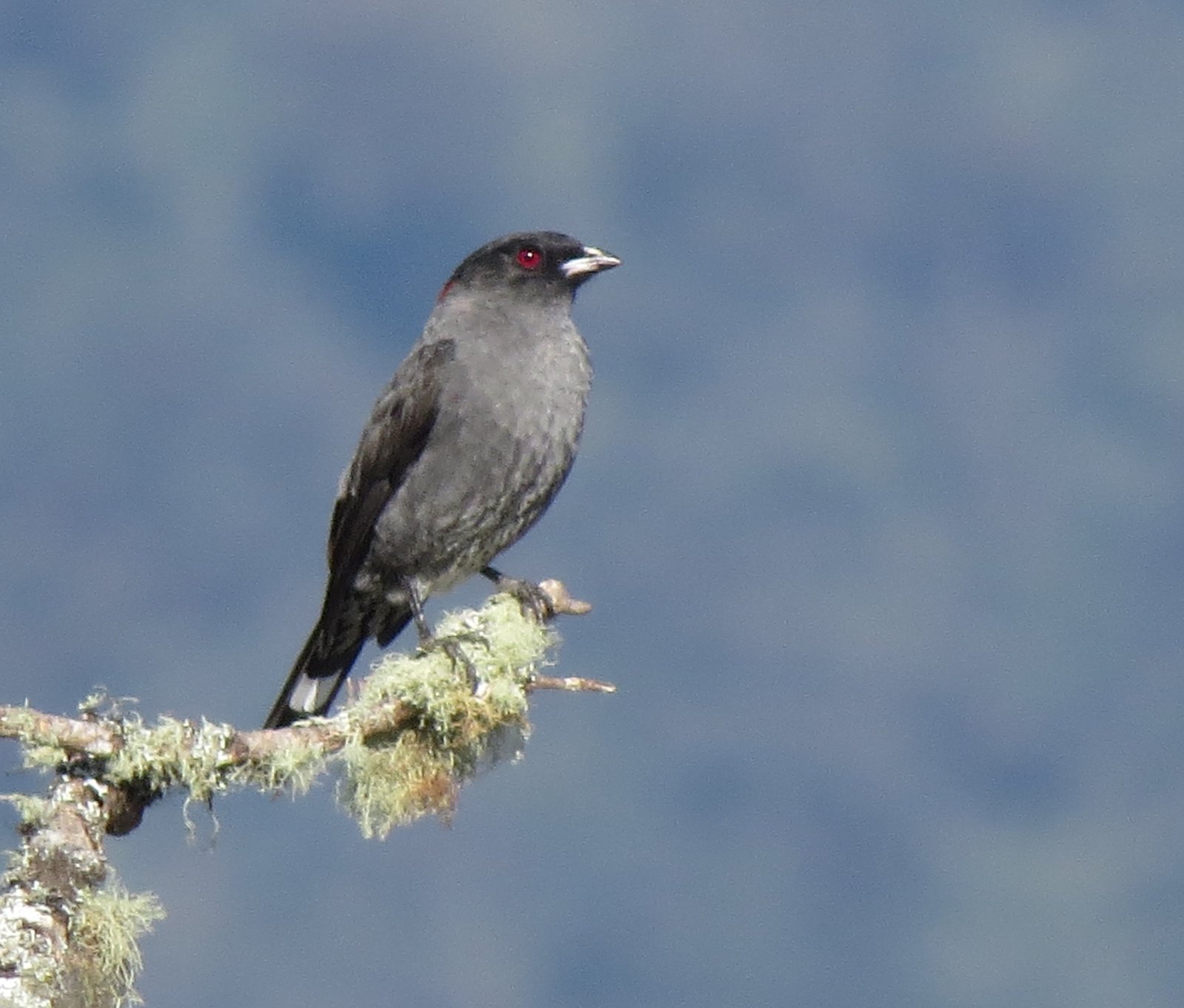
The Red-crested Cotinga is a grey cotinga of the higher Andes that often sits for long periods upright on top of a shrub or small tree at the forest edge. It has a flat, rufous crest that it raises when excited. It is the most widespread cotinga of the treeline, from Venezuela to Bolivia.
Voice
Usually silent. Sometimes a low, croaking, frog-like rattle, roughly rrrrrt, and soft, nasal notes.
Recording: Niels Krabbe — CC BY-SA 4.0 · xeno-canto
Identification
21–23 cm, with a short, thick, whitish bill with a black tip and a red iris. The head is dark, almost black, with a long, flat, chestnut-red crest that usually lies against the hindcrown. The back and breast are grey, and the rump and undertail coverts are streaked white. The wings are blackish, and the tail is black with a broad white band across the underside, visible when the bird flies off. The sexes are alike. Young birds are browner and more heavily streaked, with a smaller crest.
Confusion species
Chestnut-crested Cotinga Ampelion rufaxilla usually lives lower, and has a rufous face and throat and a yellow, black-streaked belly. Chestnut-bellied Cotinga Doliornis remseni and Bay-vented Cotinga Doliornis sclateri have a dark bill, a chestnut belly or vent and no white tail band. Great Thrush Turdus fuscater is larger and browner, with an orange bill and orange legs.
Habitat
Upper cloud forest, forest edges, elfin forest at the treeline, Polylepis woodland, scrub and hedges between pastures and fields, roughly between 2500 and 3900 m. It feeds mainly on fruit, including mistletoe berries, and also on leaves and insects. The nest is a shallow platform of twigs and moss in a tree.
Where the bird is most at home, classified by the vegetation units of the Andes and the west coast.


Range and movements
In Colombia in all three Andean ranges. In Ecuador on both slopes of the Andes and in the inter-Andean valleys. In Peru in the Andes over most of the country, on the eastern and western slopes. In Bolivia in the Andes of La Paz and Cochabamba. Absent from the Galápagos. Outside the guide area in the Andes of Venezuela.
- Resident
- dark = core range, pale = thinly spread
How and when to look
In the higher Andes look for grey birds sitting upright at the top of a shrub or small tree at the forest edge; in Ecuador for example at Yanacocha Reserve and around Papallacta. When the bird flies off, the white tail band stands out.
Conservation status
Least Concern. The species also lives in forest remnants and hedges in the farmland of the higher Andes.
Scientific name
Ampelion rubrocristatus | (d'Orbigny, ACVMD & de Lafresnaye, 1837)
D'Orbigny, ACVMD & de Lafresnaye described the species in 1837 and placed it straight away in the genus where it still stands. The genus Ampelion was introduced in 1845 by Tschudi. The genus name comes from Latin ampelion, from Greek ampeliōn, an unidentified small bird mentioned by Dionysius. The species name comes from Latin ruber, 'red', and cristatus, 'crested', for the red crest. The specimen the first description was based on came from Ayopaya, Cochabamba, Bolivia.