All species › Passerines › Cotingas › Chestnut-bellied Cotinga
Chestnut-bellied Cotinga | Doliornis remseni
Kastanjebuikcotinga | Cotinga ventricastaña | Cotinga-de-barriga-castanha
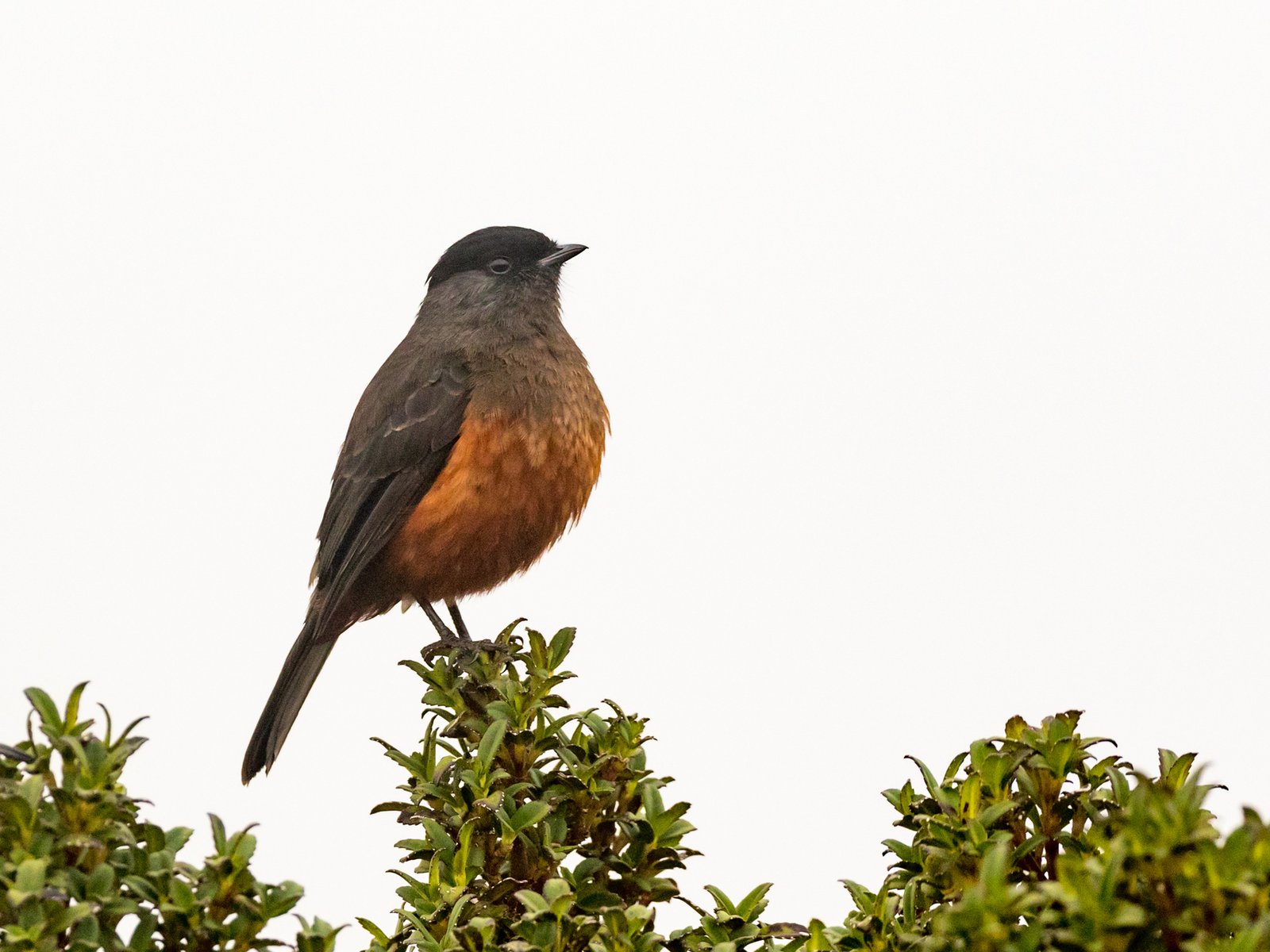
The Chestnut-bellied Cotinga is a dark cotinga of the elfin forest at the treeline in the northern Andes, described to science only in 1994. It lives scattered and local at the transition from cloud forest to páramo. Pairs often sit quietly at the top of a shrub.
Voice
Usually silent. The call is a raspy, single, overslurred note, roughly rrreh, repeated at intervals.
Recording: Juan Pablo López-O. — CC BY-NC-SA 4.0 · xeno-canto
Identification
21 cm, with a fairly long tail and a short, dark bill. The male has a black crown and nape with a usually hidden dark orange-red crest; the rest of the head is dark grey. The upperparts, wings and tail are blackish, the breast is dark grey, and the belly, flanks and undertail coverts are deep chestnut. The female has an entirely dark grey head with paler feather edges and is otherwise similar. The iris is dark reddish brown; the bill and legs are dark.
Confusion species
Red-crested Cotinga Ampelion rubrocristatus shares the habitat, but has a whitish bill with a black tip, a grey belly with white streaks on the undertail coverts, and a white band across the underside of the tail. Bay-vented Cotinga Doliornis sclateri has rufous only on the undertail coverts and lives farther south, in central Peru. Great Thrush Turdus fuscater is larger and browner, with an orange bill and orange legs.
Habitat
Elfin forest, scrub and the upper edge of cloud forest at and just below the treeline, with adjacent páramo, in Ecuador roughly between 2900 and 3500 m, in Colombia up to 3700 m. It feeds mainly on fruit, including mistletoe berries, and also on leaves. Little is known about the nest.
Where the bird is most at home, classified by the vegetation units of the Andes and the west coast.


Range and movements
In Colombia locally in the south, mainly in Putumayo and Nariño, with more recent records from the Central Andes (Quindío, Tolima). In Ecuador scattered on the eastern slope of the Andes, from the north to the border with Peru. In Peru only a few records, or expected, in the far north on the border with Ecuador. Absent from Bolivia and the Galápagos. Not known outside the guide area.
- Resident
- dark = core range, pale = thinly spread
How and when to look
Search along trails that cross the treeline, such as in Podocarpus National Park in southern Ecuador, in the early morning for pairs sitting quietly at the top of shrubs.
Conservation status
Near Threatened. The species lives in a narrow elevational zone that is damaged by fires and grazing in the páramo and by the cutting of elfin forest; the population is small and fragmented.
Scientific name
Doliornis remseni | Robbins, Rosenberg & Sornoza-Molina, 1994
Robbins, Rosenberg & Sornoza-Molina described the species in 1994 and placed it straight away in the genus where it still stands. The genus Doliornis was introduced in 1874 by Taczanowski. The genus name comes from Ancient Greek dolios, 'crafty', and ornis, 'bird'. The species name honours J. V. Remsen Jr., an American ornithologist at Louisiana State University who has worked extensively on Andean birds. The specimen the first description was based on came from Cerro Mongus, Carchi, Ecuador.