All species › Passerines › Cotingas › Barred Fruiteater
Barred Fruiteater | Pipreola arcuata
Gebandeerde cotinga | Frutero barreteado | Anambé-barrado
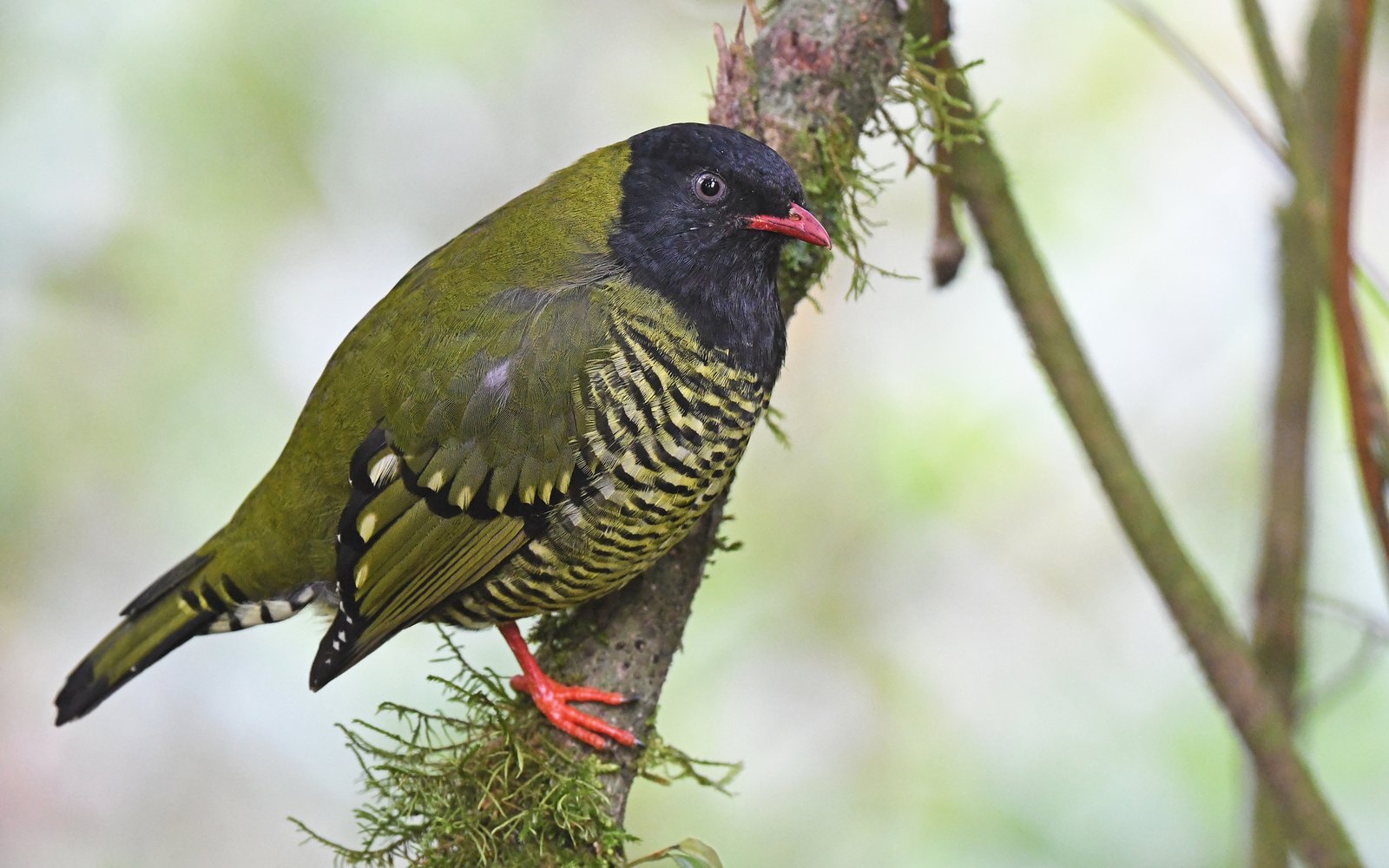
The Barred Fruiteater is the largest member of the genus Pipreola and lives higher than the others, in cloud forest up to just below the treeline. It often sits still for long periods and is then noticed mainly by its very high, drawn-out call. The finely barred underparts are the key feature in both sexes.
Voice
A very high, thin, drawn-out whistle, roughly seeeeeeeeyy, falling slightly at the end, repeated at long intervals.
Recording: Rolf A. de By — CC BY-NC-SA 4.0 · xeno-canto
Identification
22–23 cm, a large, plump bird with a red bill and red legs. The male has a glossy black head, throat and upper breast; the upperparts are olive green. The rest of the underparts is yellow with dense, fine black barring. The tertials and wing coverts have pale yellowish spots at the tips, and the tail has a black subterminal band with whitish tips. The female has a green head and is barred black and yellow from throat to undertail.
Confusion species
Band-tailed Fruiteater Pipreola intermedia and Green-and-black Fruiteater Pipreola riefferii are smaller, with streaked and scaled rather than finely barred underparts; the male has a yellow border below the black throat. Scaled Fruiteater Ampelioides tschudii has scaled plumage, a yellow collar and a dark bill, and lives lower down.
Habitat
Humid cloud forest and upper montane forest up to the treeline, also elfin forest and forest edges, at roughly 2000 to 3500 m. It eats mainly fruit and berries, and also insects. It often sits quietly in the middle storey and sometimes joins mixed flocks.
Where the bird is most at home, classified by the vegetation units of the Andes and the west coast.


Range and movements
In Colombia in all three cordilleras. In Ecuador on the western and eastern slopes of the Andes. In Peru on the eastern slope from north to south. In Bolivia in the Yungas of La Paz and Cochabamba. Absent from the Galápagos. Outside the guide area in the Andes of western Venezuela.
- Resident
- dark = core range, pale = thinly spread
How and when to look
In high cloud forest near the treeline, such as at Yanacocha above Quito in Ecuador, listen for the drawn-out high call and then scan the middle storey for a large, motionless bird.
Conservation status
Least Concern. Fairly common in suitable high cloud forest; locally declining through clearance and fires near the treeline.
Scientific name
Pipreola arcuata | (de Lafresnaye, 1843)
De Lafresnaye described the species in 1843 as Ampelis arcuata; because it was later moved to another genus, the author and year stand in brackets. The genus Pipreola was introduced in 1838 by Swainson. The genus name is a Latin diminutive of the genus Pipra (manakins). The species name is Latin arcuatus, 'arched, curved', after the curved barring. The specimen the first description was based on came from Bogotá, Colombia.