All species › Passerines › Cotingas › Band-tailed Fruiteater
Band-tailed Fruiteater | Pipreola intermedia
Zwartkopcotinga | Frutero colifajado | Anambé-de-cauda-barrada
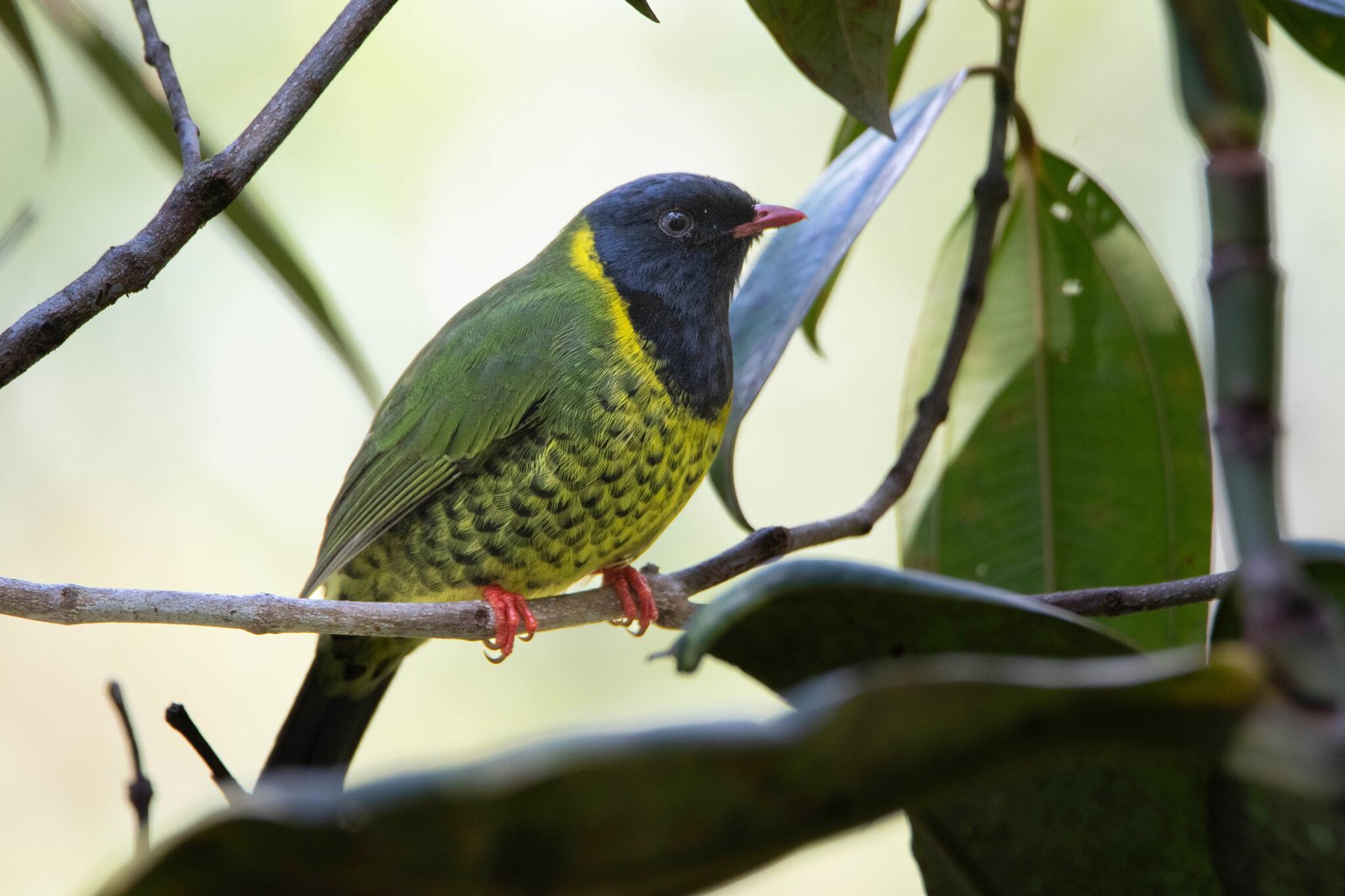
The Band-tailed Fruiteater is a green fruit-eater of high cloud forest in Peru and Bolivia. There it partly replaces Green-and-black Fruiteater, with which it occurs together in central Peru. The feature the English name refers to, the black-and-white terminal tail band, is present in both sexes.
Voice
Very high, thin, hissing tseeee notes, sometimes in a short, rising series.
Recording: Jacob Wijpkema — CC BY-NC-SA 4.0 · xeno-canto
Identification
21–22 cm, with a short, orange-red bill and orange-red legs. The male has a black head and throat, bordered below by a yellow edge; the upperparts are green. The underparts are yellow with green scaling and streaking, especially on the flanks. The tail is green with a black subterminal band and narrow white tips. The female has a green head and is scaled and streaked green and yellow throughout below; she too has the black-and-white tail band.
Confusion species
Green-and-black Fruiteater Pipreola riefferii is smaller and lacks a black band with white tips at the end of the tail. Barred Fruiteater Pipreola arcuata is larger and has finely black-and-yellow barred underparts; the male has a black hood extending onto the breast. Scaled Fruiteater Ampelioides tschudii has a scaled black-and-green back and a yellow collar.
Habitat
Humid cloud forest and upper montane forest, also forest edges, at roughly 2200 to 3200 m. It eats mainly fruit and berries, and also insects. Pairs often sit quietly in the middle storey and join mixed flocks.
Where the bird is most at home, classified by the vegetation units of the Andes and the west coast.


Range and movements
In Peru on the eastern slope of the Andes, from the north to the south of the country. In Bolivia in the Yungas of La Paz and Cochabamba. Absent from Colombia, Ecuador and the Galápagos. Does not occur outside the guide area.
- Resident
- dark = core range, pale = thinly spread
How and when to look
In high cloud forest on the eastern slope in Peru, such as along the road to Manú, search mixed flocks for a motionless green bird and watch for the tail band when it flies off.
Conservation status
Least Concern. Fairly common in suitable cloud forest; much of its habitat on the eastern slope is still intact.
Scientific name
Pipreola intermedia | Taczanowski, 1884
Taczanowski described the species in 1884 and placed it straight away in the genus where it still stands. The genus Pipreola was introduced in 1838 by Swainson. The genus name is a Latin diminutive of the genus Pipra (manakins). The species name is Latin intermedius, 'intermediate', as the form is intermediate between related forms. The specimen the first description was based on came from Maraynioc, central Peru.