All species › Passerines › Cotingas › Green-and-black Fruiteater
Green-and-black Fruiteater | Pipreola riefferii
Groen-zwarte cotinga | Frutero verdinegro | Anambé-verde-e-preto
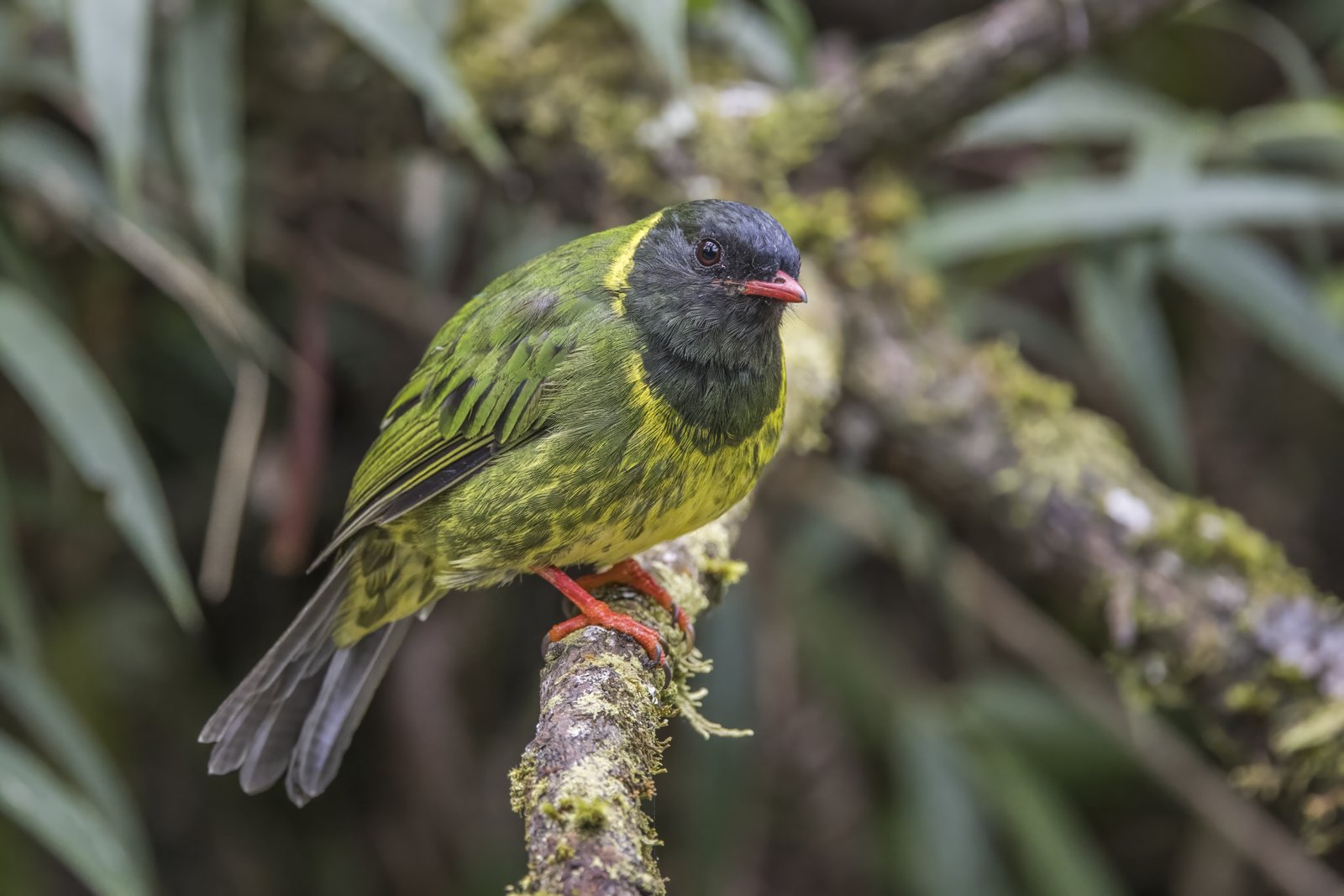
The Green-and-black Fruiteater is a plump, grass-green fruit-eater of the cloud forest of the northern Andes. It often sits motionless for long periods in the middle storey of the forest, where it is inconspicuous despite its colours. Pairs and small groups readily join mixed flocks of tanagers and other forest birds.
Voice
Very high, thin, hissing tseeee notes, resembling the sound of an insect.
Recording: Juan Freile — CC BY-NC-SA 4.0 · xeno-canto
Identification
18–20 cm, a chunky bird with a short tail. The bill and legs are orange-red. The male has a glossy black head and throat, bordered below by a narrow yellow edge; the rest of the upperparts are bright grass green. The underparts are yellow with heavy green mottling and streaking, especially on the breast and flanks. The inner secondaries sometimes have narrow pale tips. The female has a green head without black and is streaked green and yellow throughout below.
Confusion species
The male Black-chested Fruiteater Pipreola lubomirskii has a black hood extending onto the breast, without a yellow border. Band-tailed Fruiteater Pipreola intermedia has a black band with white tips at the end of the tail. Barred Fruiteater Pipreola arcuata is larger and has finely black-and-yellow barred underparts; it usually lives higher up.
Habitat
Humid cloud forest and upper montane forest, also forest edges and older secondary forest, at roughly 1500 to 3000 m. It eats mainly fruit and berries, often plucked from a branch or taken in a short sally, and also insects.
Where the bird is most at home, classified by the vegetation units of the Andes and the west coast.


Range and movements
In Colombia in all three cordilleras; in Ecuador on the western and eastern slopes of the Andes; in Peru in the north and centre of the country. Absent from Bolivia and the Galápagos. Outside the guide area in the Andes and coastal mountains of Venezuela.
- Resident
- dark = core range, pale = thinly spread
How and when to look
In cloud forest along mountain roads, such as in the Tandayapa valley in Ecuador, often in mixed flocks. Listen for the high, hissing note and then scan the middle storey for a motionless green bird.
Conservation status
Least Concern. Fairly common in suitable forest, but locally declining through clearance of cloud forest.
Scientific name
Pipreola riefferii | (Boissonneau, 1840)
Boissonneau described the species in 1840 as Ampelis Riefferii; because it was later moved to another genus, the author and year stand in brackets. The genus Pipreola was introduced in 1838 by Swainson. The genus name is a Latin diminutive of the genus Pipra (manakins). The species name honours Étienne Rieffer (1806–1872), French naturalist and collector in tropical America. The specimen the first description was based on came from Bogotá, Colombia.