All species › Passerines › Cotingas › Scaled Fruiteater
Scaled Fruiteater | Ampelioides tschudii
Groengeschubde cotinga | Frutero escamado | Anambé-escamado
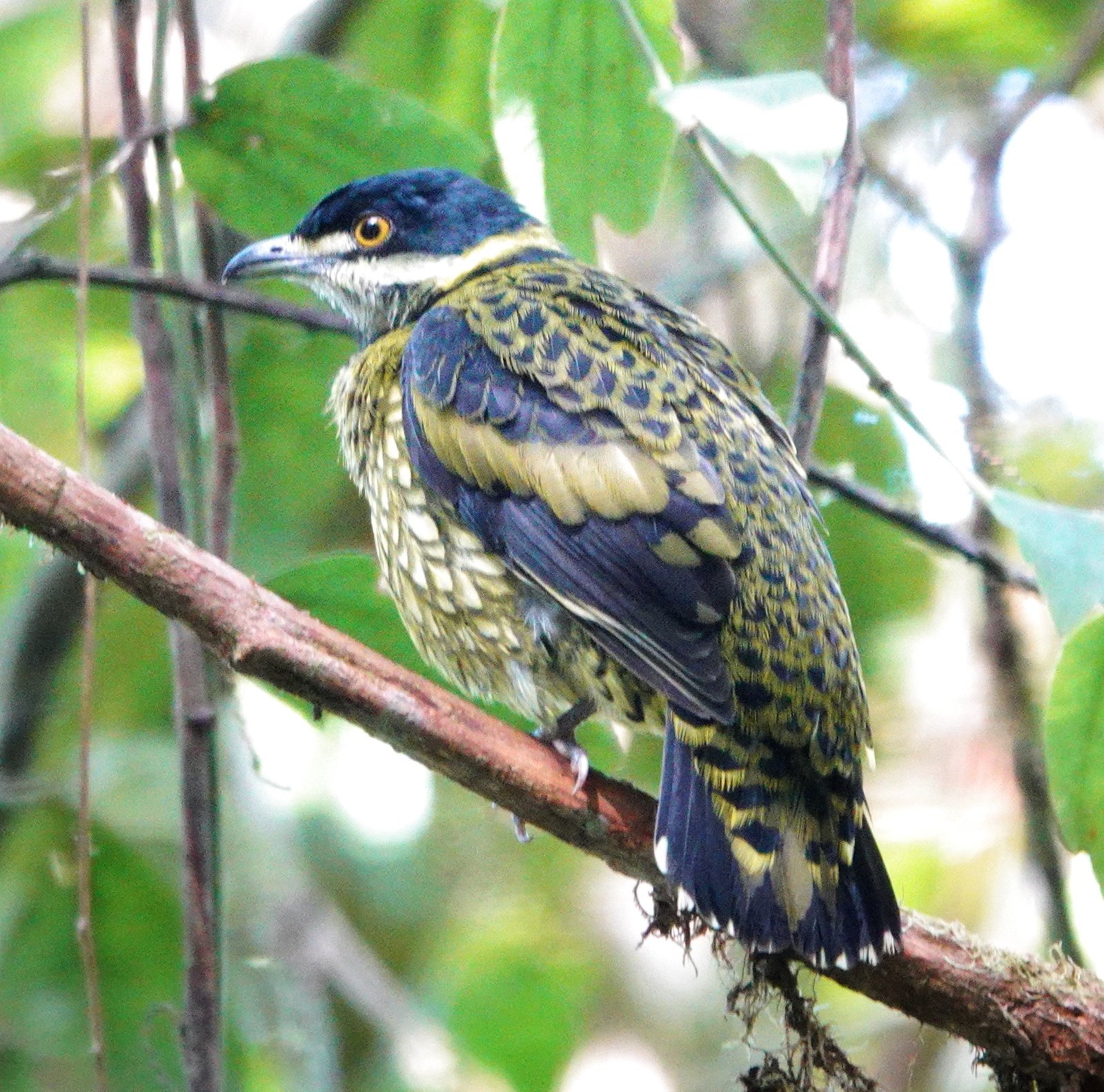
The Scaled Fruiteater is a chunky, heavily scaled fruit-eater of montane forest on both slopes of the Andes. It is the only species in its genus. It often sits motionless for long periods in the middle storey or canopy, where its scaled plumage conceals it well among moss and epiphytes.
Voice
A loud, drawn-out whistle that first rises and then falls, roughly wheeeeeyr, repeated at long intervals.
Recording: Carlos Delgado JUMABITA — CC BY-NC-SA 4.0 · xeno-canto
Identification
19–21 cm, a sturdy bird with a short tail and a short, broad bill. The iris is yellow. The male has a black crown and cheeks, a yellow collar and a yellow malar stripe; the upperparts are black with broad olive-green feather edges, giving a strongly scaled pattern. The wings are black with a large yellow-green panel. The underparts are yellowish white with black and olive-green scaling. The female has an olive-green rather than black crown and is otherwise similar.
Confusion species
Barred Fruiteater Pipreola arcuata has a red bill and finely barred rather than scaled underparts, and lives higher up. Females of Green-and-black Fruiteater Pipreola riefferii and other Pipreola species are green with streaked underparts, without a black-and-green scaled back and without a yellow collar.
Habitat
Humid montane forest and its edges, especially in the subtropical zone, at roughly 900 to 2700 m. It eats mainly fruit, and also insects. It often joins mixed flocks in the canopy.
Where the bird is most at home, classified by the vegetation units of the Andes and the west coast.


Range and movements
In Colombia locally in all three cordilleras. In Ecuador on the western and eastern slopes of the Andes. In Peru on the eastern slope from north to south. In Bolivia on the eastern slope in the north-west. Absent from the Galápagos. Outside the guide area in western Venezuela.
- Resident
- dark = core range, pale = thinly spread
How and when to look
Listen in subtropical montane forest for the long, rising and falling whistle, then scan the middle storey and canopy for a motionless bird. In Ecuador among other places around Mindo; in Peru along the road to Manú.
Conservation status
Least Concern. Generally scarce and patchily distributed; the range is large, but montane forest is being cleared in many places.
Scientific name
Ampelioides tschudii | (Gray, 1846)
Gray described the species in 1846 as C[otinga] Tschudii; because it was later moved to another genus, the author and year stand in brackets. The genus Ampelioides was introduced in 1867 by Verreaux. The genus name is formed from the genus Ampelion with Ancient Greek -oidēs, 'resembling'. The species name honours Johann Jakob von Tschudi (1818–1889), a Swiss naturalist and explorer who collected birds in Peru. The specimen the first description was based on came from Pangoa, Junín, Peru.