All species › Passerines › Manakins › Round-tailed Manakin
Round-tailed Manakin | Ceratopipra chloromeros
Rondstaartmanakin | Saltarín coliredondo | Dançarino-de-cauda-redonda
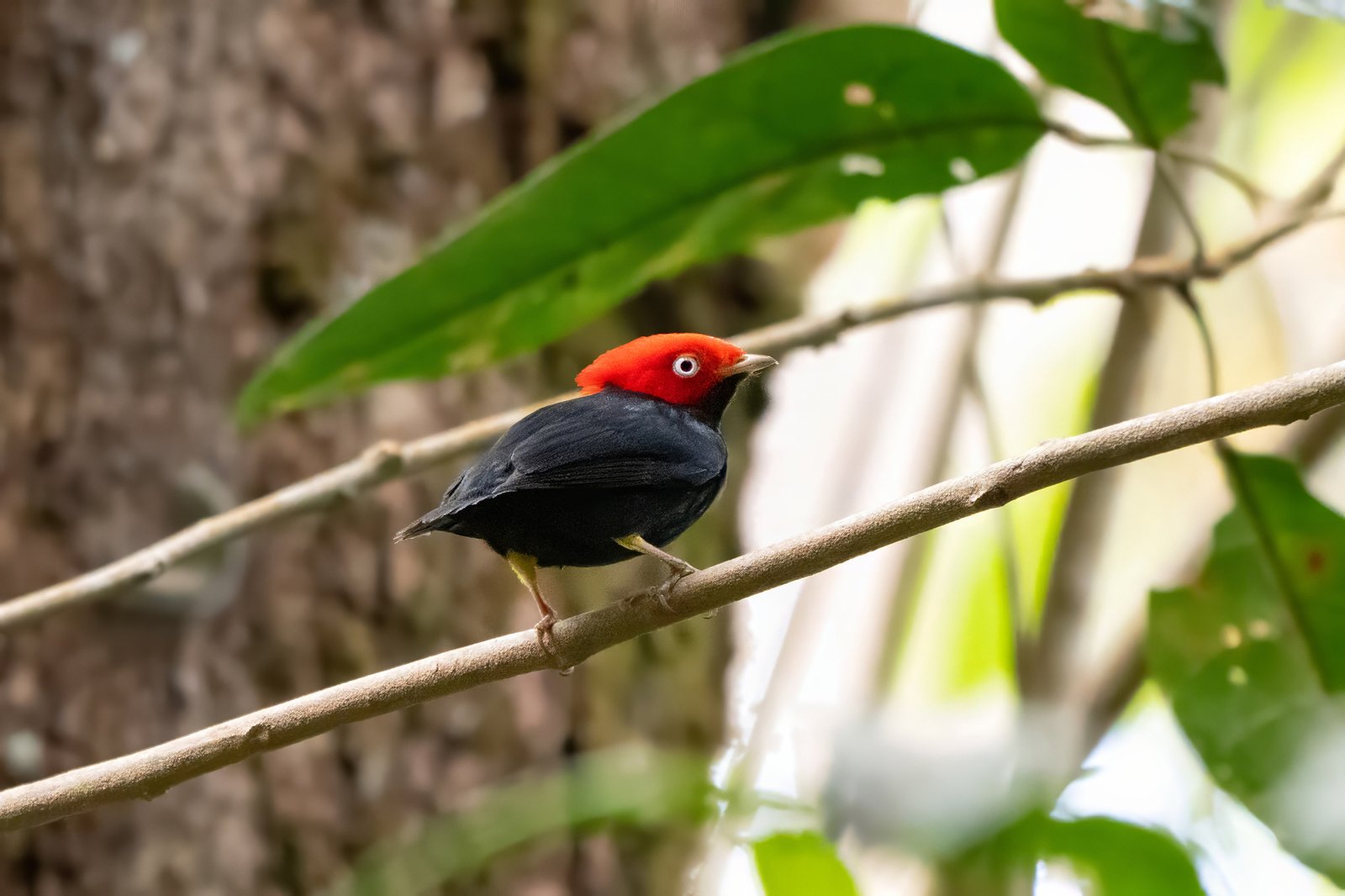
The Round-tailed Manakin is the largest of the red-headed black manakins in the guide area, with a slightly longer, rounded tail and yellow thighs. It lives in humid forest in the lowlands and foothills of Peru and Bolivia. Males display in groups in the midstorey, with snapping wing sounds.
Voice
A sharp tsik and buzzy calls, accompanied during display by snapping wing sounds.
Recording: Fabrice Schmitt — CC BY-NC-SA 4.0 · xeno-canto
Identification
11 cm, with a slightly longer, rounded tail. The male is black, with a scarlet crown and nape and yellow thighs. The iris is whitish. The female is olive green, paler below, and larger than females of related species. Young males are green with the first red feathers on the head.
Confusion species
Red-headed Manakin Ceratopipra rubrocapilla is smaller, with red and white thighs and a shorter, square tail. Golden-headed Manakin Ceratopipra erythrocephala has a golden-yellow head and lives further north. The male Band-tailed Manakin Pipra fasciicauda has a yellow belly and a white band in the tail. Females resemble those of Red-headed Manakin, but are larger, with a longer tail.
Habitat
The midstorey of humid lowland and foothill forest, also semi-humid forest, mature second growth and forest edges, to roughly 1400 m. It feeds on small fruits and insects. Males display in groups on branches in the midstorey. The nest is a small cup in a fork.
Where the bird is most at home, classified by the vegetation units of the Andes and the west coast.


Range and movements
In Peru in the centre and south of the eastern lowlands and foothills, from Huánuco and Pasco to Madre de Dios and Puno. In Bolivia in the north and centre, in the lowlands and foothills of La Paz, Beni, Cochabamba and Santa Cruz. Absent from Colombia, Ecuador and the Galápagos. Outside the guide area in western Brazil, mainly in Acre.
- Resident
- dark = core range, pale = thinly spread
How and when to look
Search along forest trails in the foothills and adjacent lowlands of south-eastern Peru and northern Bolivia for displaying males in the midstorey; the wing snaps point to the display site.
Conservation status
Least Concern. The range is of moderate size and still largely forested.
Scientific name
Ceratopipra chloromeros | (Tschudi, 1844) (GBIF: Pipra chloromeros)
Tschudi described the species in 1844 as P[ipra] chloromeros; because it was later moved to another genus, the author and year stand in brackets. The genus Ceratopipra was introduced in 1854 by Bonaparte. The genus name combines Greek keras, 'horn', with the genus name Pipra (manakins), after the horn-like head feathers of the type species. The species name comes from Greek khlōros, 'green, yellowish green', and mēros, 'thigh', referring to the male's coloured thighs. The specimen the first description was based on came from Vitoc valley, Junín, Peru.