All species › Passerines › Manakins › Red-headed Manakin
Red-headed Manakin | Ceratopipra rubrocapilla
Roodkopmanakin | Saltarín cabecirrojo | Cabeça-encarnada
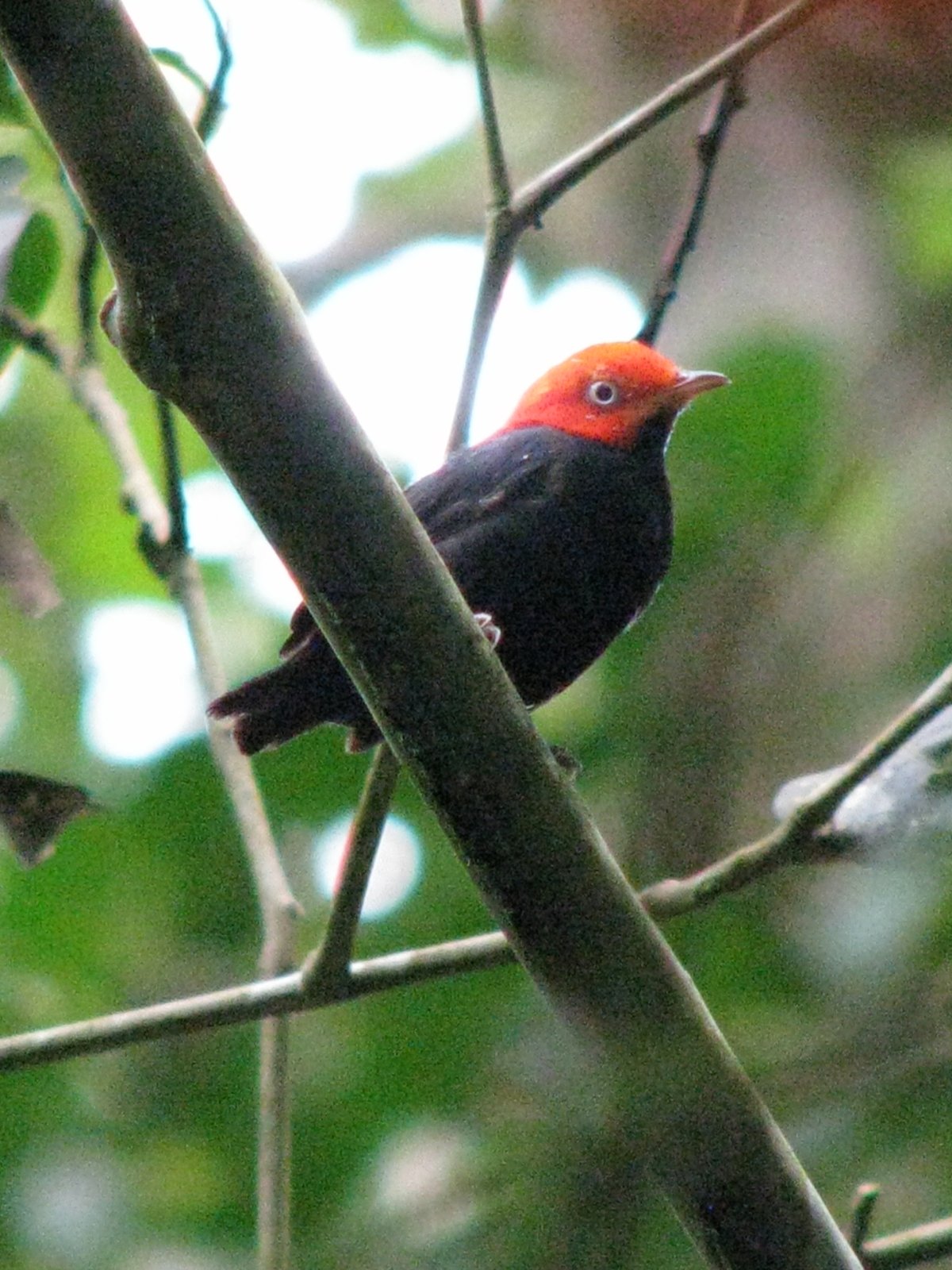
The Red-headed Manakin is a small, black manakin with a red head, of humid lowland forest south of the Amazon. It is the southern counterpart of the Golden-headed Manakin and displays in a similar way in groups in the midstorey. In the guide area it lives in eastern Peru and northern Bolivia.
Voice
A sharp tsik and a buzzy, descending call, roughly dzeeuw. During display snapping wing sounds.
Recording: JAYRSON ARAUJO DE OLIVEIRA — CC BY-NC-SA 4.0 · xeno-canto
Identification
10 cm, with a short tail. The male is glossy black, with a scarlet head and nape; the thighs are red and white. The iris is whitish. The female is olive green, paler and somewhat greyer below. Young males are green with the first red feathers on the head.
Confusion species
Round-tailed Manakin Ceratopipra chloromeros is larger, with yellow thighs and a longer, rounded tail, and more often lives in the foothills. Golden-headed Manakin Ceratopipra erythrocephala has a golden-yellow head and lives north of the Amazon and the Marañón. The male Band-tailed Manakin Pipra fasciicauda has a red crown and breast, a yellow belly and a white band in the tail. Females of these species are very similar.
Habitat
The midstorey of humid lowland terra firme forest and mature second growth, also forest edges and flooded forest, to roughly 1000 m in the foothills. It feeds mainly on small fruits and insects. Males display in loose groups on branches in the midstorey. The nest is a small cup in a fork.
Where the bird is most at home, classified by the vegetation units of the Andes and the west coast.


Range and movements
In Peru in the eastern lowlands south of the Amazon and the Marañón, south to Madre de Dios. In Bolivia in the north, in Pando, Beni and northern La Paz. Absent from Colombia, Ecuador and the Galápagos. Outside the guide area in Amazonian Brazil south of the Amazon and in the Atlantic Forest of eastern Brazil.
- Resident
- dark = core range, pale = thinly spread
How and when to look
Search forest trails in the lowlands of eastern Peru and northern Bolivia for displaying males in the midstorey; the snapping and buzzing give away the display site.
Conservation status
Least Concern. The range is large; in the Atlantic Forest the population has declined through forest loss.
Scientific name
Ceratopipra rubrocapilla | (Temminck, 1821) (GBIF: Pipra rubrocapilla)
Temminck described the species in 1821 as Pipra rubro-capilla; because it was later moved to another genus, the author and year stand in brackets. The genus Ceratopipra was introduced in 1854 by Bonaparte. The genus name combines Greek keras, 'horn', with the genus name Pipra (manakins), after the horn-like head feathers of the type species. The species name comes from Latin ruber, 'red', and capillus, 'hair of the head': red-capped. The specimen the first description was based on came from Bahia, Brazil.