All species › Tinamous › Tinamous › Barred Tinamou
Barred Tinamou | Crypturellus casiquiare
Gebandeerde tinamoe | Tinamú barrado | Inhambu-listrado
The Barred Tinamou has a small range in the border region of Colombia, Venezuela and Brazil, around the upper Orinoco and Río Negro drainages. It lives in white-sand forest, a forest type characteristic of that region. In the guide area it occurs only in the far east of Colombia.
Voice
A long series of whistles that gradually rises and accelerates, mainly in the early morning and at dusk. The voice is still poorly documented.
Recording: Iván Lau — CC BY-NC-SA 4.0 · xeno-canto
Identification
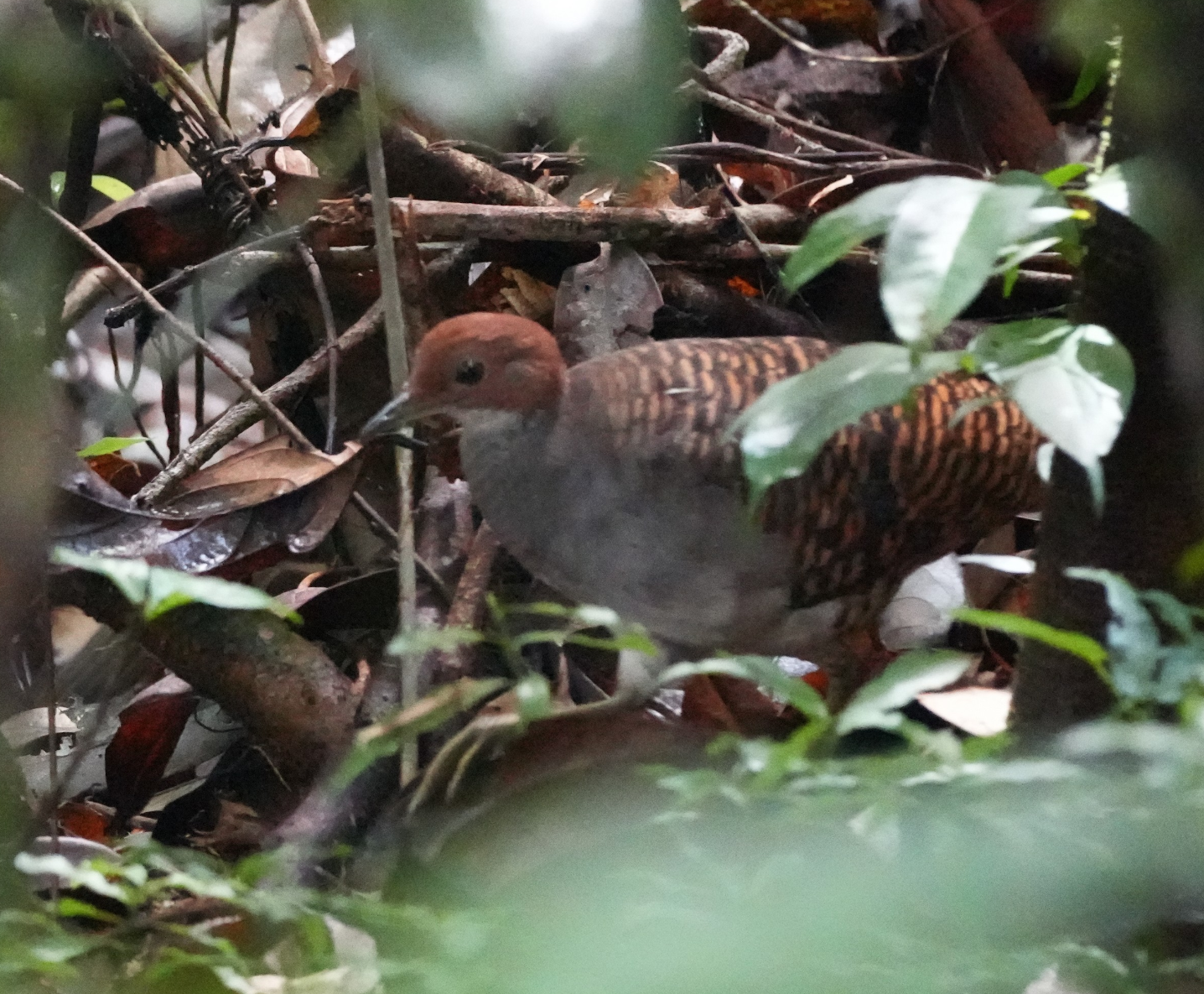
25–27 cm, with a small head and almost no tail. The head and neck are chestnut, the throat white. The back and wings are buff with broad black barring. The foreneck and breast are pale grey, the belly white and the flanks cream with black barring. The legs are olive-green. The female is somewhat paler on the back.
Confusion species
Variegated Tinamou Crypturellus variegatus has a blackish crown and a rufous, not grey, breast. Rusty Tinamou Crypturellus brevirostris is more rufous, including the breast, and more finely barred. Grey-legged Tinamou Crypturellus duidae, which lives in the same region, has grey legs, rufous underparts and a less heavily barred back. Little Tinamou Crypturellus soui is smaller and has an unbarred back.
Habitat
Low, open white-sand forest and scrubby woodland and their edges, in the lowlands below about 200 m. It walks over the forest floor, feeding on fruit, seeds and invertebrates. Little is known about its breeding; as in other tinamous the nest is presumably on the ground.
Where the bird is most at home, classified by the vegetation units of the Andes and the west coast.


Range and movements
In Colombia only in the far east, in Guainía and possibly adjacent Vichada, along the border with Venezuela. Absent from Ecuador, Peru, Bolivia and the Galápagos. Outside the guide area in southern Venezuela, in Amazonas state, and locally in adjacent north-western Brazil.
- Resident
- dark = core range, pale = thinly spread
How and when to look
Search white-sand forest around Puerto Inírida in Guainía and listen in the early morning for the series of whistles. Walk slowly and quietly; birds walk off through the low vegetation.
Conservation status
Least Concern. Its habitat is remote and largely intact; because of its small range, however, local forest loss can affect the species.
Scientific name
Crypturellus casiquiare | (Chapman, 1929)
Chapman described the species in 1929 as Crypturornis casiquiare; because it was later moved to another genus, the author and year stand in brackets. The genus Crypturellus was introduced in 1914 by Brabourne, WWK-H & Chubb. The genus name comes from Greek kruptos, 'hidden', and oura, 'tail', with the Latin diminutive -ellus: 'little hidden tail'. The species name refers to the Río Casiquiare in southern Venezuela. The specimen the first description was based on came from Río Casiquiare at the Río Guainía, Amazonas, Venezuela.