All species › Tinamous › Tinamous › Tataupa Tinamou
Tataupa Tinamou | Crypturellus tataupa
Tataupatinamoe | Tinamú tataupá | Inhambu-chintã
The Tataupa Tinamou is a small, dark tinamou of dry and semi-humid forest. Its range is strongly split: a large area in eastern South America and isolated forms in the dry Andean valleys of Peru and southern Ecuador. It is far more often heard than seen; its fast, descending trill can be heard throughout the day.
Voice
A fast, descending series of short notes that accelerates into a trill; heard throughout the day, most in the morning.
Recording: Juan Freile — CC BY-NC-SA 4.0 · xeno-canto
Identification
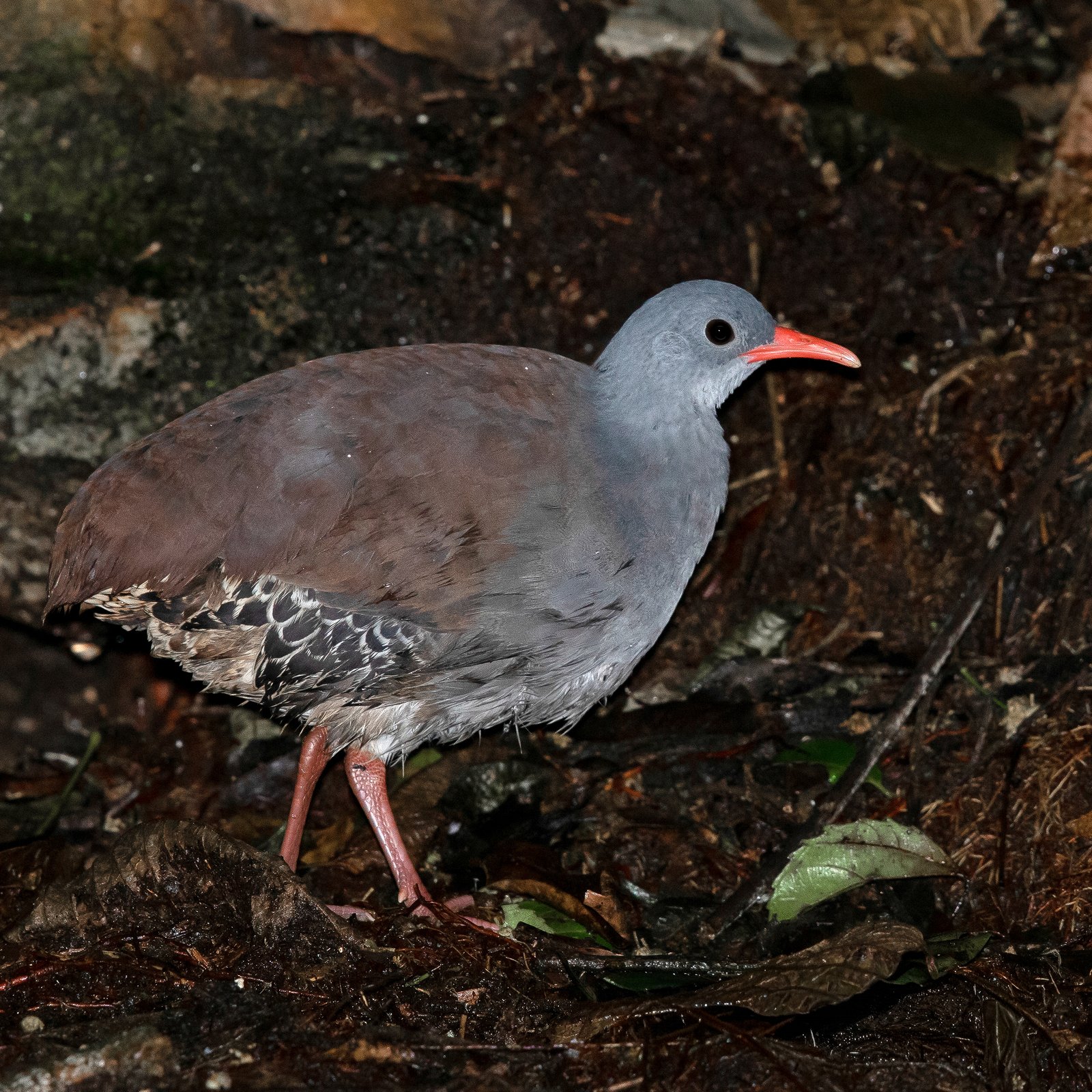
22–25 cm, with a small head, a red bill and purplish-red legs. The head, neck and breast are slate grey, the throat whitish. The back and wings are plain dark chestnut-brown. The belly is whitish; the flanks and undertail coverts are scaled black and white. The sexes are alike.
Confusion species
Small-billed Tinamou Crypturellus parvirostris is smaller and paler, with a brown rather than chestnut back, a buff breast and red legs; it lives in more open country. Brown Tinamou Crypturellus obsoletus is larger, with rufous underparts, and lives in humid montane forest. Black-capped Tinamou Crypturellus atrocapillus has a black crown and a rufous breast. Pale-browed Tinamou Crypturellus transfasciatus has a pale eyebrow and a barred back and lives in dry forest west of the Andes.
Habitat
Dry and semi-humid forest, scrubby woodland, forest edge, old secondary forest and overgrown plantations, from the lowlands up to about 2000 m in the dry Andean valleys. It walks on the ground, feeding on seeds, fruit and invertebrates. The nest is on the ground under shrubs or among leaf litter; the male incubates the eggs.
Where the bird is most at home, classified by the vegetation units of the Andes and the west coast.


Range and movements
In Ecuador only in the far south, in the dry valleys of Zamora-Chinchipe. In Peru in the dry Marañón valley and in dry valleys on the eastern slope of the Andes further south. In Bolivia in the valleys and foothills of the eastern Andes and in the eastern lowlands. Absent from Colombia and the Galápagos. Outside the guide area in eastern and central Brazil, in Paraguay and in northern Argentina.
- Resident
- dark = core range, pale = thinly spread
How and when to look
Listen in the dry valleys of northern Peru, for example around Jaén and Bagua, for the descending trills. In Bolivia it can be found in dry forest around Santa Cruz and in the valleys of the eastern Andes. Birds often walk along forest trails and sandy tracks.
Conservation status
Least Concern. The species tolerates secondary forest and forest edge well; the isolated Andean forms depend on the dry forest of the valleys, which is being heavily cleared.
Scientific name
Crypturellus tataupa | (Temminck, 1815)
Temminck described the species in 1815 as Tinamus tataupa; because it was later moved to another genus, the author and year stand in brackets. The genus Crypturellus was introduced in 1914 by Brabourne, WWK-H & Chubb. The genus name comes from Greek kruptos, 'hidden', and oura, 'tail', with the Latin diminutive -ellus: 'little hidden tail'. The species name comes from the Guaraní name Ihnambú tataupá, 'fire tinamou', via the 'Ynambú tatáupá' of Félix de Azara; in folklore the red bill showed that the bird had eaten fire, of which it was the guardian. The specimen the first description was based on came from Rio de Janeiro, Brazil.