All species › Tinamous › Tinamous › Taczanowski's Tinamou
Taczanowski's Tinamou | Nothoprocta taczanowskii
Taczanowski's tinamoe | Tinamú de Taczanowski | Inhambu-de-taczanowski
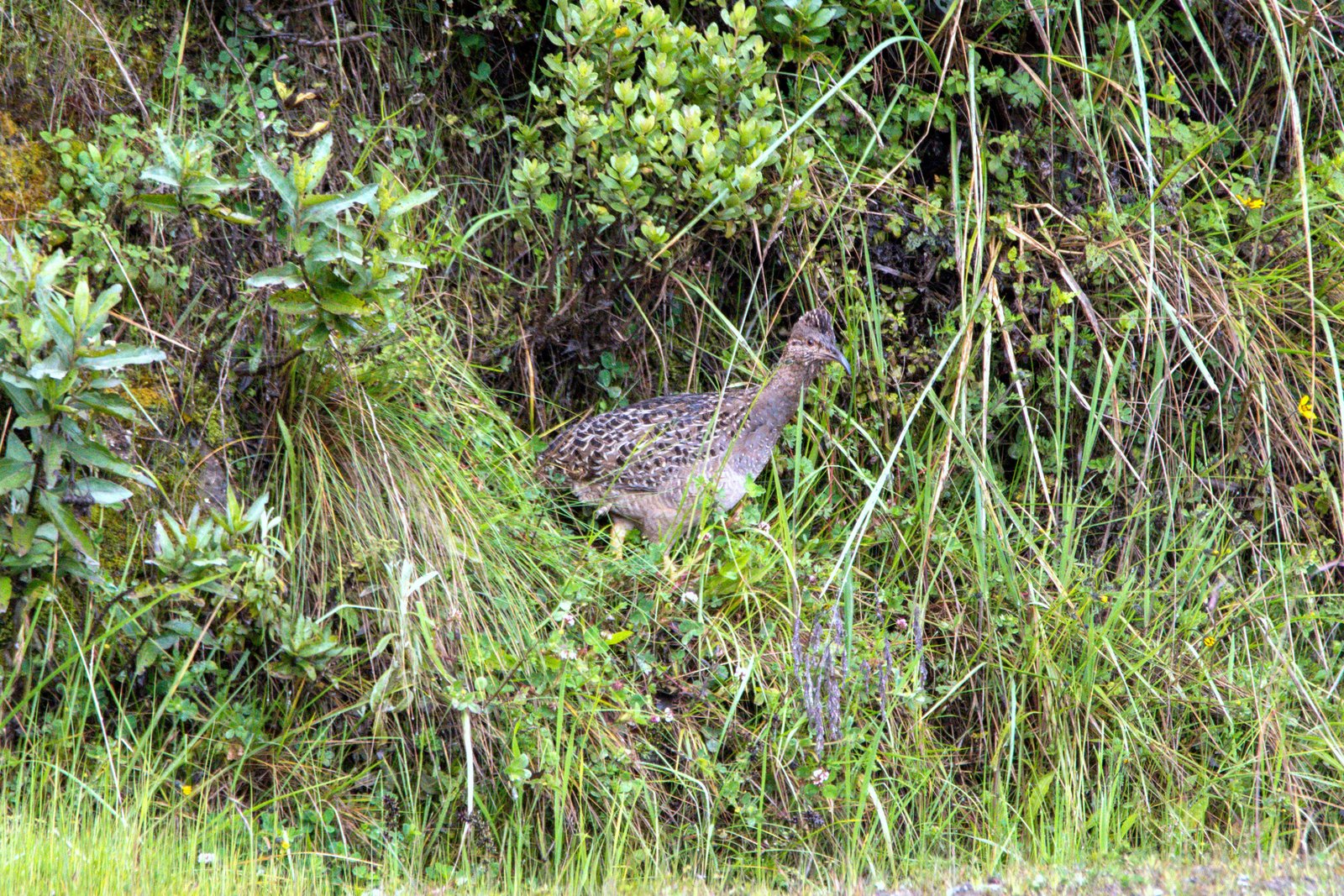
Taczanowski's Tinamou is a large, dark tinamou of the Andes of central and southern Peru, with a long, decurved bill. It lives in humid grassland interspersed with shrubs, woodland patches and fields at high elevations, where it occurs in a small and fragmented range. The species is named after the Polish zoologist Wladyslaw Taczanowski, who published widely on the birds of Peru.
Voice
The voice is poorly documented. When flushed it gives a sharp, hoarse call and a loud whirr of wings.
Recording: Sjoerd Mayer — CC BY-NC-SA 3.0 · xeno-canto
Identification
33–36 cm, with a small head, a long, clearly decurved bill and almost no tail. The upperparts are dark greyish brown to blackish, with pale, buff streaks and spots. The head and neck are dark, finely speckled with buff. The breast is grey with pale spots, and the belly is buff with dark barring. The legs are yellowish to grey. The sexes are alike.
Confusion species
Andean Tinamou Nothoprocta pentlandii is smaller and paler, with a shorter bill, and lives in drier scrub. Ornate Tinamou Nothoprocta ornata has a whitish, black-spotted head and neck and a shorter bill, and usually lives in more open puna. Curve-billed Tinamou Nothoprocta curvirostris also has a decurved bill, but is warmer rufous-brown and lives further north. Puna Tinamou Tinamotis pentlandii has black-and-white head stripes and lives in dry puna.
Habitat
Humid grassland and puna interspersed with shrubs, Polylepis patches and the upper edge of montane forest, and the edges of potato fields and other small-scale farmland, mainly between 2700 and 4000 m. It walks on the ground, feeding on seeds, tubers, shoots and insects. Little is known of its breeding biology; the nest is on the ground.
Where the bird is most at home, classified by the vegetation units of the Andes and the west coast.


Range and movements
In Peru in the Andes of the centre and south, from Junín and Huancavelica through Ayacucho, Apurímac and Cusco to Puno, locally and patchily. A few records have been reported from adjacent western Bolivia. Absent from Colombia, Ecuador and the Galápagos. Does not occur outside the guide area.
- Resident
- dark = core range, pale = thinly spread
How and when to look
Search grassy slopes with shrubs and woodland patches above the montane forest in the early morning, for example in the Andes around Cusco. Birds sit tight for a long time and flush only right at your feet.
Conservation status
Vulnerable. Its habitat is small and fragmented and is affected by the expansion of farming, overgrazing and the burning of grassland; the species is also hunted.
Scientific name
Nothoprocta taczanowskii | Sclater & Salvin, 1875
Sclater & Salvin described the species in 1875 and placed it straight away in the genus where it still stands. The genus Nothoprocta was introduced in 1873 by Sclater & Salvin. The genus name comes from Greek nothos, 'spurious', and prōktos, 'rear, tail'. Named after Władysław Taczanowski (1819–1890), Polish zoologist who described the birds of Peru. The specimen the first description was based on came from Maraynioc, Junín, Peru.