All species › Tinamous › Tinamous › Ornate Tinamou
Ornate Tinamou | Nothoprocta ornata
Pisaccatinamoe | Tinamú ornado | Inhambu-ornado
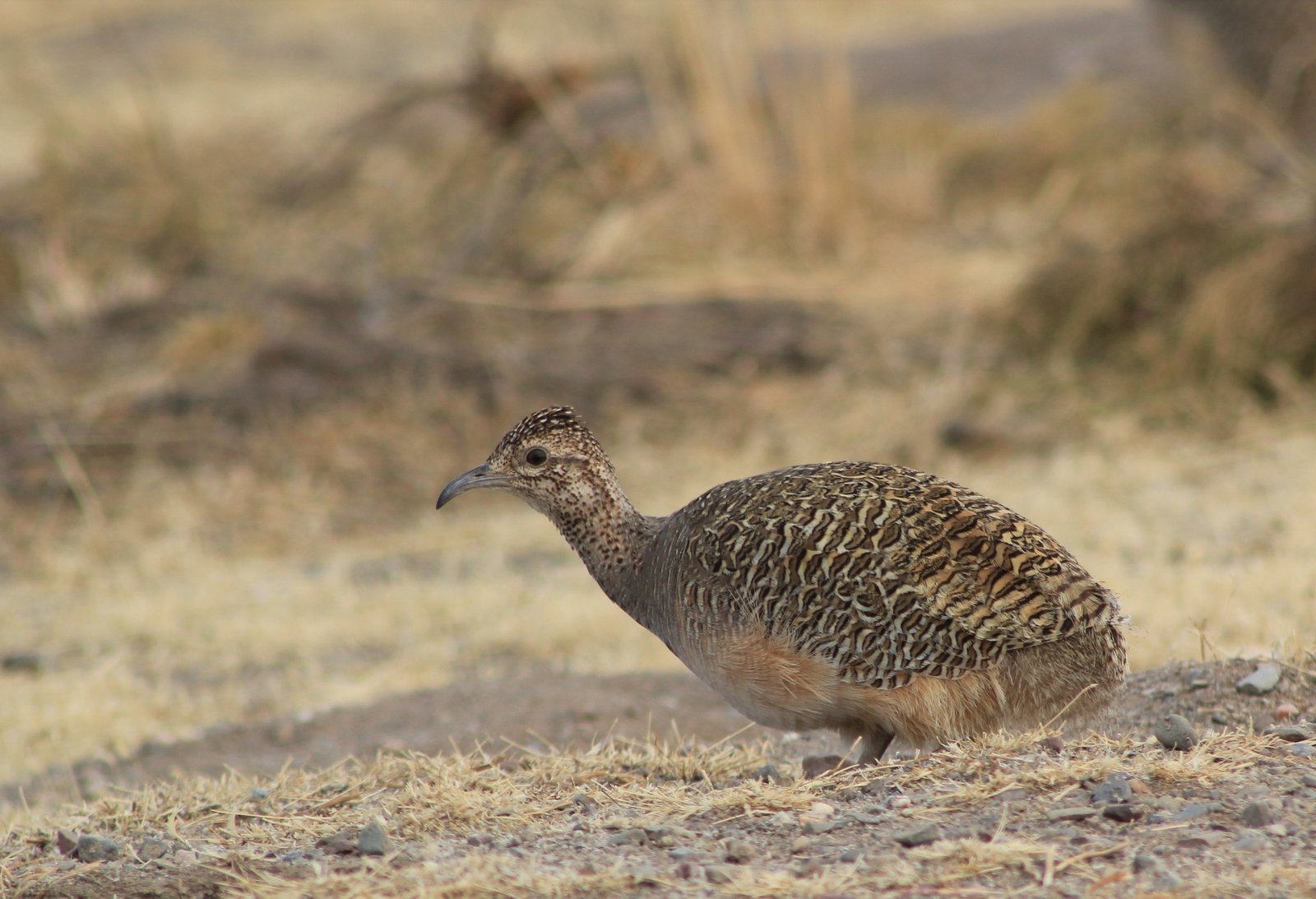
The Ornate Tinamou is a medium-sized, greyish, spotted tinamou of the bunchgrass of the puna in Peru and Bolivia. Its Dutch name goes back to pisaq, the Quechua word for these partridge-like birds. It lives higher than most other tinamous and prefers to run off between the grass tussocks rather than fly.
Voice
A high, thin whistle, repeated at intervals, mainly in the early morning and evening. When flushed shrill, whistled notes and a whirr of wings.
Recording: Niels Krabbe — CC BY-NC-SA 4.0 · xeno-canto
Identification
32–36 cm, with a small head, a fairly long, slightly decurved bill and almost no tail. The head and neck are whitish to pale buff and densely spotted black, with a darker crown. The upperparts are greyish brown, with black spots and pale streaks along the feather edges. The breast is grey with white and black spots, and the belly buff to cinnamon. The legs are yellowish. The sexes are alike.
Confusion species
Andean Tinamou Nothoprocta pentlandii is smaller and browner, with a less spotted head, and usually lives lower, in dry scrub and field edges. Taczanowski's Tinamou Nothoprocta taczanowskii is darker and browner, with a longer, more decurved bill, and lives in Peru on wetter slopes with scrub. Puna Tinamou Tinamotis pentlandii is larger, with a black-and-white striped head, and lives in small groups on the open puna. Darwin's Nothura Nothura darwinii is smaller and yellower, with a shorter bill.
Habitat
Bunchgrass puna, often with scattered shrubs or rocks, also Polylepis groves and the edges of potato and barley fields, between about 2500 and 4600 m, mainly above 3200 m. It feeds on the ground on seeds, tubers, green plant matter and insects. The nest is a scrape in the ground among the grass; the male incubates the eggs.
Where the bird is most at home, classified by the vegetation units of the Andes and the west coast.


Range and movements
In Peru in the Andes of the centre and south of the country, mainly on the high plateaus. In Bolivia in the western highlands and on the altiplano. Absent from Colombia, Ecuador and the Galápagos. Outside the guide area in the far north of Chile and north-western Argentina.
- Resident
- dark = core range, pale = thinly spread
How and when to look
Walk slowly through bunchgrass with scattered shrubs and rocks, for example around Lake Titicaca and on the high plateaus of southern Peru. Birds often press themselves to the ground until the last moment; in the early morning watch for birds walking between the tussocks.
Conservation status
Least Concern. Hunted locally and sensitive to overgrazing and the burning of grassland, but still fairly common over a large area.
Scientific name
Nothoprocta ornata | (Gray, 1867)
Gray described the species in 1867 as Rhynchotus ornatus; because it was later moved to another genus, the author and year stand in brackets. The genus Nothoprocta was introduced in 1873 by Sclater & Salvin. The genus name comes from Greek nothos, 'spurious', and prōktos, 'rear, tail'. Latin ornatus means 'adorned', after the patterned plumage. The specimen the first description was based on came from Bolivia.