All species › Tinamous › Tinamous › Brushland Tinamou
Brushland Tinamou | Nothoprocta cinerascens
Cordobatinamoe | Tinamú montaraz | Inhambu-de-matagal
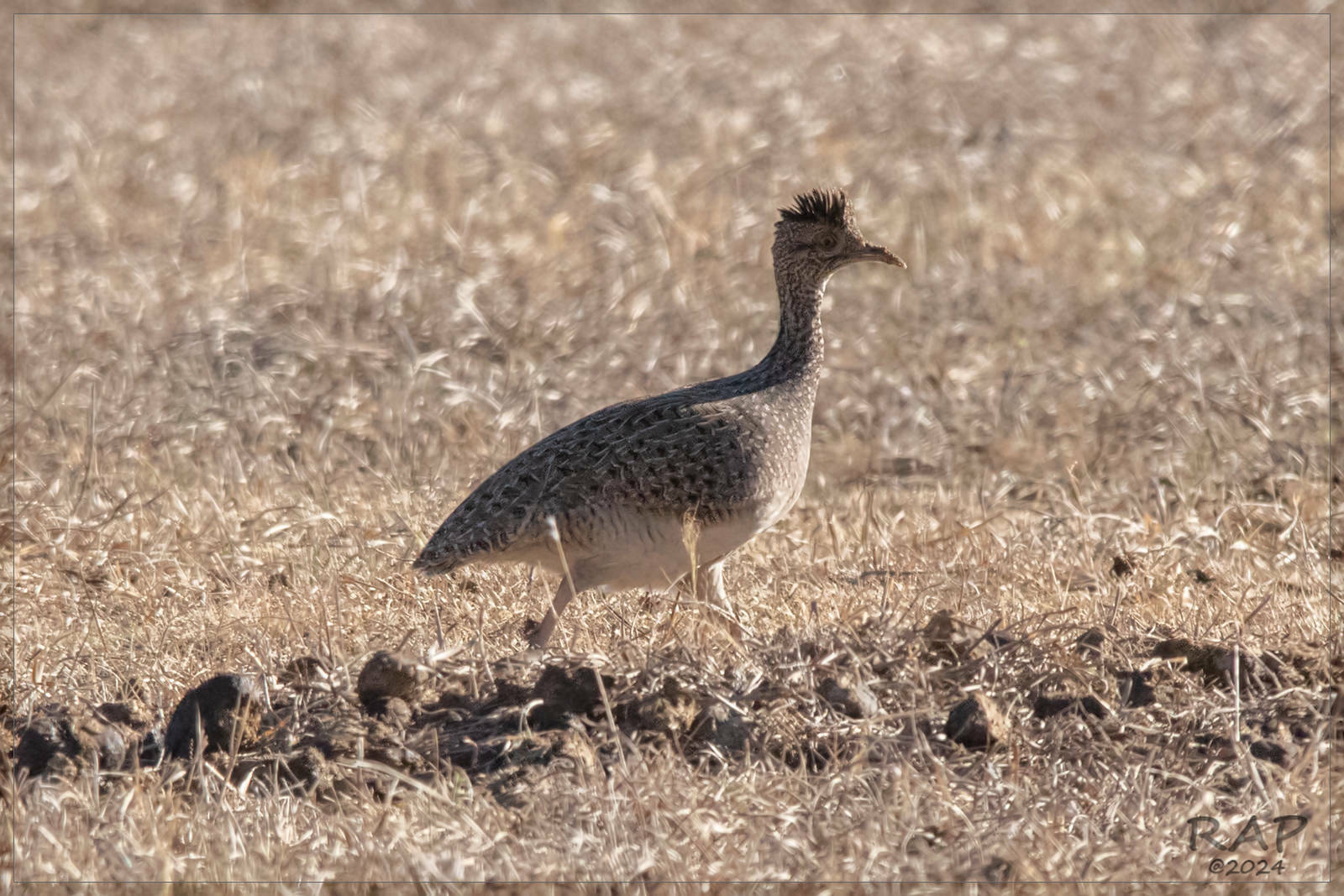
The Brushland Tinamou is a grey-brown tinamou with a short crest, of the dry forest and thorn scrub of the Chaco. In the guide area it occurs only in south-eastern Bolivia. It lives on the ground under dense scrub and is far more often heard than seen.
Voice
A series of clear, whistled notes, heard mainly at dusk and sometimes at night. A whirr of wings when flushed.
Recording: Edgar Romero — CC BY-NC-SA 4.0 · xeno-canto
Identification
31–33 cm, with a short, ragged crest, a slightly decurved bill and almost no tail. The head is striped black and white, with a white throat. The upperparts are grey-brown, with pale streaks and dark spots on the back and wings. The breast is grey with white drop-shaped spots, and the belly paler, grey to yellowish. The sexes are alike.
Confusion species
Quebracho Crested Tinamou Eudromia formosa is larger, with a long, thin, erect crest and a white stripe from the eye down the side of the neck. Red-winged Tinamou Rhynchotus rufescens is larger, with a long, decurved bill and rufous primaries, and lives in open grassland. White-bellied Nothura Nothura boraquira is smaller and yellower, without a crest, and has a white belly. Small-billed Tinamou Crypturellus parvirostris is smaller and browner, with a short red bill and red legs.
Habitat
Dry Chaco forest and thorn scrub, especially where the undergrowth is dense, also the edges of clearings and overgrown pastures; in the lowlands and lower foothills, up to roughly 1000 m. It feeds on the ground on seeds, fruit and insects. The nest is on the ground under dense scrub.
Where the bird is most at home, classified by the vegetation units of the Andes and the west coast.


Range and movements
In Bolivia only in the Chaco of the south-east (Santa Cruz, Chuquisaca and Tarija). Absent from Colombia, Ecuador, Peru and the Galápagos. Outside the guide area in the Chaco of Paraguay and in northern and central Argentina.
- Resident
- dark = core range, pale = thinly spread
How and when to look
Listen at dawn and dusk along sandy tracks through the Chaco, for example in southern Santa Cruz. Birds sometimes cross the track early in the morning.
Conservation status
Least Concern. Clearance of the Chaco for farming and ranching and local hunting reduce its habitat.
Scientific name
Nothoprocta cinerascens | (Burmeister, 1860)
Burmeister described the species in 1860 as Nothura cinerascens; because it was later moved to another genus, the author and year stand in brackets. The genus Nothoprocta was introduced in 1873 by Sclater & Salvin. The genus name comes from Greek nothos, 'spurious', and prōktos, 'rear, tail'. Latin cinerascens means 'becoming ash-grey, greyish'. The specimen the first description was based on came from Tucumán, Argentina.