All species › Tinamous › Tinamous › Andean Tinamou
Andean Tinamou | Nothoprocta pentlandii
Andestinamoe | Tinamú andino | Inhambu-andino
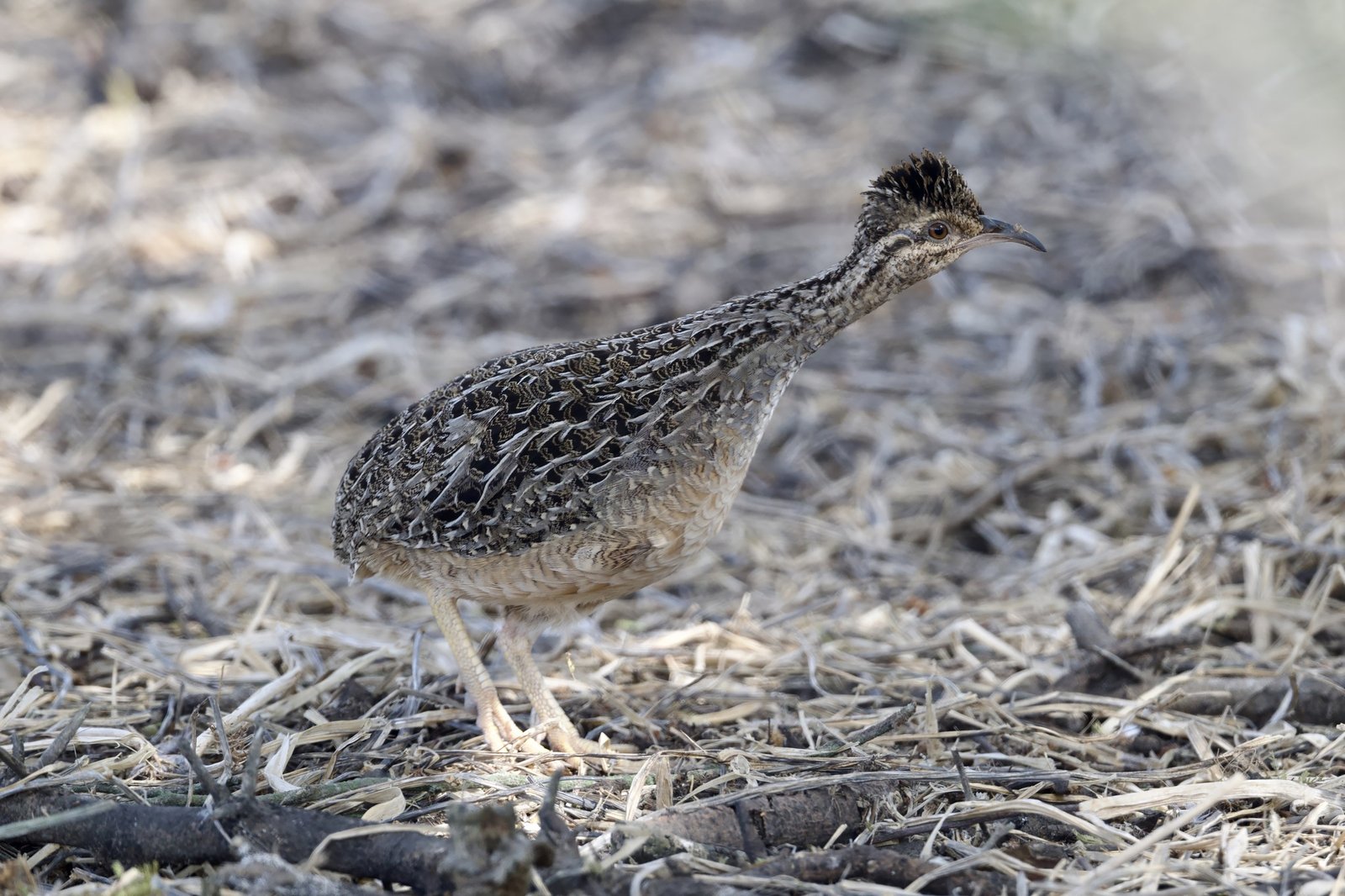
The Andean Tinamou is a small, brown, spotted tinamou of dry, open mountain slopes in the Andes. It lives hidden among shrubs and grass and flushes only when almost stepped on, then with a loud whirr of wings. Of the highland tinamous it is the one most tied to scrub and field edges at middle elevations.
Voice
A high, piercing whistle, repeated at intervals, mainly in the early morning and at dusk. When flushed a shrill note and a whirr of wings.
Recording: Paul Coopmans — CC BY-NC-SA 4.0 · xeno-canto
Identification
25–30 cm, with a small head, a thin, slightly decurved bill and almost no tail. The upperparts are greyish brown, with black spots and pale, creamy streaks on the back and wings. The head is greyish, with a dark crown and a pale throat. The breast and neck are grey with small white spots, and the belly is paler buff. The legs are yellowish. The sexes are alike.
Confusion species
Ornate Tinamou Nothoprocta ornata is larger, with a heavily spotted, whitish head and neck, and usually lives higher, in open puna grassland. Curve-billed Tinamou Nothoprocta curvirostris is warmer rufous-brown, with a more obviously decurved bill, and lives in wetter grassland in the north. Puna Tinamou Tinamotis pentlandii is much larger, with a striped head, and lives high on the puna. Darwin's Nothura Nothura darwinii is smaller and yellower, with a shorter bill, and favours open grassland.
Habitat
Dry scrub, grassland with scattered shrubs, rocky slopes and the edges of fields and terraces in the Andes, roughly between 2000 and 4000 m, locally lower. It walks on the ground, feeding on seeds, tubers, shoots and insects. The nest is on the ground, hidden under a shrub or grass tussock.
Where the bird is most at home, classified by the vegetation units of the Andes and the west coast.


Range and movements
In Ecuador only in the far south. In Peru along the western slope and in the dry inter-Andean valleys over most of the country. In Bolivia in the Andes and in the dry valleys of the eastern slope. Absent from Colombia and the Galápagos. Outside the guide area in northern Chile and north-western Argentina.
- Resident
- dark = core range, pale = thinly spread
How and when to look
Walk slowly along shrubby slopes and field edges in the dry valleys; birds often run off before flushing. In the early morning they give themselves away by their whistles.
Conservation status
Least Concern. The species tolerates small-scale farmland well, but is hunted locally.
Scientific name
Nothoprocta pentlandii | (Gray, 1867)
Gray described the species in 1867 as Rhynchotus Pentlandii; because it was later moved to another genus, the author and year stand in brackets. The genus Nothoprocta was introduced in 1873 by Sclater & Salvin. The genus name comes from Greek nothos, 'spurious', and prōktos, 'rear, tail'. Named after Joseph Barclay Pentland (1797–1873), Irish natural scientist and geographer who worked in Bolivia. The specimen the first description was based on came from Andes of Bolivia.