All species › Tinamous › Tinamous › Curve-billed Tinamou
Curve-billed Tinamou | Nothoprocta curvirostris
Krombektinamoe | Tinamú piquicurvo | Inhambu-de-bico-curvo
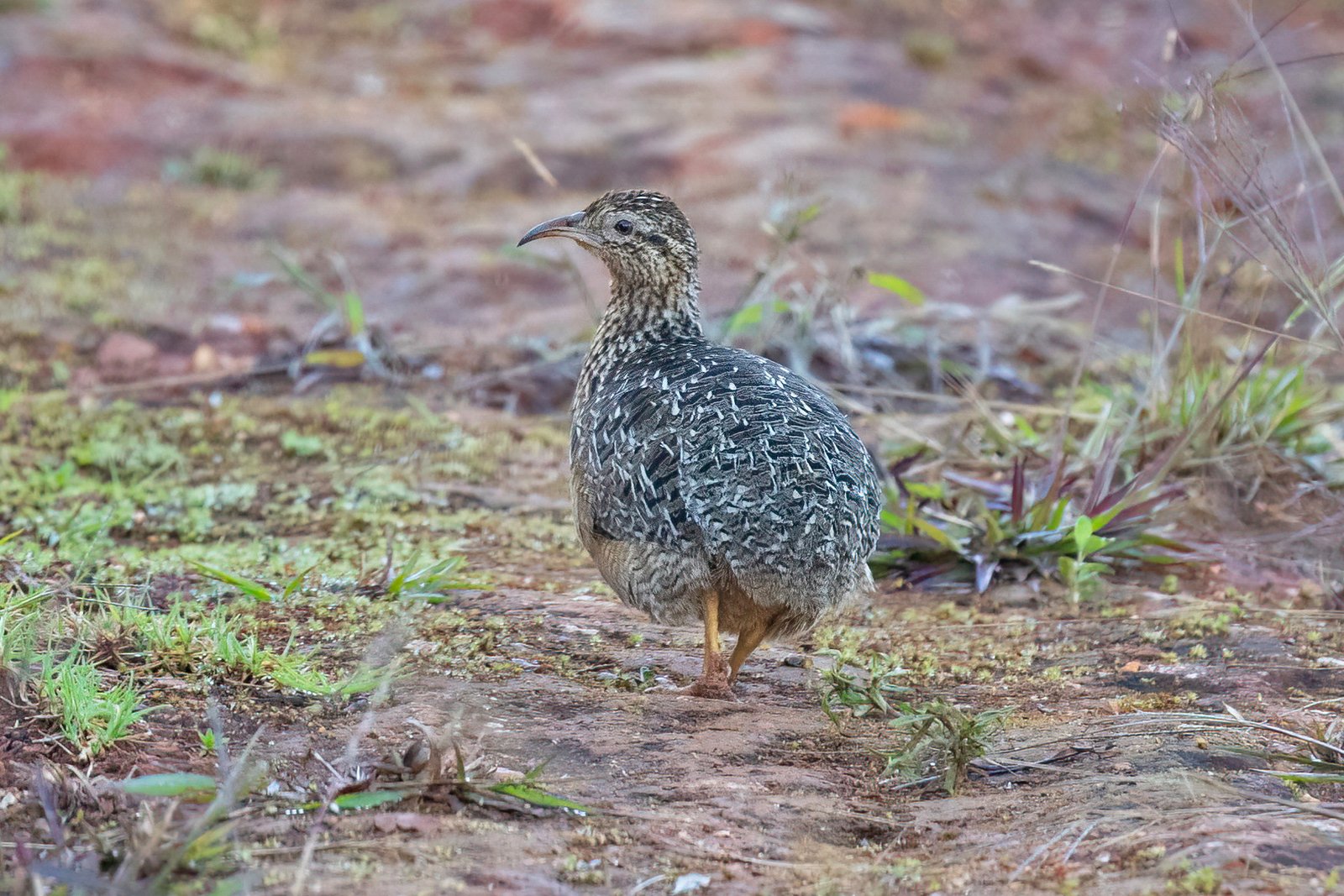
The Curve-billed Tinamou is a small, warmly coloured tinamou of the páramo and grassland of the northern Andes. The bill is clearly decurved, as the name says. It lives hidden in tall grass and flushes only when almost stepped on.
Voice
A high, thin whistle, repeated at intervals, mainly at dusk. When flushed a shrill note and a whirr of wings.
Recording: José María Loaiza B. — CC BY-NC-SA 4.0 · xeno-canto
Identification
25–29 cm, with a small head, a fairly long, clearly decurved bill and almost no tail. The crown is blackish, and the sides of the head and the throat are paler, buff and finely streaked. The upperparts are dark brown, with black spots and pale buff streaks. The breast is cinnamon to rufous with white spots, and the belly warm buff. In flight the rufous primaries stand out. The sexes are alike.
Confusion species
Andean Tinamou Nothoprocta pentlandii is greyer, with a grey breast and a less decurved bill, and lives in drier scrub; the two meet locally in the far south of Ecuador and in Peru. Taczanowski's Tinamou Nothoprocta taczanowskii is larger and darker, and lives further south in Peru. Ornate Tinamou Nothoprocta ornata is larger and greyer, with a heavily spotted, whitish head, and lives further south on the puna.
Habitat
Humid grassland of the páramo and jalca, often with scattered shrubs, also grassy edges and fields on the higher slopes, roughly between 2800 and 4000 m. It feeds on the ground on seeds, shoots and insects. The nest is on the ground, hidden in a grass tussock.
Where the bird is most at home, classified by the vegetation units of the Andes and the west coast.


Range and movements
In Ecuador locally in the páramo of the Andes, from north to south. In Peru in the Andes of the north and centre of the country. Not reliably recorded in Colombia. Absent from Bolivia and the Galápagos. Does not occur outside the guide area.
- Resident
- dark = core range, pale = thinly spread
How and when to look
Walk slowly through tall páramo grass in central and southern Ecuador. Birds usually flush right at your feet and drop back into the grass after a short flight.
Conservation status
Least Concern. Burning and ploughing of páramo and local hunting reduce its habitat.
Scientific name
Nothoprocta curvirostris | Sclater & Salvin, 1873
Sclater & Salvin described the species in 1873 and placed it straight away in the genus where it still stands. He introduced the genus Nothoprocta in that same work. The genus name comes from Greek nothos, 'spurious', and prōktos, 'rear, tail'. Latin curvus, 'curved', and rostrum, 'bill': 'curve-billed'. The specimen the first description was based on came from Calacalí and Puéllaro, Pichincha, Ecuador.