All species › Tinamous › Tinamous › Small-billed Tinamou
Small-billed Tinamou | Crypturellus parvirostris
Kortsnaveltinamoe | Tinamú piquicorto | Inhambu-chororó
The Small-billed Tinamou is a small tinamou of savanna, scrub and forest edge in central South America. In the guide area it lives in the eastern lowlands of Bolivia and in south-eastern Peru. Unlike most lowland tinamous it favours open and semi-open country and also occurs where forest has been cleared.
Voice
A series of short, high whistles that starts slowly, accelerates and ends in a rapid trill; mainly in the early morning and late afternoon.
Recording: Marcelo Javier Wioneczak — CC BY-NC-SA 4.0 · xeno-canto
Identification
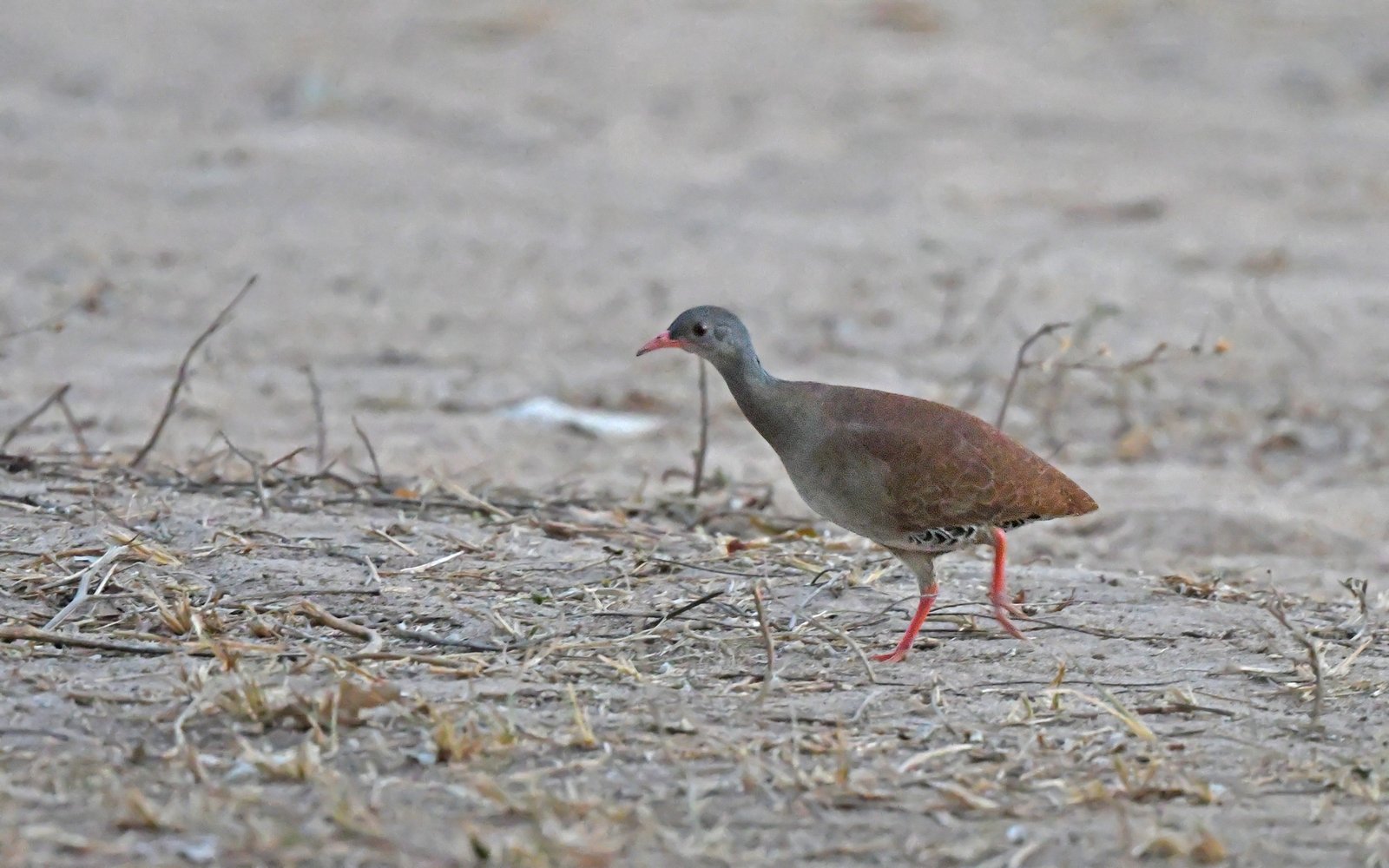
20–22 cm, small and compact, with a short, red bill with a dark tip and red legs. The head and neck are greyish, with a darker crown and a whitish throat. The upperparts are plain brown, without barring. The breast is grey-brown to buff, the belly paler, yellowish white. The sexes are nearly alike.
Confusion species
Tataupa Tinamou Crypturellus tataupa is slightly larger, with a darker, chestnut back, a dark grey head and breast, black-and-white scaled flanks and purplish-red legs; it lives more in dry forest. Little Tinamou Crypturellus soui has a dark bill and greenish legs and lives in forest. Black-capped Tinamou Crypturellus atrocapillus is larger, with a black crown and a rufous breast. Undulated Tinamou Crypturellus undulatus is much larger and finely barred.
Habitat
Savanna, grassland with shrubs, cerrado, dry scrub, forest edge, young secondary growth and overgrown fields, in the lowlands and low foothills, locally up to about 1500 m. It searches the ground for seeds, small fruits and insects. The nest is on the ground in dense vegetation; the male incubates the eggs.
Where the bird is most at home, classified by the vegetation units of the Andes and the west coast.


Range and movements
In Peru in the south-east, mainly in the savannas and clearings of Madre de Dios and Puno. In Bolivia widespread in the eastern lowlands, from the Beni savannas to Santa Cruz. Absent from Colombia, Ecuador and the Galápagos. Outside the guide area in much of Brazil south of the Amazon, in Paraguay and in north-eastern Argentina.
- Resident
- dark = core range, pale = thinly spread
How and when to look
Listen in the early morning along savanna and forest edges in the eastern lowlands of Bolivia, for example around Santa Cruz, or in the Pampas del Heath in Peru. Birds sometimes cross roads and tracks in open country.
Conservation status
Least Concern. Common in open and semi-open country; the species tolerates human-modified landscapes well.
Scientific name
Crypturellus parvirostris | (Wagler, 1827)
Wagler described the species in 1827 as Crypturus parvirostris; because it was later moved to another genus, the author and year stand in brackets. The genus Crypturellus was introduced in 1914 by Brabourne, WWK-H & Chubb. The genus name comes from Greek kruptos, 'hidden', and oura, 'tail', with the Latin diminutive -ellus: 'little hidden tail'. The species name comes from Latin parvus, 'small', and rostrum, 'bill'. The specimen the first description was based on came from Brazil.