All species › Passerines › New World blackbirds, troupials and allies › Baudo Oropendola
Baudo Oropendola | Psarocolius cassini
Bruinrugoropendola | Oropéndola del Baudó | Japu-de-baudó
The Baudo Oropendola occurs only in the Pacific lowlands of north-western Colombia and is one of the least known oropendolas. Its English and Spanish names refer to the Serranía de Baudó in the Chocó. Relatively few colonies are known, mainly along rivers.
Voice
The display song is a loud, liquid gurgle, similar to that of Black Oropendola, with a bow by the male; also harsh calls. The voice is poorly described.
Recording: Ottavio Janni — CC BY-NC-SA 3.0 · xeno-canto
Identification
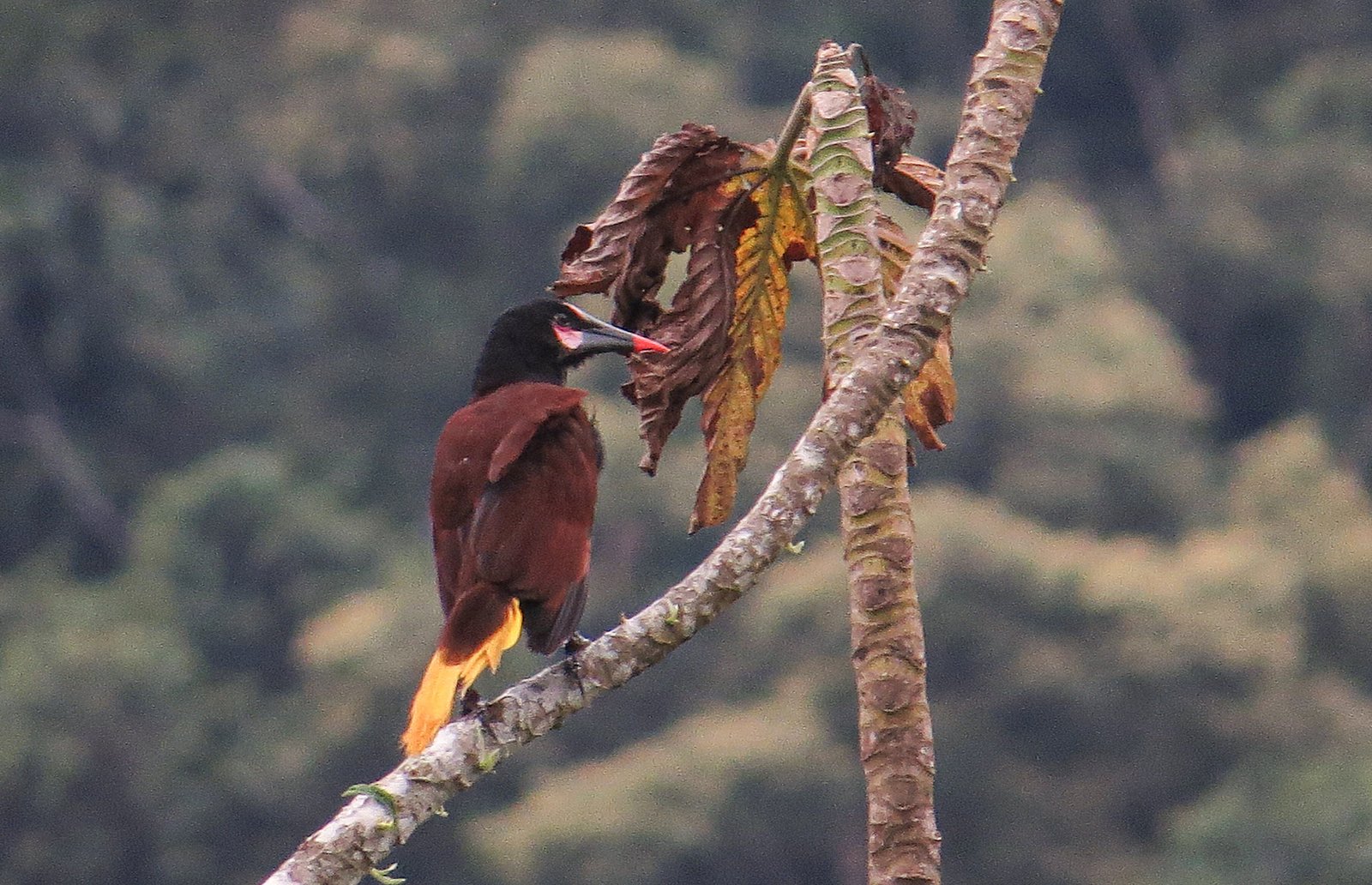
40–47 cm; the male is larger than the female. The head, neck and underparts are black; the back, wings and rump bright chestnut. The tail is yellow with dark central feathers. The bill is black with an orange-red tip. A bare cheek patch is pink. The eye is dark. Juveniles are duller.
Confusion species
Black Oropendola Psarocolius guatimozinus has a darker, duller brown back and a pale blue bare cheek patch with a pink lower edge, and lives further north. Chestnut-headed Oropendola Psarocolius wagleri is smaller, with a chestnut head and a pale bill. Crested Oropendola Psarocolius decumanus is smaller and black, with an ivory bill and a pale blue eye.
Habitat
Undisturbed and lightly disturbed humid lowland forest and forest edges along rivers, in the lowlands and low hills up to about 500 m. Colonies hang in tall, isolated trees near rivers or in clearings. It probably eats mainly fruit and insects, like related species.
Where the bird is most at home, classified by the vegetation units of the Andes and the west coast.


Range and movements
Occurs only in Colombia: in the Pacific lowlands of the Chocó, around the Serranía de Baudó and along the rivers of the centre and north of the department. Absent from Ecuador, Peru, Bolivia and the Galápagos.
- Resident
- dark = core range, pale = thinly spread
How and when to look
Visit riverbanks in the lowlands of the Chocó, preferably with a local guide who knows active colonies; the birds are most active around the colony in the morning.
Conservation status
Vulnerable. The species has a small range and a small population, threatened by logging, mining and the conversion of forest to farmland in the Chocó.
Scientific name
Psarocolius cassini | (Richmond, 1898)
Richmond described the species in 1898 as Gymnostinops cassini; because it was later moved to another genus, the author and year stand in brackets. The genus Psarocolius was introduced in 1827 by Wagler. The genus name combines Greek psar, 'starling', with koloios, 'jackdaw'. The species name honours John Cassin (1813–1869), American ornithologist and lithographer in Philadelphia. The specimen the first description was based on came from Río Truandó, Chocó, Colombia.