All species › Passerines › New World blackbirds, troupials and allies › Black Oropendola
Black Oropendola | Psarocolius guatimozinus
Zwarte oropendola | Oropéndola negra | Japu-preto
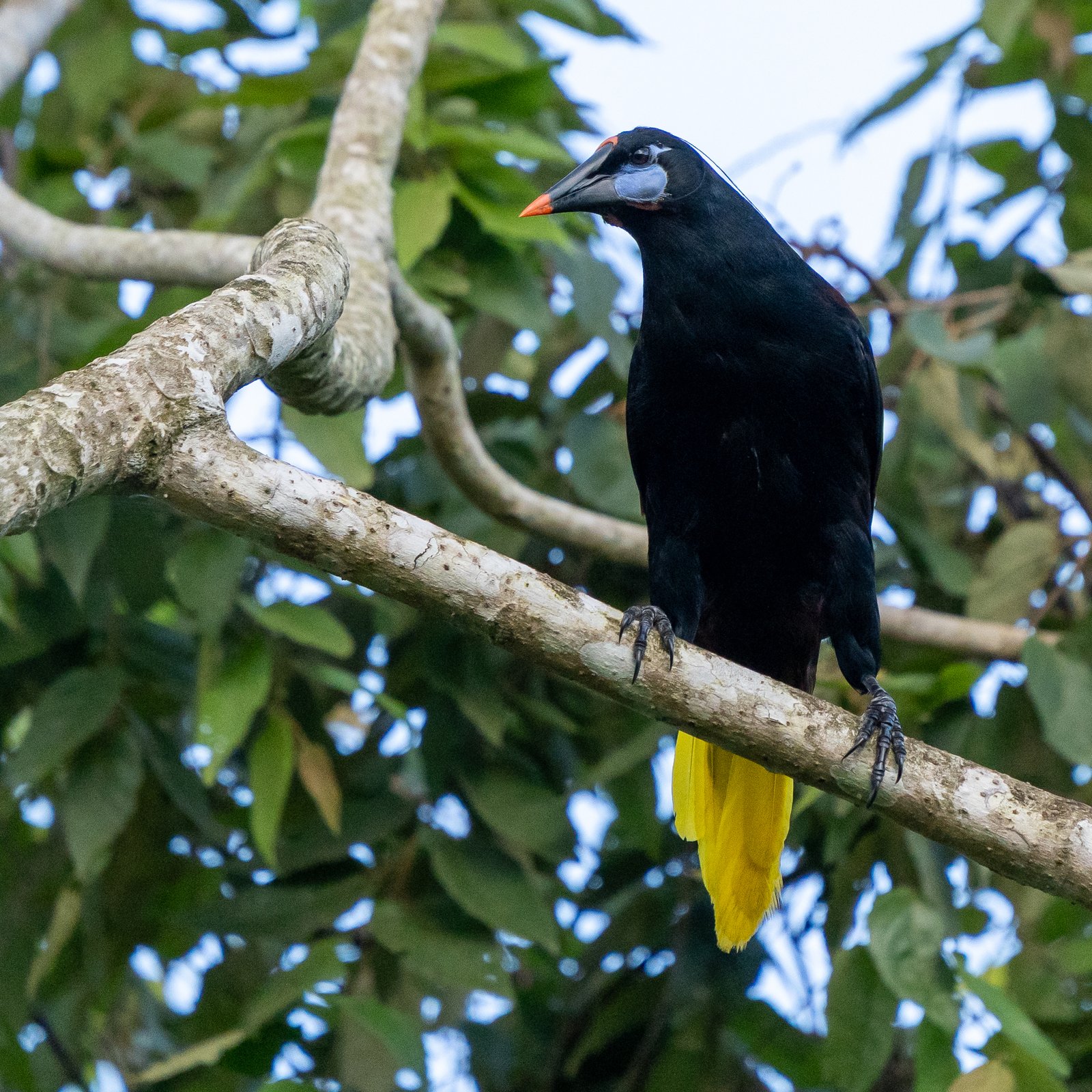
The Black Oropendola is a large, dark oropendola of north-western Colombia and eastern Panama. It is closely related to the Baudo Oropendola of the Chocó. Its range is limited, but within it the species is locally common along forest edges and rivers.
Voice
The display song is a loud, liquid gurgle with a bow by the male, similar to that of related oropendolas. The call is a harsh kak.
Recording: Andrew Spencer — CC BY-NC-SA 3.0 · xeno-canto
Identification
39–46 cm; the male is larger than the female. The head, neck and underparts are black; the back, wing coverts and rump dark chestnut. The tail is yellow with dark central feathers. The bill is black with an orange tip. A bare cheek patch is pale blue, pink on its lower edge. The eye is dark. Juveniles are duller.
Confusion species
Baudo Oropendola Psarocolius cassini has a brighter chestnut back and wings and a pink bare cheek patch, and lives further south in the Chocó. Crested Oropendola Psarocolius decumanus is smaller, with an ivory bill, a pale blue eye and a black back. Chestnut-headed Oropendola Psarocolius wagleri is smaller, with a chestnut head and a pale bill.
Habitat
Humid lowland forest, forest edges, riverbanks, secondary forest and semi-open country with tall trees, mostly below 800 m. It eats fruit, nectar and insects in the canopy. It breeds in colonies of hanging woven nests in a tall, isolated tree.
Where the bird is most at home, classified by the vegetation units of the Andes and the west coast.


Range and movements
In Colombia in the north-west: around the Gulf of Urabá, northern Chocó, the Sinú valley, the lower Cauca and the middle Magdalena valley. Absent from Ecuador, Peru, Bolivia and the Galápagos. Outside the guide area in eastern Panama.
- Resident
- dark = core range, pale = thinly spread
How and when to look
Along rivers and forest edges in the lowlands around the Gulf of Urabá and in the Sinú and Cauca valleys; look for colonies in tall, isolated trees.
Conservation status
Least Concern, although its range is small and much lowland forest in north-western Colombia has been cleared.
Scientific name
Psarocolius guatimozinus | (Bonaparte, 1853)
Bonaparte described the species in 1853 as Ostinops guatimozinus; because it was later moved to another genus, the author and year stand in brackets. The genus Psarocolius was introduced in 1827 by Wagler. The genus name combines Greek psar, 'starling', with koloios, 'jackdaw'. The species name refers to Guatimozin (Cuauhtémoc), nephew of Moctezuma and the last Aztec emperor. The specimen the first description was based on came from Garrapata, Río Magdalena, Antioquia, Colombia.