All species › Passerines › New World blackbirds, troupials and allies › Chestnut-headed Oropendola
Chestnut-headed Oropendola | Psarocolius wagleri
Waglers oropendola | Oropéndola cabeza castaña | Japu-de-cabeça-castanha
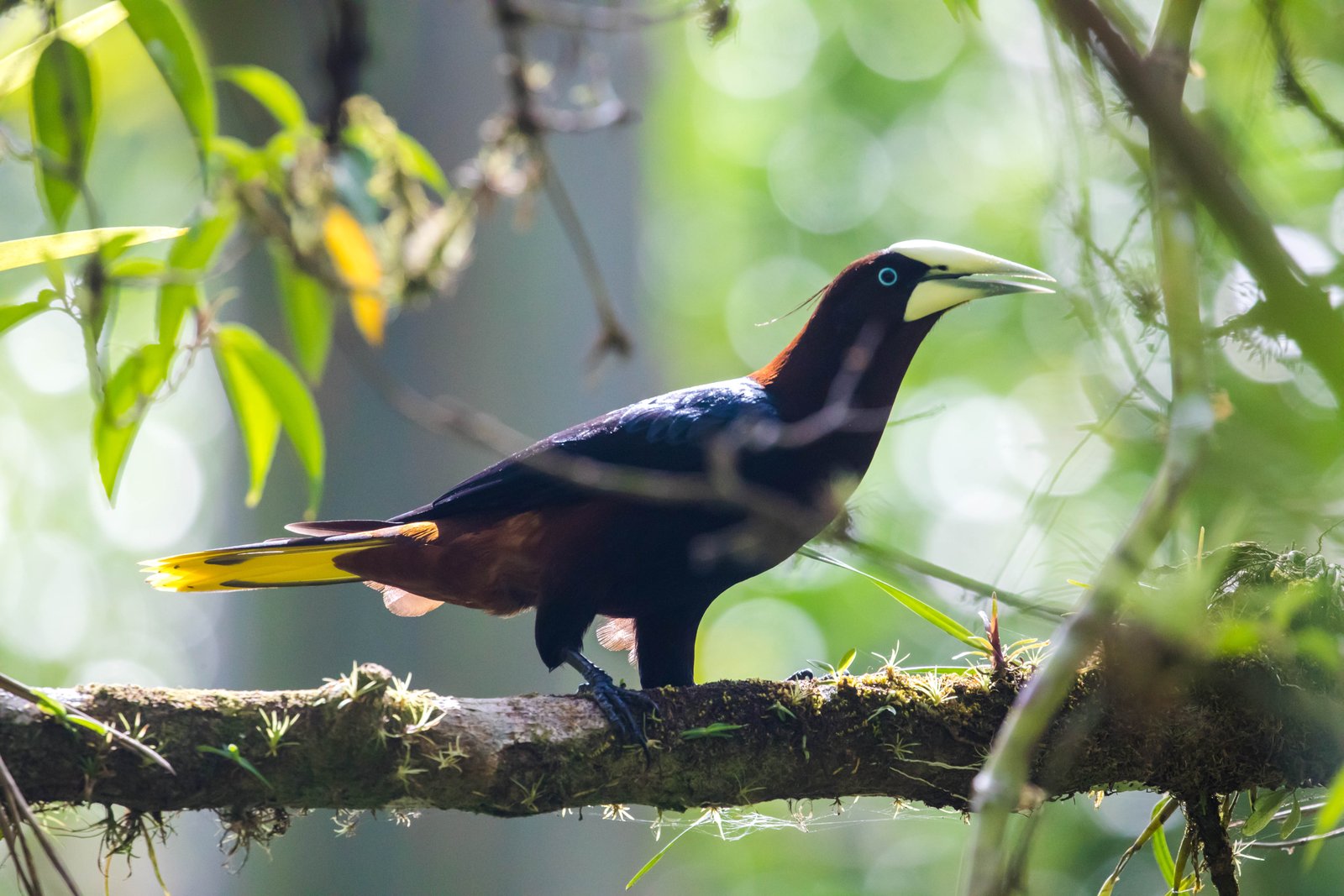
The Chestnut-headed Oropendola is the smallest oropendola of the guide area and the only one with a chestnut head and neck. It lives west of the Andes, in the Chocó and western Ecuador, and ranges north through Central America to southern Mexico. Colonies often hang in a tree near houses or along a road.
Voice
The display song is a loud, liquid, gulping gurgle, with a short bow by the male. The call is a harsh chak; also a nasal wak.
Recording: Carlos Delgado JUMABITA — CC BY-NC-SA 4.0 · xeno-canto
Identification
26–35 cm; the male is much larger than the female. The head, neck and upper breast are chestnut, the rest of the body black, with a chestnut rump and undertail. The tail is yellow with black central feathers. The bill is pale yellow to ivory, with a swollen frontal shield in the male. The eye is pale blue. The male has a few thin crest feathers. Juveniles are duller, with a darker eye.
Confusion species
Black Oropendola Psarocolius guatimozinus is larger, with a black head, a bare cheek patch and a black bill with an orange tip. Baudo Oropendola Psarocolius cassini is larger, black with a chestnut back and wings, and has a black bill with an orange tip. Crested Oropendola Psarocolius decumanus has a black head. Scarlet-rumped Cacique Cacicus uropygialis is smaller and all black, with a red rump and a black tail.
Habitat
Humid lowland forest, forest edges, secondary forest, open country with tall trees and plantations, from sea level to about 1500 m. It eats fruit, nectar and insects in the canopy and middle storey, often in small groups. It breeds in colonies of hanging woven nests, often in an isolated tree near a river, a road or houses.
Where the bird is most at home, classified by the vegetation units of the Andes and the west coast.


Range and movements
In Colombia in the Pacific lowlands and adjacent foothills, and locally in the north-west. In Ecuador in the western lowlands and foothills, mainly in the north-west, scarcer further south. Absent from Peru, Bolivia and the Galápagos. Outside the guide area from southern Mexico to Panama.
- Resident
- dark = core range, pale = thinly spread
How and when to look
Along roads in the lowlands and foothills of north-western Ecuador and the Colombian Chocó; look for colonies in isolated trees near farms and for small groups flying low over open ground.
Conservation status
Least Concern. The species tolerates disturbed forest and semi-open country, but depends on forest nearby.
Scientific name
Psarocolius wagleri | (Gray, 1844)
Gray described the species in 1844 as C[acicus] Wagleri; because it was later moved to another genus, the author and year stand in brackets. The genus Psarocolius was introduced in 1827 by Wagler. The genus name combines Greek psar, 'starling', with koloios, 'jackdaw'. The species name honours Johann Georg Wagler (1800–1832), German zoologist who published on birds and reptiles. The specimen the first description was based on came from Cobán, Guatemala.